

The “90-10 Rule” speaks to how leaders should challenge their teams, peers and themselves. Bob Sutton, an organizational psychologist at Stanford, suggests effective leaders should aim for about 90% of people to like them. This means accepting that around 10% may not. This principle implies that a leader who is universally liked may not be taking a tough enough stance. Or, they may not be making difficult but necessary decisions. Sutton’s argument is that leadership requires balance.Hence, if everyone loves you, you might be avoiding difficult conversations, compromising too much, or failing to make hard choices that benefit the organization in the long run.
My Experience Lead to a Slightly Different 90-10 Rule
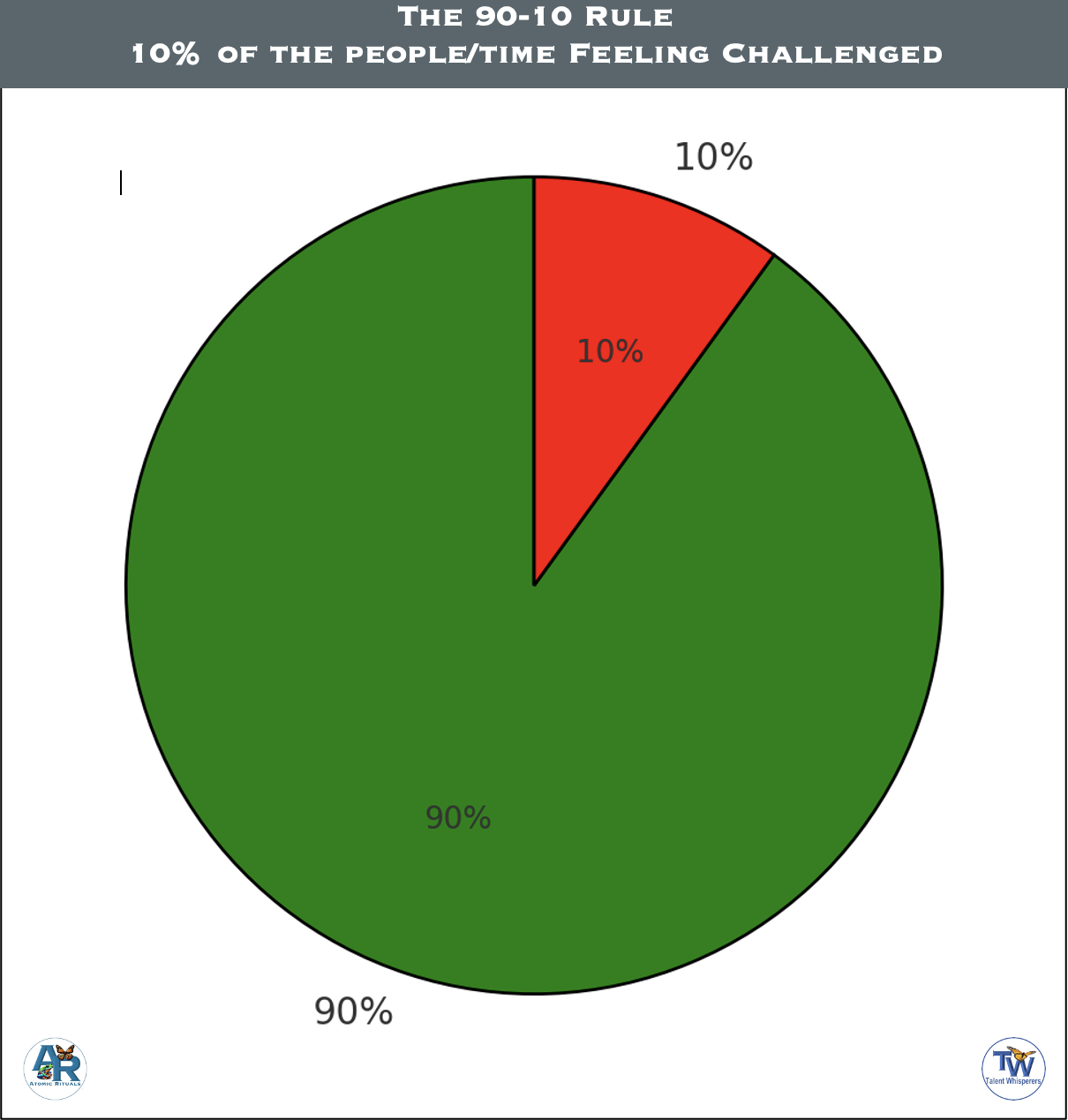
My experience has taught me that leadership is not about being liked. It is about ensuring those around us receive the encouragement and challenge they need to grow. My experience has led me to arrive at a variant on the 90-10 rule Sutton proposes. About 10% of what I ask of my team, colleagues should be a challenge to step outside their comfort zone. The same holds for what I expect of myself. If all my asks are met with enthusiasm, I’m not fostering an environment that encourages taking risks and stretching oneself. When you/your team gets comfortable with this, you can go beyond 10%.
At any given time, at least 10% of what I propose should meet reluctance, skepticism, or at least grudging agreement. Otherwise, I am not fully embracing my role as a leader. One could keep 90% of the people doing what they are comfortable with and love doing 100% of the time. However, that could be 90% of the people not stepping up and pushing the limits.
That said, leadership is not about pushing people arbitrarily outside their comfort zones. Instead, I focus on creating an environment of trust. Hence, one where people believe challenges come from a place of striving for the best. This is also one where they feel trusted to do their best and push themselves. This trust extends to the understanding that not every effort will succeed. 10% of initiatives, challenges, or experiments may result in failures or setbacks. However, these are opportunities to improve systems and processes. Growth happens not through force but through a culture of trust. Challenges are embraced when people know that setbacks will be seen as learning moments rather than personal failures.
The Difference of Applying a 90-10 Rule in Trust and an Overly “Safe” Environments
A supportive environment of trust differs significantly from an overly cautious “safe” environment that avoids discomfort at all costs. Don’t coddle people by shielding them from challenges in the name of psychological safety. However, this often comes at the expense of resilience and growth. A high-trust leadership environment provides support but also sets expectations for risk-taking, personal challenge, and striving for excellence.
When an environment is merely “safe,” people may avoid difficult conversations. They shy away from hard problems, or resist pushing their own boundaries. Trust, on the other hand, creates a space where people take risks. Empowered them to act without fear of punitive consequences. They can thrive with the expectation that they will challenge themselves and contribute to meaningful progress.
The 90-10 Rule and Being “Kind” not “Nice”
The 90-10 rule approach ties into the idea that leaders should be kind, not just nice. Nice leaders seek approval 100% of the time; kind leaders push people toward their best selves, even when it is uncomfortable. I view servant leadership not simply as serving people’s immediate desires but as acting in service of their long-term growth. That means helping them navigate challenges they might otherwise avoid. It also means challenging assumptions, setting high standards, and ensuring that individuals and teams do the hard, necessary work to achieve excellence—while ensuring they feel trusted to take those risks.
The Lao Tzu Perspective: Leadership Beyond Love or Hate
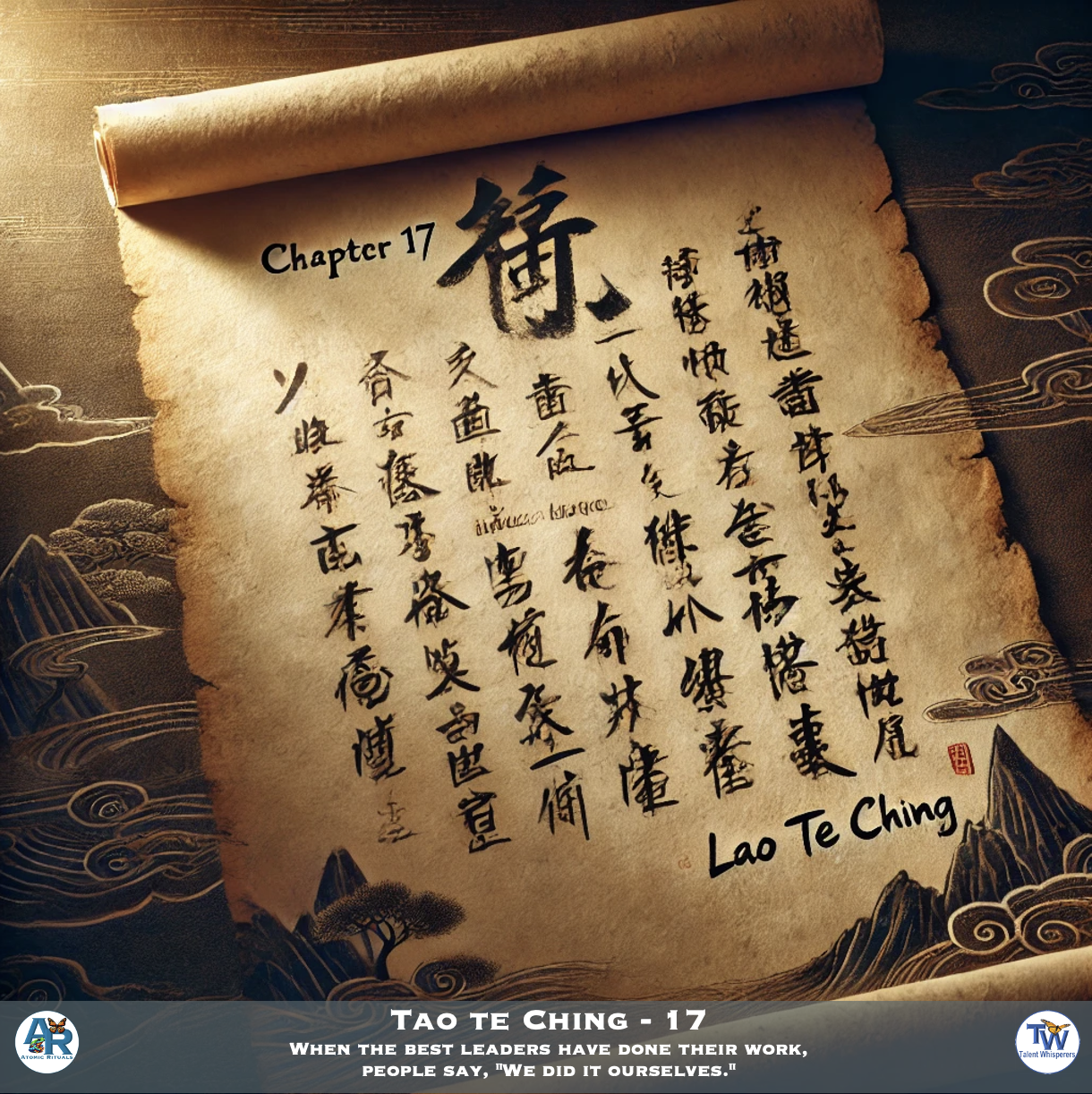
Lao Tzu, in Stephen Mitchell’s translation of Tao Te Ching (Chapter 17), suggests that the best leaders are those who are barely noticed at all. Leadership is neither about being loved nor hated. Instead, it is about creating an environment where people feel empowered to take ownership of their actions. When the best leaders have done their work, people say, “We did it ourselves.”
This perspective does not necessarily contrast with mine but rather complements it. While I emphasize the need to encourage people to step up in an environment of trust, Lao Tzu suggests that the ultimate form of leadership enables people to grow so seamlessly that they do not even attribute their growth to the leader. My approach fosters an environment where trust enables risk-taking and learning, while Lao Tzu’s philosophy suggests that when leadership is truly effective, people feel they were in control of their own growth all along. Both perspectives recognize that leadership is not about control but about empowering others to rise.

Lessons from Elite Athletes and Coaches
Great athletes do not reach the pinnacle of their sport by staying comfortable. Many of the greatest champions have had coaches who pushed them beyond their perceived limits—often to the point of frustration, exhaustion, or even resentment in the moment. However, it is precisely that level of challenge that separates the great from the merely good.
- Michael Jordan & Phil Jackson – Jordan is widely regarded as the greatest basketball player of all time, but even he had to be pushed. Under Phil Jackson, Jordan learned to trust his teammates and embrace a team-first mindset. Jackson didn’t coddle him but challenged him to evolve beyond being just a dominant scorer. Jordan often spoke about how much he hated certain practices, but he later credited them with making him the player he became.
- Kobe Bryant & His Relentless Work Ethic – Bryant’s legendary work ethic was fueled in part by coaches and mentors who demanded more of him. He embraced being uncomfortable, famously waking up at 4 AM to train, and he sought out coaches who would push him harder. He once said, “I have nothing in common with lazy people who blame others for their lack of success. Great things come from hard work and perseverance.”
- Serena Williams & Her Father Richard Williams – Richard Williams was relentless in training Serena and her sister Venus. He wasn’t always well-liked for his methods, but his approach instilled discipline, resilience, and an unshakable belief in their own abilities. Serena has acknowledged that her father’s approach, though tough, was instrumental in shaping her into a champion.
- Vince Lombardi & Pushing Athletes to Excellence – Lombardi, one of the greatest football coaches in history, was famous for his demanding coaching style. He pushed players to their limits, expecting excellence from them at all times. While not all players loved him in the moment, many later acknowledged that his high standards made them better and prepared them for success beyond football.
Comparison of Perspectives
| Aspect | Bob Sutton’s 90-10 Rule | My Perspective | Lao Tzu’s Perspective |
|---|---|---|---|
| Focus | Balancing likability with decisiveness | Creating an environment of trust where challenge and growth thrive | Enabling people to lead themselves |
| Measure of Success | 90% of people like you, 10% don’t | Everyone is challenged ~10% of the time | People say, “We did it ourselves.” |
| Philosophy | If everyone likes you, you’re not leading well | People should trust each other’s intent in striving for the best | The best leadership is invisible |
| Key Takeaway | Leaders shouldn’t avoid tough decisions for approval | Leaders should foster a culture of trust, where challenge and learning thrive | Leadership’s highest form is seamless empowerment |
Related Insights from Other Experts
- Kim Scott (Radical Candor) argues that leaders must “care personally and challenge directly.” The best leaders provide tough feedback and set high expectations while demonstrating care for their people. This aligns with the idea that discomfort is necessary for growth.
- Ed Catmull (Pixar) emphasizes that fostering creative environments requires leaders to challenge assumptions and create healthy tension. The willingness to push people to refine and improve their work is a critical component of leadership.
- Brené Brown (Dare to Lead) differentiates between avoiding discomfort and true leadership. She states that leaders who shield their teams from challenge in the name of ‘niceness’ ultimately stunt their growth.
- Andy Grove (Intel, High Output Management) highlights the importance of constructive confrontation. He suggests that teams thrive when they engage in rigorous debate and challenge each other’s assumptions.
- Carol Dweck (Growth Mindset) explains that embracing challenges is fundamental to a growth mindset. Avoiding risks and playing it safe aligns with a fixed mindset, whereas leaders with a true growth mindset encourage taking on difficult tasks, learning from setbacks, and pushing beyond perceived limitations.
See Also
- Everything is a Gift – Embracing setback, failures that will come with stepping outside your comfort-zone as gifts.
- Saboteurs and Allies – Our Inner Voices that can hold us back from stepping outside of comfort zones and achieving more.
- Edge of Chaos – Taking it to the limit. There is a spectrum between complete order and the safety of doing everything prudently and by the book to complete chaos of total risk-taking. The Edge of Chaos speaks to the idea that the ideal zone for innovation lies close chaos.
- Vygotsky’s Zone of Proximal Development – The zone of proximal development (ZPD) is the difference between what a learner can do without help and what they can do with guidance and encouragement from a skilled partner.
- Chapter 17 of Lao Tzu’s Tao Te Ching – as translated by Stephen Mitchell
- Bob Sutton (90-10 Rule) – Stanford Insights on Leadership
- Kim Scott (Radical Candor) – Radical Candor Framework
- Ed Catmull (Pixar) – Creativity, Inc.
- Brené Brown (Dare to Lead) – Dare to Lead
- Andy Grove (Intel, High Output Management) – High Output Management
- Carol Dweck (Growth Mindset) – Mindset: The New Psychology of Success
Why My Experience Is Relevant

My perspective on leadership is informed by decades of coaching, advising, and mentoring executives and leaders, as well as holding engineering leadership roles. In addition to engineering leadership, I have also worked in product management, consulting, sales, and other roles. I have taken multiple companies from startup to billion-dollar valuations, guided leaders through near-collapse to success, and coached top-performing teams to national championships. Through this, I have consistently seen that true growth comes not from comfort but from the right balance of challenge and trust. My work aligns with the principles of Co-Active Coaching, stakeholder-centered leadership, and the philosophy that leadership is about service, not subservience.
Finding the balance of kindness and challenging also helped me lead two sports teams to winning national championships and served as a good approach when working with horses and dogs.
 Atomic Rituals