
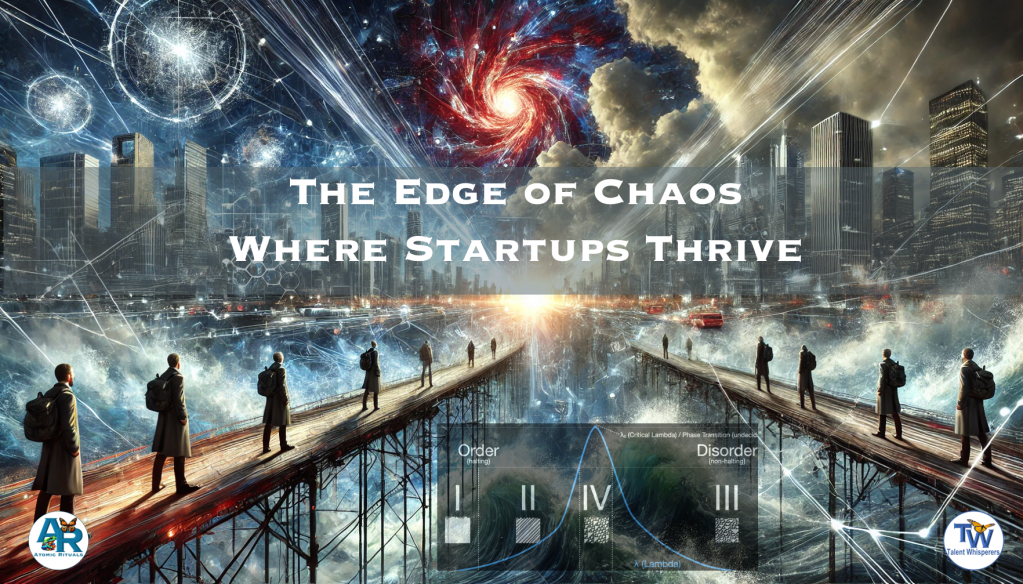
The “Edge of Chaos” is the fertile boundary between rigidity and randomness—where startups either collapse or evolve. This zone rewards adaptive systems, emotional resilience, and feedback-driven iteration.
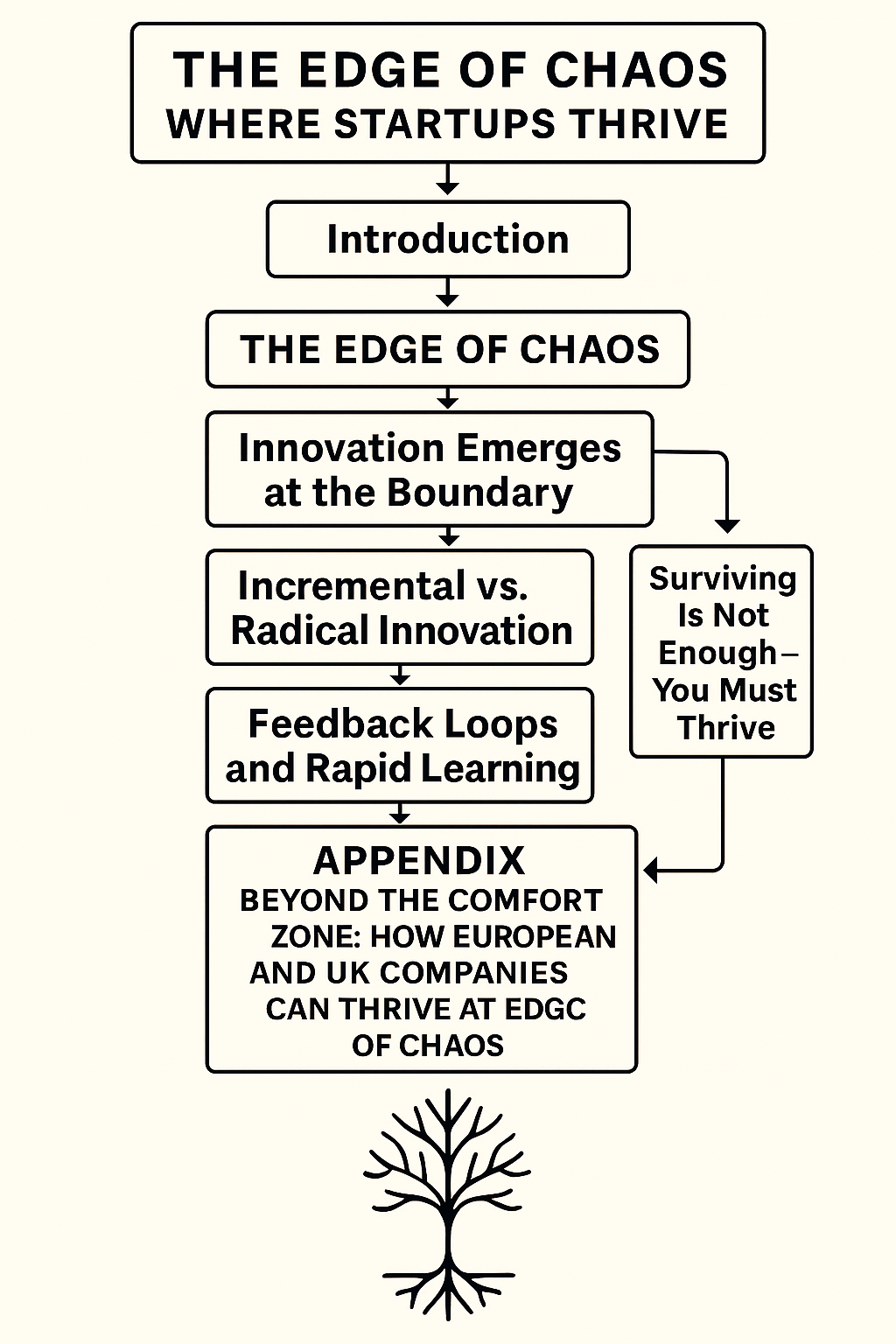
Somewhere between rigid stability and uncontrolled chaos, there exists a narrow zone where the most innovative and disruptive startups thrive. This is the critical transitional zone—the space where companies remain adaptable enough to pivot but structured enough to execute. It is the difference between a breakthrough company and one that collapses under its own weight.
This concept comes from complexity science. It describes the narrow zone between order and disorder where systems adapt, innovate, and evolve. Too much order creates rigidity and stagnation. Too much chaos brings breakdown and incoherence. The best startups thrive here. They balance structured execution with the agility to pivot, experiment, and innovate.
Where the Magic Happens

I’ve always been a believer that outside the comfort zone is where the magic happens. It is a place where I find myself thriving most. This thrill-seeker aspect is perhaps what has continually drawn me to disruptive-tech startups to help them navigate storms on their road to success. I write about those challenges in Weathering Storms. Granted, life has also taught me that stepping too far outside the comfort zone can be fraught with more risks than manageable. Here we’ll explore the notion of thriving at the boundary of order and disorder.
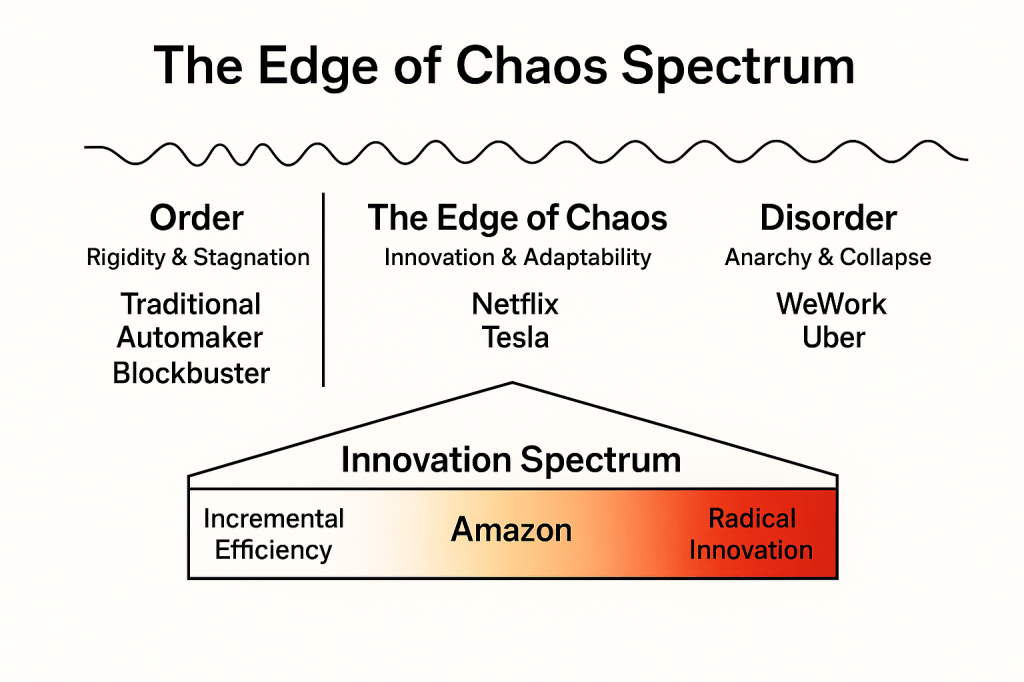
Table of Contents
- Introduction
- Where the Magic Happens
- Entrepreneurs as Thrill-Seekers
- Weathering Storms: Crisis as a Catalyst for Growth
- Why Innovation Emerges at the Boundary
- Necessity Drives Radical Innovation at the Edge of Chaos
- Beyond Survival: Building Learned Resilience in Startups
- Emotional Calibration: Navigating Fear, Panic, and Complacency in Startups
- Near-Death Experiences as a Rite of Passage for Startups
- Key Leadership Qualities for Navigating the Edge of Chaos
- Measuring Chaos Quotient (CQ)
- The Startup Playbook for Thriving at the Edge of Chaos
- Glossary of Terms
- Frequently Asked Questions (FAQs)
- See Also
Appendices
- Appendix 1: How European Companies Can Embrace Chaos Without Losing Control
- The Challenge of Disruption in a Conservative Climate
- Reconciling the Contradiction: Risk-Averse Leaders Who Want Disruption
- European and UK Success Stories: Proof That It Can Be Done
- Building a Bridge: Translating Edge of Chaos Thinking for European and UK Leaders
- Rituals and Routines: Gradually Expanding the Comfort Zone
- A New Archetype of the European and UK Leader
- Conclusion: A Call to Courage
- Appendix 2: How APAC Companies Thrive at the Edge of Chaos
- Appendix 3: Case Studies of Leaders Navigating the Edge of Chaos
Jeff Bezos (Amazon), Reed Hastings(Netflix), Brian Chesky(Airbnb), Steve Jobs(Apple), Elon Musk (Tesla, SpaceX, Neuralink, X) - Appendix 4: 5 Case Studies of Leaders Who Failed at the Edge of Chaos—and Why
Adam Neumann (WeWork), Travis Kalanick (Uber), Elizabeth Holmes (Theranos), John Sculley (Apple), Juergen Schrempp (Daimler-Chrysler Merger) - Appendix 5: 7 Ways How Startups Can Build Resilience to Survive at the Edge of Chaos
- Appendix 6: Case Studies of Startups That Built Resilience at the Edge of Chaos
Shopify, Airbnb, Twilio, Stripe, Figma - Appendix 7: How Established Companies Can Apply Startup Resilience Principles to Avoid Stagnation
Entrepreneurs as Thrill‑Seekers

“The brave may not live forever, but the cautious do not live at all.”
Richard Branson from his book Like a Virgin
High-performing founders aren’t thrill-seekers in a reckless sense; they’re sensation-seekers who crave challenge, risk, and novelty. This craving is deeply tied to the happiness found in the pursuit itself—the drive to engage with uncertainty and forge new paths, cultivating Learned Resilience that fuels their ability to thrive. Research shows entrepreneurs often score higher on sensation-seeking and risk tolerance than the average person (see Zuckerman). It’s not about impulsivity—it’s about engaging with uncertainty as a strategic opportunity rather than something to avoid. See also: Intention to reengage in entrepreneurship: Performance feedback, sensation seeking and workaholism.
What distinguishes thrive-from-survive is this: they don’t just tolerate chaos—they lean into it. Where others see danger, they see possibility. They’re drawn to puzzles others won’t touch, markets others can’t predict. Their brains release positive reinforcement at the boundary of uncertainty—what looks like adrenaline is actually dopamine-driven learning that fuels creativity, resilience, and sustained performance.
Successful entrepreneurs also echo this:
- Richard Branson paints entrepreneurship as full-contact adventure.
- Sir Richard Branson on entrepreneurship | London Business School
- Life is an adventure (Branson’s blog, July 11, 2022)
“The brave may not live forever, but the cautious do not live at all … I have always gone in search of adventures because it’s where I feel most alive.”
- Elon Musk describes stepping into industries “with a high likelihood of failure” as a necessity for meaningful impact.
- Axios Podcast – “Elon Musk vs. Twitter Part II: Empire of Risk”
In this episode, Musk emphasizes that meaningful innovation often involves “significant risk”, especially when aiming for groundbreaking change. He says:
“Anything… which is significantly innovative, is gonna come with a significant risk of failure” - “Failure is an option here. If things are not failing, you are not innovating enough.”
25 Elon Musk Quotes That Will Inspire Innovation, Risk-Taking, and Relentless Ambition.
- Axios Podcast – “Elon Musk vs. Twitter Part II: Empire of Risk”
- Sara Blakely has said she looked for the “fireplace” of discomfort, not the “sofa” of safety.
- “Most of the reason we don’t do things is because we’re afraid to fail. I just made a decision one day that I was not not going to do things in my life because of fear…” Sara Blakely’s Most Inspiring Quotes
- “Failure is not attached to outcome, but in not trying.” Sara Blakely’s Most Inspiring Quotes
Not without caution — the adrenaline of uncertainty must be balanced with discipline. That tension—the thrill paired with strategy and self-awareness—is what allows founders not just to survive, but to thrive long-term.
Why Innovation Emerges at the Boundary
Innovation flourishes at the edge of chaos—where systems balance structure with flexibility. Startups that operate here evolve through experimentation, feedback, and nonlinear growth.
- In complex adaptive systems, evolution and learning occur at the edge of chaos, where new structures emerge from interaction and experimentation.
- Startups thrive in environments where they push the limits of existing industries, iterating rapidly in response to market signals while avoiding complete disorder.
Balancing Stability and Flexibility
- Systems at the edge of chaos maintain enough structure to be coherent but enough adaptability to shift when needed.
- Successful startups establish just enough process to scale while avoiding the bureaucracy that stifles speed and creativity.
Nonlinear Growth and Sensitivity to Initial Conditions
- Small changes at the edge of chaos can lead to exponential transformations, much like how minor strategic decisions in a startup’s early days can compound into massive impact.
- Unlike traditional companies that optimize for efficiency, startups operating at the edge embrace unpredictability and emergent opportunities.
How Feedback Loops Drive Startup Resilience and Adaptation
Startups thrive by learning faster than their competitors. Tight feedback loops—driven by user data, iteration, and blameless post-mortems—enable continuous adaptation and resilience.
- The edge of chaos is defined by strong feedback loops where systems self-correct and evolve dynamically.
- Startups that succeed are those that build tight feedback mechanisms—whether through user data, market reactions, or internal iteration—to continuously refine their product and strategy.
- In the context of innovative tech startups, operating at the edge of chaos necessitates a similar commitment to rapid learning through continuous feedback. These startups often employ practices such as:
- Continuous Deployment: Releasing code in small, frequent increments allows for immediate user feedback, facilitating quick adjustments and learning.
- A/B Testing: Experimenting with different versions of a product feature to gather data on user preferences and behaviors, enabling data-driven decision-making.
- Blameless Post-Mortems: After failures or incidents, teams analyze what went wrong without assigning blame, focusing instead on learning and preventing future issues.
Resilience and Anti-Fragility
- Systems at the edge of chaos are neither fragile nor rigid; they are resilient and capable of growth through stress.
- The best startups don’t just withstand market shocks. They leverage them to strengthen their competitive advantage, pivoting faster than incumbents can react.
Necessity Drives Radical Innovation in Unpredictable Environments
At the edge of chaos, necessity transcends mere pressure—it becomes an imperative for invention. Traditional methods and incremental gains no longer suffice. Instead, innovation demands bold leaps—rethinking not how something is done, but what is done.
Take the automotive example: a reduction from five to four turns speaks of incremental optimization. But swapping in a clip for the screw? That’s a radical redefinition of assembly. It reframes the problem itself and unleashes vastly greater efficiency.
In the realm of tech startups, this is how paradigm shifts occur. Rather than polishing existing processes, innovators at the edge of chaos re-envision the solution entirely—because the environment requires more than speed or efficiency; it requires reinvention.
- Incremental vs. Transformative: Efficiency is often a resort within stable systems; revolution becomes essential when the system itself is unstable.
- Reframe, Don’t Refine: At the edge of chaos, success lies not in refining existing methods but in reframing problems to discover novel, more effective pathways.
- Startups as Transformative Agents: Disruptive startups harness necessity to challenge orthodox assumptions, break free from norms, and deliver solutions that previously seemed unimaginable.
This is the heart of thriving at the edge of chaos: the unwavering recognition that necessity isn’t just prompting invention—it is invention.
Incremental vs. Radical: Two Paths at the Edge
“Incremental efficiency may buy time, but only radical reinvention ensures survival at the edge of chaos.”
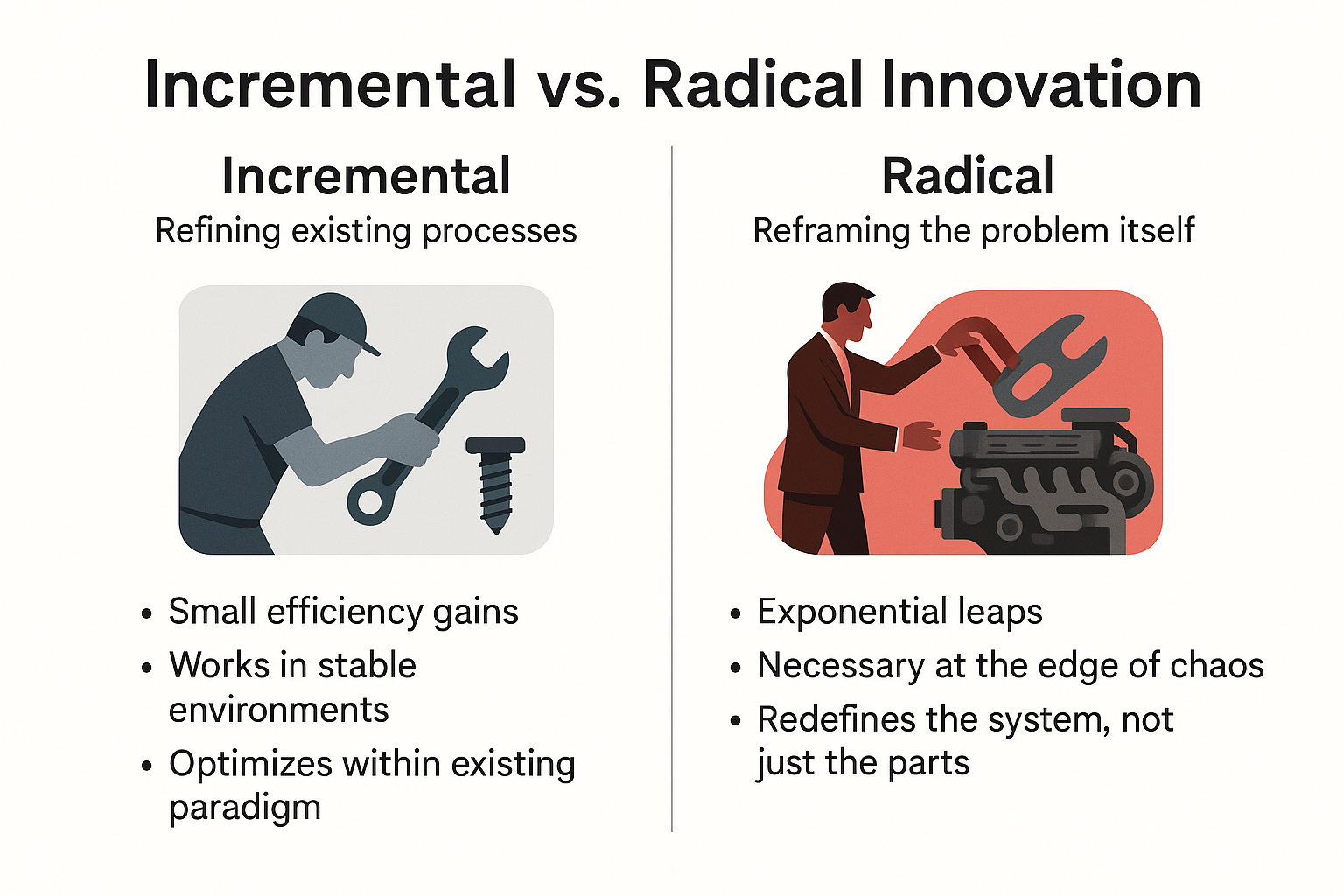
The story of the screw and the clip highlights a deeper truth: incremental efficiency is a path for steady-state systems, while radical innovation is the lifeline at the edge of chaos. Startups that thrive here don’t just shave seconds off existing methods — they reimagine the method altogether.
Choosing Between Efficiency and Reinvention in Startup Strategy
| Approach | Example | Outcome | Lesson for Startups |
|---|---|---|---|
| Incremental Efficiency | American automaker reduces a screw tightening step from 5 turns to 4. | 20% faster (5 seconds down to 4). | Small optimizations work in stable environments but rarely shift the competitive landscape. |
| Radical Innovation | Japanese automaker replaces the screw with a clip. | Nearly 90% faster (5 seconds down to < 0.5). | Paradigm shifts reframe the problem entirely, creating exponential advantages. |
| Incremental Efficiency (Digital) | Blockbuster improved late fee collection and store layouts to maximize rentals. | Marginal efficiency in a declining model. | Refining an old system delays decline but doesn’t avert disruption. |
| Radical Innovation (Digital) | Netflix pivoted from DVD rentals to streaming. | Entirely new delivery model, global scale. | Reinventing the model, not just optimizing the old one, created a market-defining leap. |
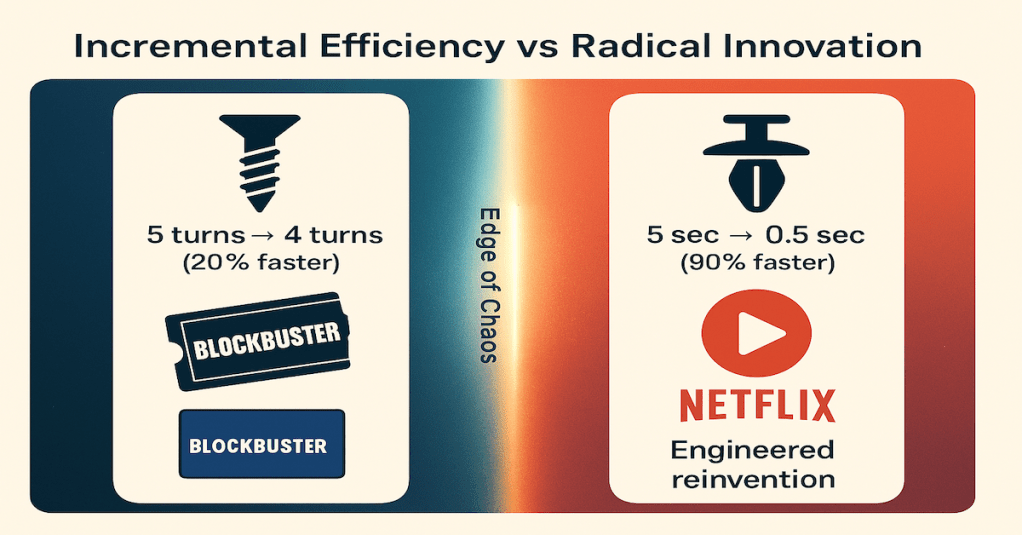
Takeaway: Whether it’s an automaker replacing a screw with a clip or Netflix reinventing entertainment delivery, the lesson is the same: incremental efficiency may buy time, but only radical reinvention ensures survival at the edge of chaos.
Beyond Survival: Building Learned Resilience in Startups
“Bad companies are destroyed by crises. Good companies survive them. Great companies are improved by them.”
Andy Grove
Startups often face Near-Death Experiences (NDEs)—moments where survival hangs by a thread. I have personally lived through eleven of these at different companies, each on the brink of failure. Seven of them went on to become billion-dollar unicorns. The difference? The leaders, teams, and cultures that embraced the Edge of Chaos rather than fearing it.
Steve Jobs once said, “It’s really hard to start a company… if you don’t love it, you’re going to give up.”
“People say you have a lot of passion for what you’re doing, and it’s totally true and the reason is because it’s so hard that if you don’t any rational person would give up. It’s really hard and you have to do it over a sustained period of time. So if you don’t love it, if you’re not having fun doing it, if you don’t really love it, you’re going to give up. And that’s what happens to most people, actually.
If you really look at the ones that ended up being successful in the eyes of society, and the ones who didn’t, often times it’s the ones that are successful love what they did so they could persevere, you know, when it got really tough. And the ones that didn’t love it, quit. Because they’re sane, right? Who would want to put up with this stuff if you don’t love it? So it’s a lot of hard work and it’s a lot of worrying constantly and, if you don’t love it, you’re gonna fail. So, you gotta love it, you gotta have passion.“
Love alone isn’t enough. Many founders speak of passion and perseverance, but those who endure the Edge of Chaos don’t just tolerate uncertainty—they crave the struggle, thrive in ambiguity, and embrace reinvention.
Beyond Survival: Why Some Truly Thrive at the Edge of Chaos
Operating at this crucial threshold demands more than mere endurance; it requires a unique mindset that transforms uncertainty into a catalyst for growth. My belief is that it’s not the pursuit of happiness that matters, it’s the happiness of the pursuit itself. This profound truth helps explain why some individuals and organizations don’t just survive in unpredictable environments, but truly thrive.
Consider the pioneers who historically came to America, or the innovators who still flock to Silicon Valley. They frequently abandoned familiar situations, leaving behind family, friends, country, culture, and language to step into the unknown. Why embrace such a profound risk? It is rooted in the hope of achieving something better. I contend that finding this “better thing” is not the sole source of happiness; rather, it is the pursuit of attaining it, with a realistic yet challenging goal, that brings fulfillment. This same drive propels individuals to flourish at the intersection of order and disorder.
Why successful entrepreneurs repeatedly return to the demanding grind
This explains why successful entrepreneurs repeatedly return to the demanding grind of new challenges. It clarifies why individuals with more wealth than they could ever spend continue to seek greater financial gain. It is not merely about achieving success or accumulating wealth. Instead, it is about the inherent thrill of the journey and the profound validation of one’s ability to navigate and achieve those goals. This internal validation, gained through purposeful engagement with risk and uncertainty, is a hallmark of those who thrive at the Edge.
Ultimately, it is not simply the journey or the destination that holds paramount importance. It is who you become and what you learn throughout that journey that truly matters. Without overcoming challenges, a true sense of victory remains elusive. Each challenge overcome weakens our inner saboteur, the voice that whispers we are ‘not good enough’. This builds Learned Resilience – an ‘earned confidence’ that precisely allows leaders and teams to confidently navigate the unpredictable dynamics of the Edge of Chaos.
The Danger of Unachievable Goals
However, if individuals or teams are presented with unachievable goals, the fundamental belief that success or upward mobility is attainable through hard work can diminish or even disappear entirely. We see this phenomenon in many communities today, where people may feel there is no clear path forward, no real chance of upward mobility, or even a remote possibility of success. For many, what once motivated the pioneers to come to America and later to Silicon Valley – the hope of something better, the realistic challenge of self-determination – has been lost. People do not find lasting happiness with handouts unless those handouts serve as a catalyst, enabling them to make a goal achievable. The true value lies not in the handout itself, but in the enablement it provides.
The behavior of rescue dogs offers a poignant illustration. When rescue dogs repeatedly search for survivors and find only those who did not make it, they may eventually give up. One perspective is that they are not finding the reward that drives their challenge. Alternatively, they might sense their handlers losing hope, which discourages their own efforts, leading them to stop trying when consistent effort yields only disappointment. To counteract this, handlers will sometimes allow themselves to be “buried” so the dog can successfully find them. This reaffirms the joy that accompanies overcoming a challenge, serving as a vital reminder for both the handler and the dog of the success that is possible. This principle applies directly to human engagement in dynamic situations: fostering a culture where manageable challenges lead to celebrated successes, thereby sustaining motivation and Learned Resilience. This principle applies directly to human engagement at the Edge of Chaos: fostering a culture where manageable challenges lead to celebrated successes, thereby sustaining motivation and learned resilience.
Emotional Calibration: Navigating Fear, Panic, and Complacency in Startups
“Fear sharpens awareness, but panic clouds judgment.”
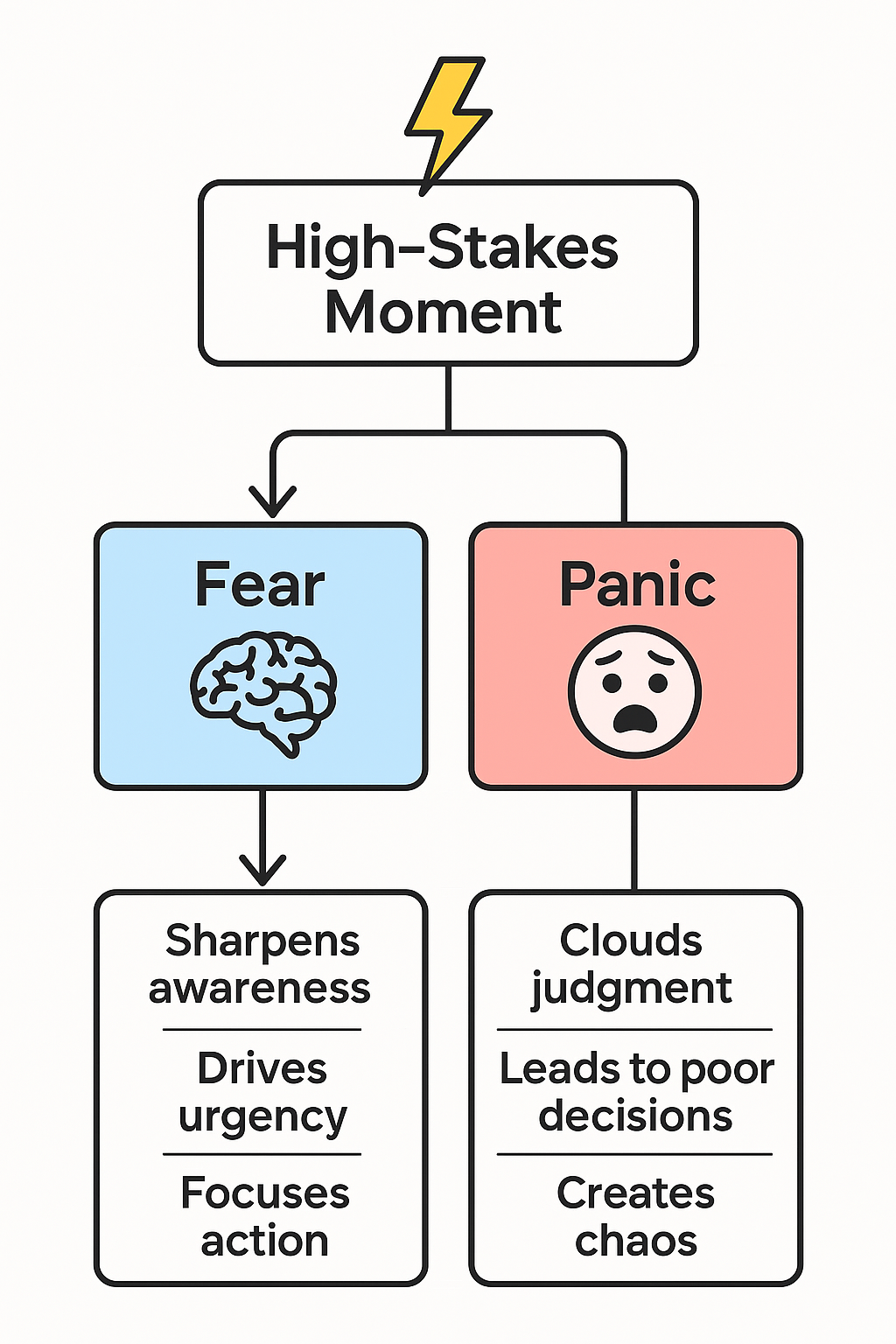
One lesson from my personal NDE in the Pacific Ocean stands out: Fear sharpens awareness, but panic clouds judgment. The same applies to startups. Fear makes you aware of risks, panic leads to poor decisions, and complacency ensures failure.
- Fear drives urgency and innovation. Successful startups stay paranoid enough to avoid stagnation but clear-headed enough to act strategically.
- Panic leads to short-term, reactionary decisions. Companies that react without thinking—laying off employees in a crisis without strategic adjustment, pivoting in all directions—end up lost.
- Complacency is silent failure. Companies that assume past success guarantees future survival are often blindsided by disruption.
Amazon thrives by operating in a constant state of Day 1, meaning it never assumes stability is permanent. Netflix killed its own DVD business before streaming took over. BlackBerry ignored disruption and paid the price. The lesson? Fear is fuel, panic is poison, and complacency is a death sentence.
Weathering Storms: Crisis as a Catalyst for Growth:
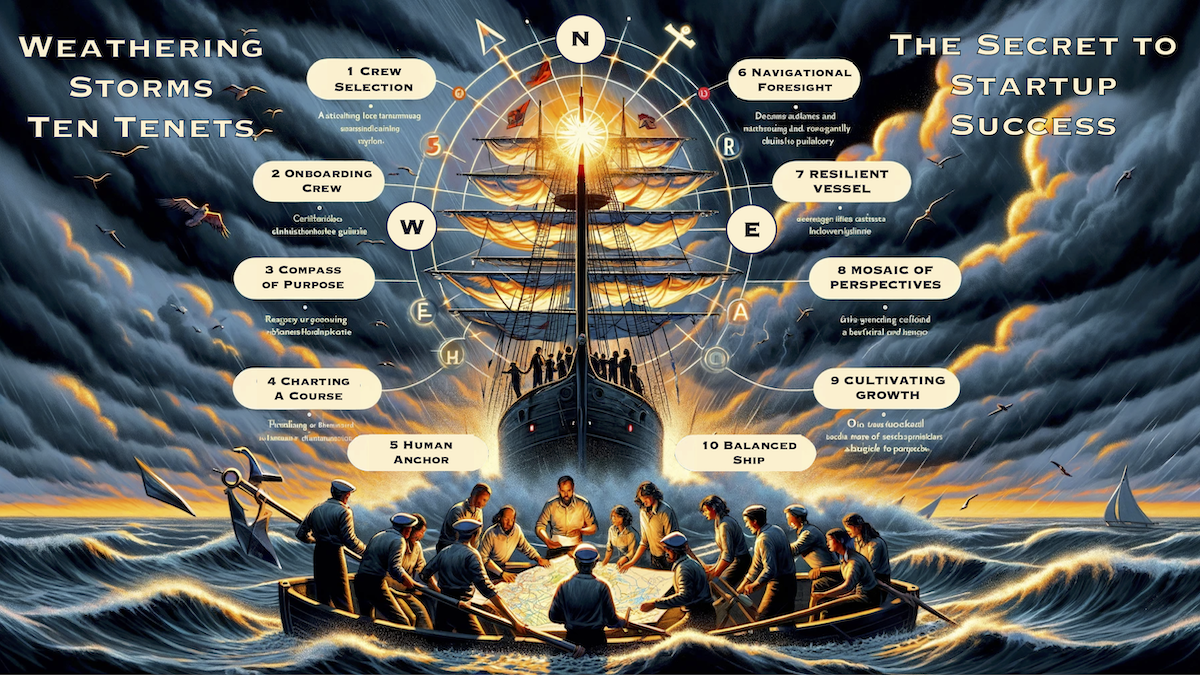
- In Weathering Storms: I highlight that crises compel startups to adapt and innovate, transforming existential threats into opportunities for development.
- Edge of Chaos: Operating at this boundary enables systems to evolve and self-organize, as the interplay between stability and chaos promotes resilience and creativity.
Navigating Uncertainty:
- In Weathering Storms: I discuss the necessity for startups to remain flexible amidst paradigm shifts, economic fluctuations, and competitive pressures.
- Edge of Chaos: This concept suggests that systems poised between order and chaos are better equipped to respond to unpredictable changes, maintaining functionality while exploring new possibilities.
Resilience Through Challenges:
- In Weathering Storms: I propose that facing and overcoming crises not only tests a company’s business model but also provides opportunities for growth and innovation.
- Edge of Chaos: Systems at this threshold are inherently resilient, capable of reorganizing and emerging stronger from disruptions.
Near-Death Experiences as a Rite of Passage for Startups
In my experience, almost every successful startup has faced the abyss—the moment where failure seems inevitable. This is often referred to as “The Valley of Death”. Those who make it out emerge stronger, often reshaped by the experience. Andy Grove of Intel put it perfectly: “Bad companies are destroyed by crises. Good companies survive them. Great companies are improved by them.“
Some examples:
- Netflix pivoted from DVD rentals to streaming before it was forced to, ensuring survival.
- Microsoft shed its stagnant culture, embraced open source, and became a cloud computing giant.
- Tesla nearly ran out of money before turning the EV industry upside down.
The Near-Death Experience of a startup is not just a test of survival—it is a crucible that can forge a company into something even greater.
Key Leadership Qualities for Navigating the Edge of Chaos
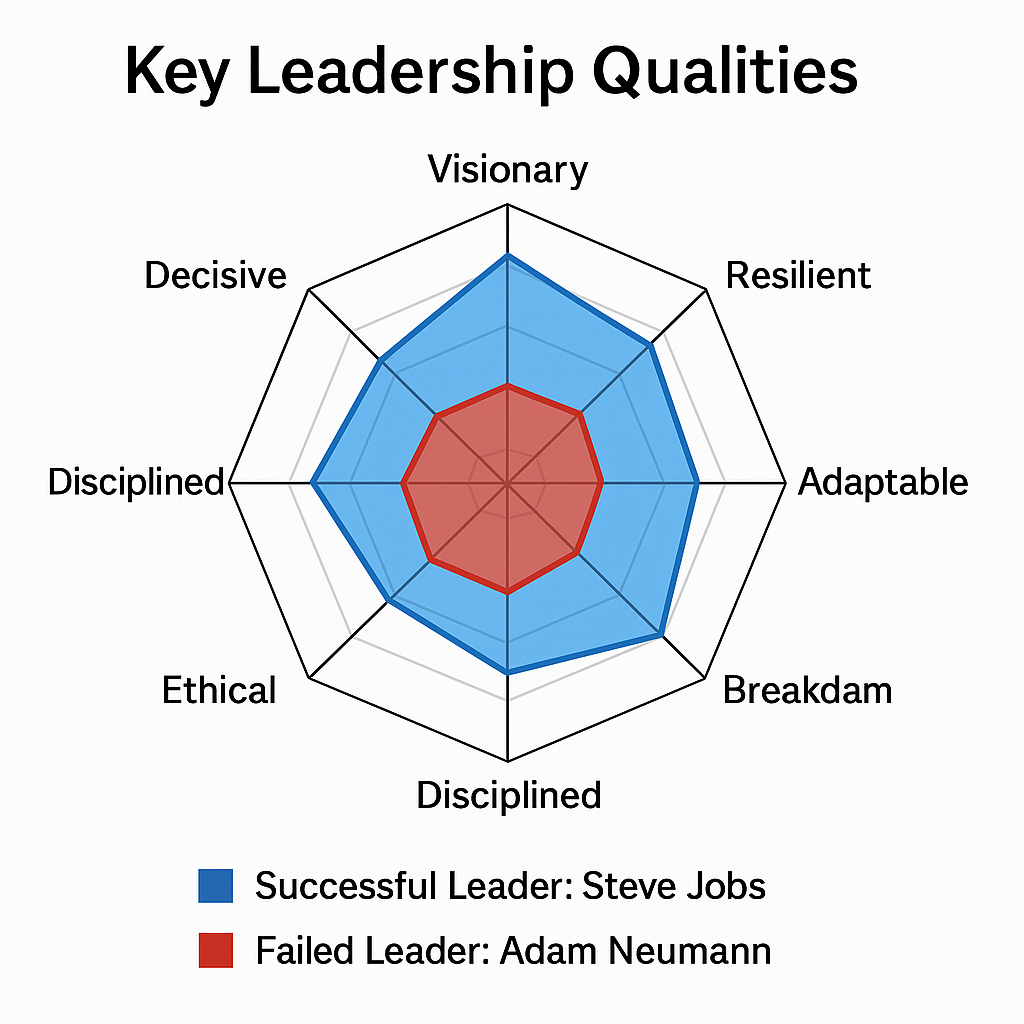
- Passionate, Purpose-Driven Risk Takers
- These leaders are often thrill seekers, not in a reckless sense but in their ability to embrace calculated risks.
- They derive energy from the unknown and find purpose in pushing boundaries, whether in technology, business models, or industry norms.
- Their passion fuels the team, inspiring others to tackle audacious goals, driven by the inherent satisfaction of the pursuit itself.
- Comfortable with Fear, Avoiding Panic
- Fear is a natural, healthy response at the edge of chaos—it sharpens instincts, enhances focus, and encourages strategic thinking.
- Panic, however, is deadly—it leads to knee-jerk decisions, erodes trust, and destabilizes the organization.
- The best leaders acknowledge fear but channel it into productive urgency, ensuring the team stays focused rather than reactive.
- View Failure as a Learning Ingredient
- Non-fatal failures are essential for growth, much like micro-stressors that build resilience.
- These leaders don’t just tolerate failure; they operationalize it—building cultures where experimentation is encouraged, post-mortems are blameless, and rapid iteration is the norm.
- They differentiate between smart failures (that yield learning) and reckless failures (that stem from avoidable mistakes).
- These leaders embrace non-fatal failures as necessary stepping stones toward breakthrough innovations, understanding that overcoming these challenges is essential for building authentic confidence and fostering sustained engagement in the dynamic environment of the Edge of Chaos.
- Sense-Making in Complexity
- The Edge of Chaos is, by definition, complex and unpredictable. Leaders must see patterns in ambiguity and make sense of chaos without oversimplifying it.
- They don’t just react to what’s happening; they anticipate emergent shifts and guide the company toward opportunities others don’t see.
- This requires strong intuition, honed through experience, combined with data-driven insights to avoid cognitive biases.
- Decisive, Yet Flexible
- These leaders make tough calls fast, understanding that delaying decisions in chaotic environments is often worse than making the wrong one.
- However, they don’t get locked into ego-driven choices—they remain flexible, ready to pivot when new information emerges.
- They balance conviction with humility, knowing that being right eventually is more important than being right immediately.
- Building Systems, Not Just Products
- While passionate about innovation, these leaders understand that a startup is an evolving system, not just a collection of great ideas.
- They build self-reinforcing feedback loops—whether in culture, processes, or market signals—that sustain innovation without chaos spiraling out of control.
- They scale wisely, adding just enough structure to prevent collapse while preserving agility.
- High Emotional Intelligence & Resilience
- Chaos tests personal resilience—these leaders must manage stress effectively to keep a steady hand on the wheel.
- They recognize that people, not just strategy, determine success—investing in the emotional and psychological safety of their teams.
- They model calm confidence, ensuring that even in uncertainty, their team trusts the vision and process.
- They model calm confidence, ensuring that even in uncertainty, their team trusts the vision and process, and finds fulfillment in the continuous journey of growth and problem-solving.
Conclusion: Leaders as Edge Navigators
The best founders and entrepreneurs in disruptive startups are those who thrive on the thin line between control and disorder. They harness the energy of chaos without being consumed by it. Passionate yet disciplined, fearless yet prudent, these leaders don’t just survive the Edge of Chaos—they make it their home.
Measuring Chaos Quotient (CQ)
Not every team navigates the Edge of Chaos with equal skill. Some collapse into disorder. Others lock themselves into rigid structures that stifle innovation. The Chaos Quotient (CQ) provides a way to measure how effectively a team balances discipline with adaptability in order to thrive.
High-CQ teams don’t just survive crises — they turn turbulence into fuel for resilience and reinvention. Low-CQ teams either panic under pressure or cling to failing systems.
The Seven Dimensions of CQ
1. Feedback Velocity
How quickly insights from users, markets, and experiments are turned into action.
- High CQ: Teams ship, test, and integrate learnings continuously.
- Low CQ: Feedback is delayed, ignored, or filtered through bureaucracy.
2. Decision Balance
The ability to distinguish between reversible (“two-way door”) and irreversible (“one-way door”) decisions.
- High CQ: Leaders act fast when risk is low and deliberate when consequences are permanent.
- Low CQ: Either analysis paralysis or reckless, unexamined moves dominate.
3. Resilience Under Stress
How the team responds to crisis and uncertainty.
- High CQ: Fear sharpens focus; setbacks fuel adaptation.
- Low CQ: Panic drives short-term overreactions or paralysis.
4. Cultural Safety
The level of psychological trust that allows for risk-taking, dissent, and fast failure.
- High CQ: People can experiment, challenge leaders, and recover from mistakes.
- Low CQ: Fear of blame or reprisal suppresses learning.
5. Reinvention Capacity
The ability to reframe problems and redefine the playing field instead of optimizing broken solutions.
- High CQ: Teams embrace bold pivots like Netflix’s shift to streaming.
- Low CQ: Companies cling to outdated processes or business models.
6. Process & Talent Flexibility
The capacity to adjust workflows, redeploy teams, and rely on T-shaped engineers who combine deep expertise with cross-functional adaptability.
- High CQ: Teams shift seamlessly from one initiative to another.
- Low CQ: Silos and rigid role definitions prevent redeployment.
7. Adaptive Mindset
The learned resilience that comes from repeated exposure to adversity. Mindset shapes whether challenges are seen as threats or opportunities.
- High CQ: Discomfort is embraced as fuel for growth.
- Low CQ: Change is resisted, and resilience erodes under stress.
The CQ Scale (0–100)
- Low CQ (0–30): Teams are rigid or chaotic. Innovation falters.
- Medium CQ (31–70): Teams manage bursts of adaptability but swing between extremes.
- High CQ (71–100): Teams deliberately cultivate balance, process flexibility, and learned resilience.
CQ in Action
- Airbnb (High CQ): When COVID-19 collapsed global travel, Airbnb redeployed talent, pivoted to long-term stays, and communicated transparently — turning near-death into renewal.
- WeWork (Low CQ): Lacked decision balance and cultural safety. Growth was mistaken for resilience, leading to collapse.
- Stripe (High CQ): Designed modular systems and nurtured T-shaped engineers, enabling rapid expansion into adjacent markets.
Quick CQ Diagnostic
Ask your team to rate (1–5) how strongly they agree with each statement:
- We rapidly integrate customer or market feedback into product changes.
- We know when to move fast and when to slow down for careful decisions.
- Crises sharpen our focus rather than causing panic.
- People feel safe experimenting and challenging assumptions.
- We reframe problems instead of polishing broken solutions.
- Our processes and team structures can flex quickly as priorities shift.
- We embrace discomfort as growth fuel and learn resilience from setbacks.
Scoring:
- 7–14 → Low CQ (rigid or chaotic)
- 15–28 → Medium CQ (inconsistent adaptability)
- 29–35 → High CQ (balanced, resilient, innovative)
The Link Between Chaos Quotient (CQ) and Learned Resilience (LR)
Chaos Quotient (CQ) captures how well a team or organization balances order and disorder to unlock innovation. But CQ is never stronger than the resilience of the people within it. This is where Learned Resilience (LR) comes in.
Learned Resilience is the individual’s capacity to transform adversity into growth through repeated cycles of challenge, reflection, and recovery. Teams with high CQ tend to be filled with individuals who have developed high levels of LR. When crises hit, these people don’t just endure — they adapt, reframing problems and stabilizing the collective.
This coupling suggests that CQ and LR are two sides of the same coin:
- LR at the individual level fuels CQ at the team level.
- CQ at the organizational level provides the environment where LR can grow.
Just as CQ offers a way to measure adaptability across teams, there is value in imagining a Learned Resilience Quotient (LRQ) for individuals. An LRQ would assess:
- Challenge Engagement — How readily someone steps into stretch zones.
- Recovery Practices — The ability to restore clarity and energy after stress.
- Reframing Skill — Turning setbacks into actionable learning.
- Consistency — Building resilience through sustained cycles of adaptation.
- Support Utilization — Drawing strength from mentors, peers, or rituals.
High-LRQ individuals strengthen team CQ, while low-LRQ individuals may destabilize it. Together, LRQ and CQ create a dual lens for diagnosing resilience — one focused on the person, the other on the system.
For a deeper dive into how individuals build Learned Resilience, see the dedicated guide: Learned Resilience: Beyond Grit — What It Is and How to Build It.
The Startup Playbook for Thriving at the Edge of Chaos
So how do startups not just survive but thrive in this space?
1. Tighten Feedback Loops
Speed of learning determines survival. The faster you can test, iterate, and adapt, the better. Startups that build tight customer feedback loops (like Superhuman’s onboarding process or Netflix’s recommendation engine) stay ahead. Startups must learn faster than competitors to stay ahead of disruption. The tighter the feedback loop, the faster a company can iterate and refine its offering.
How to Implement It:
- Customer Development as a Core Process:
- Talk to real users constantly (not just through surveys but through direct interaction).
- Observe pain points in action rather than relying only on verbal feedback.
- Use Data to Guide Decisions, Not Just Intuition:
- Implement early-stage analytics to track user behavior, engagement, and drop-off points.
- Define clear leading indicators of product-market fit (e.g., retention over revenue in early stages).
- Iterate in Public:
- Release minimum viable features quickly rather than perfecting them behind closed doors.
- Gather real-time feedback from beta users & early adopters before scaling.
Example: Superhuman (Email Productivity Tool) – The company ran 1:1 onboarding calls with users, refining the product based on detailed behavioral feedback, leading to ultra-high retention.
See also what I wrote about such feedback loops as the fuel for success at Talent Code Applied.
2. Build for Modularity and Optionality
Rigid systems and business models break under chaos. Stripe’s API-first approach, Amazon’s cloud-based infrastructure, and Shopify’s adaptable e-commerce platform all illustrate the power of modularity—allowing companies to evolve without breaking apart. A rigid product or business model can collapse when the market shifts. Modularity ensures resilience under uncertainty.
- How to Implement It:
- Keep Initial Architecture Flexible:
- Use API-first approaches so integrations and pivots are easier.
- Avoid overbuilding features before knowing what customers truly need.
- Offer Pricing & Revenue Flexibility:
- Experiment with freemium, subscriptions, usage-based pricing, and hybrid models to see what scales best.
- Design multiple monetization paths rather than relying on one core stream.
- Don’t Lock Yourself Into a Single Customer Type Too Early:
- Stay open to expanding your ICP (ideal customer profile) over time.
- Ensure that your platform can adapt to enterprise and SMB markets if needed.
Example: Twilio (Cloud Communications) – Twilio started with a simple API but expanded into voice, video, and customer engagement tools, ensuring adaptability to multiple industries.
3. Build an Adaptive Culture That Encourages Experimentation & Learning
Why? A startup’s culture dictates how well it can navigate uncertainty. Resilient cultures celebrate learning over perfection.
How to Implement It:
- Reframe Failure as Learning:
- Hold blameless post-mortems to extract insights from setbacks.
- Reward well-reasoned risks that lead to insights, even if they don’t succeed.
- Encourage Fast Decision-Making:
- Implement a “disagree and commit” principle to avoid indecision.
- Use a bias toward action, ensuring that experiments don’t stall.
- Embed Psychological Safety into the Culture:
- Leaders should admit mistakes publicly, setting the tone for transparency.
- Employees should feel safe raising concerns & offering dissenting opinions.
Example: Netflix’s “Freedom & Responsibility” Culture – Netflix gives employees full ownership over decisions, balancing autonomy with clear accountability for results.
4. Balance Speed with Stability Using a Two-Speed Approach
Why? Resilient startups know when to move fast and when to pause for long-term sustainability.
How to Implement It:
- Two-Speed Decision Framework:
- Reversible Decisions (Speed Mode): Move quickly on product experiments, feature releases, and hiring early employees.
- Irreversible Decisions (Deliberate Mode): Take time on market positioning, core technology bets, and strategic partnerships.
- Prevent Burnout from Hypergrowth:
- Use sprint-recovery cycles instead of sustaining constant intensity.
- Rotate team members between high-pressure & deep-work periods to prevent attrition.
Example: Amazon’s “Two-Way Door” Decisions – Bezos distinguished easily reversible decisions (fast & iterative) from one-way-door decisions (slow & deliberate) to optimize adaptability.
5. Maintain Financial Resilience by Avoiding Over-Reliance on a Single Funding Source
Why? Many startups fail not because of bad ideas, but because they run out of money. Companies like Mailchimp survived by staying profitable early, while others like WeWork collapsed under reckless spending. Cash efficiency and adaptability matter more than vanity metrics. Many promising startups die not from product failures but from running out of cash at the wrong time.
How to Implement It:
- Keep Burn Rate Under Control:
- Avoid over-hiring too early or scaling customer acquisition unsustainably.
- Track unit economics from day one, ensuring that revenue models can support scale.
• Diversify Funding Strategies:
- Consider revenue-based financing, strategic partnerships, or early monetization instead of relying solely on VC funding.
- Avoid chasing valuation growth at the expense of long-term financial health.
📌 Example: Mailchimp (Bootstrapped to $12B) – Mailchimp scaled without VC funding, ensuring that it could control its own growth trajectory rather than being forced into hyper-scaling prematurely.
6. Train Leadership to Handle Fear vs. Panic
Companies thrive at the intersection of control and disorder when their leaders can make calm, strategic decisions in high-stakes moments. Airbnb’s Brian Chesky navigated the COVID-19 collapse of the travel industry not by panicking, but by methodically refocusing the company on long-term stays. Startups at the Edge of Chaos will encounter crises—leadership must recognize when to lean into fear and when to stabilize operations.
How to Implement It:
- Teach Crisis Management as a Core Skill:
- Leaders must practice decision-making under stress, ensuring they don’t default to panic-driven choices.
- Scenario planning exercises can prepare teams for high-pressure moments before they happen.
- Embrace Fear as a Healthy Driver of Urgency:
- Fear is a natural signal to pay attention to risks—but must be channeled productively.
- Panic leads to rash, reactive decisions—successful founders pause, assess, and act deliberately.
Example: Airbnb’s Response to COVID-19 – Brian Chesky faced an existential crisis but avoided panic, calmly repositioning Airbnb toward remote work & long-term stays, ensuring a strong post-pandemic rebound.
7. Never Assume Stability—Build for Reinvention
Every startup should assume that today’s competitive advantage will be irrelevant in a few years. Tesla constantly reinvents its battery tech. Amazon expands into new verticals. Microsoft transitioned from Windows licensing to cloud dominance. The only constant is change. The most resilient startups don’t just build products—they create ecosystems that adapt to changing environments.
How to Implement It:
- Build a Platform, Not Just a Product:
- Open APIs, marketplaces, and integrations create self-reinforcing network effects.
- Invest in Community & Partnerships:
- A strong developer/customer community ensures organic growth and long-term retention.
- Anticipate Competitive Shifts Before They Happen:
- Stay ahead of industry changes by experimenting with emerging trends before they become mainstream.
Example: Shopify (Ecosystem Thinking) – Shopify built a thriving developer ecosystem, ensuring that third-party apps and services enhanced its core platform’s value.
Final Thought: The Boundary of Disorder is Where Pioneers Succeed
Startups that thrive at the Edge of Chaos are not just resilient—they are antifragile. They don’t just survive crises; they become stronger because of them.
Those who embrace the uncertainty, who step back into the fray after every setback, and who see paradigm shifts as opportunities rather than threats will be the pioneers of tomorrow. The Edge of Chaos is not a place to fear—it is the proving ground for those willing to push boundaries, redefine industries, and create lasting impact.
The most resilient startups:
- Tighten feedback loops to outlearn competitors.
- Design for modularity & flexibility, preventing rigid structures.
- Create an adaptive culture where failure = learning.
- Balance speed with deliberate stability.
- Ensure financial resilience by avoiding short-term thinking.
- Train leadership to recognize fear vs. panic in high-stakes moments.
- Build ecosystems that reinforce long-term sustainability.
Ready to put this into practice?
Begin with our ‘Weathering Storms’ guide — your first step to building resilience at the Edge of Chaos.
Leaders Who Thrive at the Edge of Chaos
Jeff Bezos – Amazon
- Built Amazon by pairing relentless customer obsession with a tolerance for failure. Initiatives like AWS and Prime were born from calculated bets at the edge.
- Read full Bezos case study: AtomicRituals.com/Chaos#Jeff-Bezos
Reed Hastings – Netflix
- Pivoted Netflix from DVDs to streaming long before competitors. Embraced constant reinvention, making Netflix the benchmark for adaptability.
- Read full Hastings case study: AtomicRituals.com/Chaos#Reed-Hastings
Brian Chesky – Airbnb
- Navigated existential crises, from regulation battles to the COVID-19 travel collapse, by staying true to vision while reinventing the business model.
- Read full Chesky case study: AtomicRituals.com/Chaos#Brian-Chesky
Steve Jobs – Apple
- Balanced chaos and discipline, transforming Apple through visionary products like the iPhone while fostering a culture of creative tension.
- Read full Jobs case study: AtomicRituals.com/Chaos#Steve Jobs
Elon Musk – Tesla & SpaceX
- Thrived in industries rife with risk. Turned near-death experiences into resilience lessons, pushing boundaries with reusable rockets and EV disruption.
- Read full Musk case study: AtomicRituals.com/Chaos#Elon-Musk
Leaders Who Failed at the Edge of Chaos
Adam Neumann – WeWork
- Scaled recklessly without fundamentals. Vision outpaced reality, creating a culture where hype replaced discipline.
- Read full Neumann case study: AtomicRituals.com/Chaos#Adam-Neumann
Travis Kalanick – Uber
- Drove hypergrowth with a toxic culture and adversarial mindset. Chaos fueled early dominance but eroded long-term sustainability.
- Read full Kalanick case study: atomicrituals.com/Chaos#Travis-Kalanick
Elizabeth Holmes – Theranos
- Ignored scientific reality while selling a dream. Suppressed feedback and doubled down on deception until collapse was inevitable.
- Read full Holmes case study: AtomicRituals.com/Chaos#Elizabeth-Holmes
John Sculley – Apple
- Overcorrected toward corporate stability after ousting Jobs. Killed Apple’s creative energy, leading to stagnation.
- Read full Sculley case study: atomicrituals.com/Chaos#John-Sculley
Juergen Schrempp – Daimler-Chrysler
- Forced a merger without cultural alignment. The clash of order and chaos produced dysfunction rather than innovation.
- Read full Schrempp case study: atomicrituals.com/Chaos#Juergen-Schrempp
Six appendices follow below for a deeper dive:
- How European Companies Can Thrive at the Edge of Chaos
- Case Studies of Leaders Navigating the Edge of Chaos
- Case Studies of Leaders Who Failed at the Edge of Chaos—and Why
- 7 Ways How Startups Can Build Resilience to Survive at the Edge of Chaos
- Case Studies of Startups That Built Resilience at the Edge of Chaos
- How Established Companies Can Apply Startup Resilience Principles to Avoid Stagnation
Glossary of Terms
Adaptability
The ability of startups or systems to adjust rapidly to changing conditions without losing effectiveness.
Adaptive Crucible
- A high-pressure zone where startups are forged through stress, iteration, and emotional intensity. It’s not just survival—it’s transformation through volatility.
Antifragility Loop
- A continuous cycle of stress, recovery, and growth where companies grow stronger from shocks. Feedback loops turn volatility into long-term resilience.
Anti-Fragile Spiral
- A dynamic upward trajectory where systems don’t just endure adversity but thrive through it. This spiral reflects cyclical resilience and emergent strength.
Architected Agility
- The flexibility needed to thrive at the Edge of Chaos is deliberately designed into culture and systems, not left to chance.
Antifragility
- A property of systems that don’t just withstand shocks but actually grow stronger through them.
Boundary Intelligence
- The leadership capacity to sense when to tighten control and when to release it. This discernment keeps startups from slipping into either rigidity or collapse.
Chaos Compass
- An intuitive guide founders use to navigate ambiguity without losing direction. It blends instinct with strategic calibration.
Chaos Engineering
- A practice of intentionally introducing controlled failures into systems to test resilience and adaptability.
Chaos Margin
- The narrow band between collapse and coherence where radical innovation thrives. Structure bends but doesn’t break here.
Chaos Quotient (CQ)
- A measure of how well a team balances discipline and disorder in pursuit of innovation. CQ reflects not only processes and talent but also the adaptive mindset and learned resilience of the team.
Crucible of Convergence
- The pivotal moment when structured execution and chaotic unpredictability intersect, forging resilience. Often experienced as a founder’s near-death crucible.
Discomfort Dividend
- The long-term payoff leaders gain by deliberately operating outside the comfort zone. Growth compounds through intentional stretch.
Dopamine-Driven Discipline
- The neurochemical balance where risk-taking is fueled by novelty-seeking dopamine yet channeled into structured, sustained effort.
Earned Equilibrium
- A state of balance achieved only through repeated exposure to volatility. It’s adaptive calm, not static stability.
Ecosystem Alchemy
- The art of transforming diverse elements—users, partners, platforms—into a self-reinforcing network that stabilizes amidst chaos.
Edge of Chaos (Bord du Chaos, Rand des Chaos; Borde del Caos; ボーダー・オブ・カオス; 混沌边缘; 혼돈의 가장자리)
- The transitional zone between order and disorder where innovation, adaptability, and growth thrive.
Edgecraft
- The deliberate skill of steering at the boundary of order and disorder, transforming chaos into a creative ally.
Edgewalker Ethos
- The mindset of those who thrive in liminal zones, balancing vision and volatility. They embrace discomfort as fuel.
Entropy Line
- The invisible threshold where order begins to unravel and new form can emerge. It is the invitation point for reinvention.
Feedback Frontier
- The competitive edge startups gain by learning faster than rivals through tight feedback loops and rapid iteration.
Feedback Loop
- A cycle where outputs of a system influence future inputs, enabling rapid learning and adaptation.
Feedback Spine
- The central nervous system of adaptive startups, built from continuous loops of input and iteration.
Fear Fuel
- Fear sharpens focus and drives urgency when used productively, as opposed to panic which clouds judgment.
Flux Lattice
- The underlying geometry of emergence, where chaotic elements form, dissolve, and reform through feedback loops.
Learned Resilience (Résilience acquise; Resiliencia aprendida; Erlernte Widerstandsfähigkeit; 習得したレジリエンス; 学到的韧性)
- The capacity to transform challenge into growth through repeated, conscious engagement with progressively greater adversity—stretching without breaking. It is not an innate trait but a skill cultivated through cycles of challenge, reflection, recovery, and reinvention. Explore more about Learned Resilience
Modularity
- Designing systems or organizations in interchangeable, independent units, allowing easier adaptation and scaling.
Narrative of Necessity
- Innovation that emerges not from luxury but from survival. Startups reframe problems entirely because incremental fixes won’t suffice.
Near-Death Experience (NDE)
- A pivotal moment in a startup’s journey where survival hangs by a thread but can lead to reinvention.
Paradigm Shift
- A fundamental change in how a problem is understood or solved, often replacing old frameworks with new approaches.
Phoenix Arc
- The cycle of collapse and rebirth that defines resilient startups. Destruction becomes the precursor to renewal.
Pivot Horizon
- The moment vision collides with volatility, demanding decisive reinvention. It is the horizon of transformative choice.
Purposeful Peril
- The intentional, non-reckless embrace of risk for the sake of meaningful pursuit. Fulfillment comes from the challenge itself.
Reinvention as a Service (RaaS)
- A company’s ongoing ability to evolve its model, not as a one-off but as a permanent function. Reinvention becomes the core offering.
Reinvention Reflex
- The instinct to reframe problems entirely rather than refine existing methods. It is the lifeline at the Edge of Chaos.
Resilience Engine
- The systems, rituals, and culture that convert stress into strength, ensuring adaptation rather than collapse.
Resilience Gradient
- The shifting internal terrain between fear, panic, and clarity. It maps the psychological contours of chaos navigation.
Ritual Engine
- The set of micro-practices and cultural rhythms that stabilize teams in turbulence. Rituals become anchors under stress.
Storm Calibration
- The art of navigating crises without losing focus. Leaders adjust emotional and strategic dials in real time.
Threshold Field
- The liminal space where transformation is possible but not assured. It is the energy field of potential change.
Thrival Instinct
- The deep impulse not only to survive chaos but to metabolize it into growth. Thriving is encoded in adaptive drive.
Two-Speed Cortex
- The dual-mode cognitive system that balances fast, iterative experimentation with slow, deliberate strategic moves.
Weathering Storms
- The practice of navigating existential crises and market upheavals not by avoiding them but by steering directly into them. Storms test not just survival capacity but the ability to emerge stronger, more cohesive, and more innovative. It’s the proving ground for resilience and adaptability. Read more at Talent Whisperers
Frequently Asked Questions (FAQs)
Q: What does “Edge of Chaos” mean for startups?
- A: It refers to the delicate balance between structure and flexibility where startups innovate best. Too much order creates rigidity; too much chaos creates collapse. The edge is where breakthroughs happen.
Q: How is efficiency different from radical innovation?
- A: Efficiency tweaks existing processes (like reducing screw turns from five to four). Radical innovation reframes the problem entirely (like replacing the screw with a clip), unlocking transformative gains.
Q: Why do startups thrive at the edge of chaos?
- A: Because they can pivot faster than incumbents, harness feedback loops, and reframe problems. Chaos becomes a catalyst for invention, not just a threat.
Q: What does “Weathering Storms” mean in startups?
- A: It describes the ability to face crises head-on rather than avoid them. Startups that weather storms—like cash crunches, failed pivots, or existential competition—often emerge stronger, more cohesive, and more innovative. Great companies are improved by crises, not destroyed by them
Q: How is Learned Resilience different from regular resilience?
- A: Resilience is often thought of as bouncing back. Learned Resilience goes further: it is a cultivated strength developed through repeated cycles of challenge, reflection, and recovery. This transformation of adversity into confidence enables founders and teams to thrive under uncertainty
Q: How do founders manage fear without panic?
- A: Fear sharpens awareness and drives urgency. Panic clouds judgment and leads to bad decisions. Successful leaders channel fear productively, using it as fuel rather than allowing it to paralyze.
Q: What role do near-death experiences play in startup growth?
- A: They act as crucibles. Startups that survive NDEs often emerge stronger, more focused, and better equipped to navigate future uncertainty.
Q: Which companies are examples of thriving at the edge of chaos?
- A: Amazon, Netflix, Airbnb, Tesla, and Stripe — all leveraged uncertainty, reinvented themselves before markets forced them to, and embraced antifragile systems.
Q: Can established companies benefit from edge of chaos thinking?
- A: Yes. By embracing modularity, feedback loops, and cultural shifts, even large enterprises can avoid stagnation and stay competitive.
International FAQ Additions
Q: What does the “Edge of Chaos” represent in Japanese companies (カオスの縁)?
- A: In Japan, the concept often emerges through practices like kaizen (continuous improvement) and just-in-time systems. Companies such as Toyota embody the Edge of Chaos by blending discipline with adaptability — maintaining structure while innovating under constraint.
Q: How do German companies balance Ordnung (order) with innovation?
- A: German companies are known for Ordnung — structure, precision, and engineering rigor. At the Edge of Chaos, firms like SAP and Siemens balance this with iterative innovation, ensuring high quality while staying competitive in fast-moving markets.
Q: Why does resilience (resiliencia) matter for Spanish startups?
- A: Spanish startups often face limited funding ecosystems and regulatory hurdles. Resiliencia — the ability to recover and adapt — enables founders to turn adversity into growth opportunities, sustaining momentum even in challenging environments.
Q: Do Chinese startups have their own concept of antifragility (反脆弱性)?
- A: Yes. Chinese startups often thrive by adapting quickly to volatile environments. The idea of 反脆弱性 (antifragility) resonates with companies like ByteDance and Alibaba, which grow stronger through regulatory shocks and rapid market shifts.
Q: Is there an Australian twist to the Edge of Chaos in business?
- A: Australian companies like Atlassian thrive by turning geographic distance into a strength. Their culture emphasizes transparency and collaboration, proving that even from the “edge” of global markets, innovation at the Edge of Chaos can scale worldwide.
Q: How is operating at the Edge of Chaos (혼돈의 가장자리) seen in Korean companies?
- A: In Korea, startups often coexist with powerful chaebols (family-run conglomerates). Operating at 혼돈의 가장자리 (the Edge of Chaos) means navigating both opportunity and constraint — as seen with Coupang’s rapid rise alongside giants like Samsung and Hyundai.
Appendix 1: How European Companies Can Embrace Chaos Without Losing Control

European and UK companies often struggle with risk aversion and rigid structures. Yet by embracing discomfort and iterative learning, they can thrive at the edge of chaos—without abandoning their cultural strengths.
The Challenge of Disruption in a Conservative Climate
Many European and UK companies excel at efficiency, quality, and long-term planning. However, when it comes to breakthrough innovation and embracing disruption, they often face a cultural and operational mismatch. Leaders may aspire to emulate the boldness of Silicon Valley startups, but find themselves constrained by risk-averse mindsets, rigid processes, and a deep-seated preference for control over chaos.
And yet, as the core of this document on The Edge of Chaos outlines, it is precisely in the unstable zone between order and disorder where innovation thrives. So how can European and UK companies—often steeped in traditions of stability—begin to step into that liminal space without losing their identity or footing?
This meta-section explores that challenge with practical pathways and real-world examples.
1. Reconciling the Contradiction: Risk-Averse Leaders Who Want Disruption
Many senior leaders in Europe want to be more innovative, but their management training and career incentives emphasize:
- Avoiding failure
- Ensuring compliance
- Protecting reputation
Advisor’s Role:
- Name the tension. Help leaders see the contradiction explicitly: you can’t disrupt an industry while insisting on predictability.
- Normalize discomfort. Use neuroscience and behavioral psychology to explain why discomfort doesn’t mean danger—just unfamiliarity.
- Use low-risk zones to model high-risk behavior. Start with internal innovation labs, limited-scope pilots, or partnerships with startups.
2. European Success Stories: Proof That It Can Be Done
Here are several examples of European and UK-based companies that embraced uncertainty and emerged stronger:
- Spotify (Sweden): Began as a scrappy team navigating piracy laws. Now a global leader in streaming, known for its agile squads and experimentation culture.
See: Spotify’s Innovation Culture – How a Swedish company used agile rituals, autonomous squads, and rapid iteration to challenge risk-averse norms and redefine music distribution. - ARM (UK): Pivoted from failed consumer electronics into licensing chip designs, becoming the backbone of mobile computing.
See ARM’s Strategic Pivot to IP Licensing – How a UK firm transitioned from building physical chips to licensing IP, taking a calculated risk that defied traditional manufacturing logic. - Klarna (Sweden): Reinvented payment processing by embracing regulatory complexity and iterating aggressively in the face of banking norms.
See Klarna’s Risk-Tolerant Model in a Conservative Industry – How Klarna navigated strict EU banking regulations while innovating with “buy now, pay later”—balancing caution with bold product design. - DeepMind (UK): Thrived on experimentation at the edge of chaos—now an AI research leader backed by Alphabet.
See DeepMind’s Research-First Gamble – How DeepMind overcame early skepticism and internal resistance by demonstrating long-term value through deep R&D in artificial intelligence. - Monzo (UK): Became a neobank by iterating in public, building product features based on rapid customer feedback.
See Monzo’s Community-Driven Banking Disruption – How Monzo built user trust and internal confidence by being radically transparent during early iterations—minimizing perceived risk through real-time feedback.
3. Building a Bridge: Translating Edge of Chaos Thinking for European Leaders
Rather than asking European leaders to “think like Silicon Valley,” translate disruptive ideas into a language that aligns with their strengths:
- Disruption as Risk Management: Frame innovation as a hedge against irrelevance.
- Iteration as Quality Assurance: Show that continuous testing can enhance rather than dilute product quality.
- Resilience as Competitive Differentiator: Highlight how operating at the edge of chaos builds anti-fragility.
4. Rituals and Routines: Gradually Expanding the Comfort Zone
Atomic Rituals can be a practical onramp:
- Daily learning debriefs normalize experimentation.
- Failure-sharing circles reduce stigma.
- Leadership standups that include metrics on learnings, not just performance.
Introduce just enough ritualized discomfort to train teams for chaos—without overwhelming them.
5. A New Archetype of the European Leader
The future is not the American founder clone. It’s the hybrid leader—someone who can:
- Honor tradition while questioning it
- Balance discipline with risk
- Lead not just with authority but with humility and curiosity
These are leaders who thrive not in the center of control, but right at the edge of chaos.
Conclusion: A Call to Courage
To the leaders of Europe and the UK: you do not need to abandon your culture of quality, your pride in legacy, or your instinct for prudence. But if you want to build what’s next—not just protect what was—you must get more comfortable with discomfort.
Let discomfort become a training ground, not a red flag. Let chaos become a creative ally, not a threat. Let risk become a means of reinvention, not just exposure to failure.
The edge of chaos is not Silicon Valley’s property. It’s where your next transformation can begin.
Appendix 2: How APAC Companies Thrive at the Edge of Chaos
While Silicon Valley and Europe often dominate discussions of disruption, the Asia-Pacific region (APAC) provides some of the most powerful lessons in navigating the Edge of Chaos. From Japan’s disciplined reinvention to China’s hypergrowth ecosystems, Korea’s chaebol–startup dynamics, and Australia’s culture-driven scale-ups, APAC companies show that innovation under pressure is a truly global phenomenon.
1. Japan – Turning Constraint into Reinvention
- Cultural challenge: Japan’s corporate tradition prizes stability and harmony, often leaning toward order and incrementalism. Yet, scarcity and constraint have historically driven reinvention.
- Success examples:
- Toyota: Built the lean system (kaizen + just-in-time manufacturing) after WWII, turning resource scarcity into a global model of continuous innovation.
- Sony: Reinvented itself across multiple eras — from radios and TVs to gaming and entertainment — by balancing craftsmanship with timely pivots.
- Lesson: Japan demonstrates how discipline at the edge of chaos can produce long-term resilience.
2. China – Scaling at the Speed of Chaos
- Cultural challenge: China’s regulatory environment can shift overnight, forcing companies to adapt at breakneck speed. Rapid scale is rewarded, but volatility is constant.
- Success examples:
- ByteDance (TikTok): Built an empire by adapting algorithmically, thriving in global markets despite political scrutiny and platform bans.
- Alibaba: Pivoted during the SARS epidemic to accelerate e-commerce adoption, turning crisis into exponential growth.
- Lesson: Chinese companies excel at thriving in fluid environments where uncertainty is the only constant.
3. South Korea – Balancing Giants and Startups
- Cultural challenge: Korea’s chaebols (Samsung, Hyundai, LG) dominate, creating barriers for startups. Yet, intense competition fuels experimentation.
- Success examples:
- Samsung: Iterates rapidly across product lines, embracing both incremental and radical innovation at global scale.
- Coupang: Became “the Amazon of Korea” by using chaos as opportunity — building a hyper-fast delivery system that reshaped consumer expectations.
- Lesson: Korea illustrates how ecosystems shaped by giants can still spawn disruptive startups.
4. Australia & Southeast Asia – Global Players from the Edge
- Cultural challenge: Smaller domestic markets push companies to think globally from day one, often forcing them to innovate under constraints.
- Success examples:
- Atlassian (Australia): Scaled globally from Sydney by fostering a radical culture of transparency and collaboration.
- Grab (Singapore): Pivoted from ride-hailing into a superapp ecosystem (payments, delivery, finance), using crises like the pandemic to expand its relevance.
- Lesson: When local markets are limited, survival demands global ambition and relentless adaptability.
Closing Takeaway
APAC leaders thrive not by imitating Silicon Valley but by translating their cultural realities into engines of innovation. Japan shows discipline, China shows speed, Korea shows adaptation, and Southeast Asia shows ambition. Together, they prove that the Edge of Chaos is not confined to one geography — it is the universal frontier of resilience and reinvention.
See Also:
- Defining the Edge of Chaos: Explore the concept of the “Edge of Chaos,” a transition space between order and disorder where complex systems exhibit dynamic interplay, fostering innovation and adaptability.
- Weathering Storms: Insights into how startups can navigate crises and emerge stronger by embracing challenges and maintaining resilience.
- F1 Edge of Chaos: What Formula One Teaches About Resilience Under Pressure
This page explores Formula One racing as a high-stakes lens on Learned Resilience, where teams operate at the limits of what is possible without panic or recklessness. It shows how coherence, learning, and advantage emerge not on the straightaway, but in the turn—when interaction, turbulence, and consequence are unavoidable. The page bridges elite performance, leadership, and team resilience in environments where mistakes carry real cost. - The Key for Startups in Surviving Near-Death Experiences: Strategies and real-world examples of startups that faced existential threats and the lessons learned from their journeys.
- Cynefin Framework and Decision-Making at the Edge of Chaos: Understanding the Cynefin Framework to make informed decisions in complex and chaotic environments.
- Andy Grove on Crisis and Company Resilience: Lessons from Intel’s former CEO, Andy Grove, on how companies can not only survive crises but use them as opportunities for improvement.
- Only the Paranoid Survive: In this book, Grove discusses how businesses can navigate strategic inflection points—critical moments when massive change occurs—and turn crises into opportunities.
- MIT Lecture Exploiting the Crisis Points: Challenging Every Company and Career: In this lecture, Grove shares his experiences and strategies for leveraging crisis points to drive company growth and resilience.
- Article Fragility, Resilience, and Whatever Else Is Left: This article explores Grove’s perspective on how companies can be improved by crises, emphasizing the importance of resilience and adaptability.
- How Great Companies Reinvent Themselves: Case studies of organizations that have successfully reinvented their business models to adapt to changing markets and technologies.
- 20 Case Studies of Organizations Undergoing Business Model Innovation: This article compiles a collection of 20 case studies showcasing how various organizations have redefined value creation through business model innovation.
- 13 Hugely Successful Companies That Reinvented Their Business: This piece highlights companies like Amazon, Netflix, and IBM, detailing how they pivoted from their original models to achieve massive success.
- Adapt or Die: Eight Businesses That Transformed Their Business Models to Survive: This article discusses how companies such as Netflix, Lego, and Amazon anticipated trends and embraced innovation to stay relevant.
- Chaos Engineering by Casey Rosenthal and Nora Jones: This book provides a comprehensive overview of chaos engineering principles, practices, and tools.
- Netflix’s Chaos Engineering Blog: Netflix has been a pioneer in chaos engineering, and their blog offers valuable insights and case studies.
- Gremlin’s Blog: Gremlin is a leading chaos engineering platform, and their blog provides practical guidance and best practices.
Appendix 3: Case Studies of Leaders Navigating the Edge of Chaos
To understand how leaders successfully operate at the Edge of Chaos, let’s examine founders and executives who have thrived in high-risk, high-uncertainty environments, leveraging passion, resilience, and adaptability to build disruptive companies.
| Leaders Who Succeeded | Leaders Who Failed |
| Jeff Bezos (Amazon) – Relentless customer obsession – Long-term thinking – Failure as a learning mechanism | Adam Neumann (WeWork) – Scaled recklessly without fundamentals – Vision outpaced reality – Mistook hype for discipline |
| Reed Hastings (Netflix) – Pivoted before being forced to – Embraced constant reinvention – Strong but flexible culture | Travis Kalanick (Uber) – Drove hypergrowth with a toxic culture – Adversarial mindset – Eroded long-term sustainability |
| Brian Chesky (Airbnb) – Rewrote the playbook in crisis – Visionary adaptability – Emotional resilience | Elizabeth Holmes (Theranos) – Ignored scientific reality – Suppressed feedback – Doubled down on deception until collapse |
| Steve Jobs (Apple) – Balanced chaos and discipline – Visionary product focus – Fearless in rewriting rules | John Sculley (Apple) – Killed creative energy – Over-corrected toward corporate stability – Led to company stagnation |
| Elon Musk (Tesla & SpaceX) – Bold vision and extreme risk tolerance – Iterative failure as a strength – Fear as a motivator | Juergen Schrempp (Daimler-Chrysler) – Forced a merger without cultural alignment – Clash of order and chaos produced dysfunction – Underestimated cultural complexity |
| Daniel Ek (Spotify) – Created a modular, adaptable culture – Navigated a chaotic industry with a new model – Embraced discomfort and data-driven learning | |
| Christo Wiese (Steinhoff) – Built a global retail empire – Used aggressive acquisitions for growth – Showed initial resilience in Africa | Christo Wiese (Steinhoff) – Ignored warning signs and expanded recklessly – Failed to implement proper governance and oversight – Led to the collapse of the company due to fraud |
Note: Christo Wiese is a complex case study who both succeeded and failed at the Edge of Chaos. While he was a visionary leader, his lack of governance and reckless expansion ultimately led to the collapse of Steinhoff.
1. Jeff Bezos (Amazon)
Systematic Chaos: Building an Experimentation-Driven Culture
Edge of Chaos Factors:
- Amazon operates at the boundary of efficiency and experimentation. It uses structured, data-driven insights while embracing radical risk-taking (AWS, Alexa, Prime, drone delivery).
- Bezos treated non-fatal failures as learning mechanisms. This ensured rapid iteration didn’t destabilize the company.
- Amazon balances logistical precision with exploratory bets, allowing for both efficiency and disruption.
Key Leadership Traits:
- Long-Term Thinking: Unlike many leaders focused on short-term gains, Bezos always played a decades-long game, making strategic investments even when they didn’t yield immediate returns.
- Failure as a Feature, Not a Bug: Encouraged a culture where big bets could fail without taking down the company—e.g., Fire Phone flopped, but the lessons fueled Alexa and Kindle’s success.
- Customer Obsession as a Stabilizing Force: While embracing chaos internally, he ensured Amazon’s north star remained clear—customer satisfaction drove every major decision.
Takeaway: Structured chaos works when leaders balance high-risk innovation with a deeply ingrained, mission-driven operating system.
2. Reed Hastings (Netflix)
Adaptive Leadership: Pivoting at the Right Moments
Edge of Chaos Factors:
- Netflix has reinvented itself multiple times, evolving from DVD rentals to streaming to global content production.
- Hastings navigated industry disruption by continuously questioning Netflix’s own business model, staying ahead of change rather than reacting to it.
- Built a feedback-heavy, high-accountability culture where employees thrived on direct, candid conversations.
Key Leadership Traits:
- Decisiveness in Pivots: Recognized when to disrupt his own company—shifting to streaming long before competitors, doubling down on original content before Hollywood took it seriously.
- Embracing Discomfort: Understood that staying in the safe zone would lead to obsolescence, so he continually pushed Netflix into new frontiers.
- Strong but Flexible Culture: Created Netflix’s famous culture of freedom and responsibility, allowing employees to operate independently while staying aligned with company goals.
How Netflix Built Resilience:
- Embraced Cannibalization: Instead of clinging to DVD rentals, Netflix disrupted itself by pivoting to streaming—before the industry forced it to.
- Rapid Learning Loops: Used A/B testing and data-driven decision-making to optimize user experience, content recommendations, and pricing models.
- Culture of Freedom & Responsibility: Gave employees autonomy to experiment and take ownership, avoiding stagnation.
- Financial Agility: Shifted from licensing content to owning IP, reducing dependence on third parties and increasing margins.
Key Lesson: Resilient startups kill their own legacy business before competitors do.
Takeaway: Success at the Edge of Chaos requires leaders who challenge their own success, ensuring adaptability remains a core strength.
3. Brian Chesky (Airbnb)
Rewriting the Playbook While Holding the Vision
Edge of Chaos Factors:
- Airbnb challenged entrenched hospitality models, operating in legal gray areas while growing at hyper-speed.
- The company weathered regulatory battles, platform crises, and economic downturns while scaling into a global brand.
- Chesky had to balance creative disruption with the operational rigor needed to run a hospitality marketplace.
Key Leadership Traits:
- Emotional Resilience: During the COVID-19 pandemic, Airbnb faced existential threats as travel collapsed. Chesky led with transparency, making tough but humane decisions (layoffs, refunds, host support).
- Visionary Adaptability: He didn’t abandon Airbnb’s core mission but repositioned the company for a new era of remote work and long-term stays.
- Design Thinking Applied to Business: Leveraged his background in design to approach problems creatively, iterating on solutions rapidly while maintaining user trust.
Takeaway: Successful leaders at the Edge of Chaos keep their core mission intact while remaining nimble enough to navigate major disruptions.
Steve Jobs (Apple)
The Master of Creating Order from Chaos
Edge of Chaos Factors:
- Jobs embraced chaos as part of the creative process, fostering an environment where innovation could emerge organically.
- Apple’s culture under his leadership thrived on intense debate, rapid iteration, and an obsession with excellence.
- He understood that controlled constraints fuel creativity, balancing open-ended exploration with disciplined execution.
Key Leadership Traits:
- Product-First Obsession: While other CEOs focused on market research, Jobs operated from intuition, iterating until products felt right.
- Uncompromising Vision: Was willing to bet the company on radical ideas—whether the iPod, iPhone, or the transition to new chip architectures.
- Fearless in Rewriting the Rules: He didn’t just create new products; he reshaped industries by questioning conventional wisdom.
Takeaway: The Edge of Chaos rewards leaders who balance creative intuition with rigorous execution, ensuring that bold ideas translate into reality.
5. Elon Musk (Tesla, SpaceX, Neuralink, X)
Navigating Chaos Through Bold Vision and Extreme Risk Tolerance
Edge of Chaos Factors:
- Continually operates in industries that blend cutting-edge innovation with extreme unpredictability (electric vehicles, space travel, AI, brain-computer interfaces).
- Willing to bet everything on moonshot ideas, maintaining unwavering conviction despite widespread skepticism.
- Frequently shifts between structured execution (engineering excellence at SpaceX, Tesla production) and chaotic, first-principles iteration.
Key Leadership Traits:
- Thrill Seeker Mentality: His appetite for risk is unparalleled—whether funding Tesla and SpaceX from personal savings or pivoting entire product roadmaps overnight.
- Resilience & Iteration: Both Tesla and SpaceX nearly collapsed multiple times. Rather than retreat, he doubled down, adjusting strategies and iterating at breakneck speed.
- Fear vs. Panic: Musk embraces fear as a motivator but doesn’t allow panic to dictate decisions. During Tesla’s near-bankruptcy in 2008, he focused on execution, negotiating last-minute funding that saved the company.
How SpaceX Built Resilience:
- Fail Fast, Learn Faster: SpaceX embraced controlled failures, testing rockets iteratively rather than waiting for a “perfect” launch.
- Closed Feedback Loops: Collected real-time telemetry from failures, feeding insights directly into design improvements.
- Resilience in Funding Strategy: Secured diverse revenue streams (NASA contracts, Starlink, private sector clients) to avoid over-reliance on government funding.
- Modular, Reusable Systems: Created reusable rockets, reducing launch costs dramatically and ensuring long-term sustainability.
Key Lesson: Iterative failure is a strength if feedback loops are fast and learning is constant.
Takeaway: Radical vision and calculated risk-taking can drive breakthroughs, but survival requires an ability to stay calm and pivot under immense pressure.
Key Patterns Across These Leaders
- They Thrive in Uncertainty – They don’t just tolerate ambiguity; they use it as a competitive advantage, adapting faster than rigid incumbents.
- They Accept Fear, Reject Panic – They acknowledge the stakes of failure but maintain clarity under pressure, ensuring that fear sharpens their focus.
- They View Failure as Iteration – They embrace non-fatal failures as necessary stepping stones toward breakthrough innovations.
- They Operate with Conviction & Flexibility – They make bold, decisive moves but aren’t afraid to pivot when necessary.
- They Build Feedback-Driven Cultures – Whether through customer obsession, radical candor, or iterative experimentation, they ensure that learning is continuous.
Appendix 4: Case Studies of Leaders Who Failed at the Edge of Chaos—and Why
Operating at the Edge of Chaos offers opportunities for massive breakthroughs, but it also comes with existential risks. Some leaders, despite early success, lost control of the balance between order and disorder, resulting in their companies collapsing, stagnating, or losing their competitive edge. Below are case studies of leaders who failed at the Edge of Chaos—along with key lessons from their downfalls.
1. Adam Neumann (WeWork)
Mistaking Chaos for Innovation & Overhyping a Vision Without Fundamentals
What Happened?
Adam Neumann built WeWork on the promise of transforming office spaces into a global movement—but his leadership style was unstructured, overly ambitious, and detached from financial reality. He raised billions in funding but operated without discipline, treating WeWork as a tech company when it was, at its core, a real estate business.
Why He Failed at the Edge of Chaos:
- Vision Without Execution: Neumann had an inspiring vision but failed to ground it in operational and financial discipline.
- Lack of Feedback Loops: He created an insular culture, where dissent was discouraged, and reckless spending went unchecked.
- Mistook Growth for Success: He focused on hyper-growth over sustainability, leading to massive cash burn with no clear path to profitability.
- Panic vs. Strategic Adjustments: When public scrutiny increased, WeWork spiraled—its planned IPO collapsed, and Neumann was ousted.
Lesson: Disruptors need structure to scale—unchecked chaos is a liability, not an advantage.
2. Travis Kalanick (Uber)
Toxic Culture & Burnout from Relentless Aggression
What Happened?
Travis Kalanick built Uber into a dominant force by embracing ruthless competition and an “ask for forgiveness, not permission” mindset. However, this culture of constant warfare—with regulators, competitors, and even internal employees—led to ethical scandals, leadership crises, and long-term instability.
Why He Failed at the Edge of Chaos:
- Prioritized Speed Over Sustainability: Uber expanded aggressively but ignored the legal and cultural repercussions of its actions.
- Created Internal Chaos: Employees operated in a toxic, fear-driven environment, leading to high turnover and reputational damage.
- Lacked Emotional Intelligence & Empathy: His leadership style was brash, confrontational, and dismissive of long-term risks.
- Failed to Adapt Culture as the Company Scaled: A fast-and-loose startup culture doesn’t work at the global enterprise level.
Lesson: Chaos can drive early success, but long-term leadership requires emotional intelligence and cultural evolution.
3. Elizabeth Holmes (Theranos)
Delusion, Deception & Ignoring Scientific Realities
What Happened?
Elizabeth Holmes promised to revolutionize healthcare with Theranos, claiming its technology could run hundreds of tests from a single drop of blood. But the tech never worked, and instead of iterating, she doubled down on deception, hiding failures until the company collapsed.
Why She Failed at the Edge of Chaos:
- No Real Feedback Loops: She ignored scientific evidence, silenced whistleblowers, and resisted transparency, preventing iterative learning.
- Mistook Vision for Reality: She was so committed to selling the dream that she ignored the gap between ambition and execution.
- Built a Culture of Fear Instead of Experimentation: Employees were afraid to question leadership, leading to catastrophic decision-making.
- Failed to Pivot: When it became clear that the technology didn’t work, she clung to the illusion instead of adapting.
Lesson: At the Edge of Chaos, reality must always take precedence over ideology. If a product doesn’t work, vision alone won’t save it.
4. John Sculley (Apple)
Killing Innovation by Over-Correcting Toward Stability
What Happened?
John Sculley was brought into Apple as CEO by Steve Jobs but clashed with Jobs over control. After ousting Jobs, he shifted Apple away from risk-taking and innovation toward a more traditional corporate structure. While initially stabilizing the company, his focus on predictable execution over bold innovation led to Apple’s decline.
Why He Failed at the Edge of Chaos:
- Over-Corrected Toward Order: Instead of maintaining Apple’s creative, risk-taking DNA, he turned it into a slow-moving corporate giant.
- Focused on Incrementalism Instead of Disruption: Without Jobs’ product vision, Apple stagnated, and competitors overtook it.
- Failed to Inspire the Culture: Apple’s culture became bureaucratic, losing the experimental energy that had fueled its early success.
- Didn’t See the Edge of Chaos as a Strength: He viewed Jobs’ chaotic, high-risk leadership as a problem to be solved rather than a creative engine.
Lesson: The Edge of Chaos requires a balance—overcorrecting toward stability kills innovation, but total chaos is unsustainable.
5. Juergen Schrempp (Daimler-Chrysler Merger)
Forcing a Disruptive Idea Without Cultural Compatibility
What Happened?
As Daimler’s CEO, Juergen Schrempp orchestrated the $36 billion Daimler-Chrysler merger, promising it would create a global automotive powerhouse. However, he failed to recognize the cultural and operational chaos this merger would create. Instead of a synergy, the two companies clashed, leading to disastrous execution and eventual collapse.
Why He Failed at the Edge of Chaos:
- Underestimated Cultural Complexity: Daimler’s precision-focused German engineering culture clashed with Chrysler’s scrappy, risk-taking American approach.
- Ignored Feedback from Within: Employees saw the issues early, but leadership dismissed concerns until it was too late.
- Didn’t Allow for Gradual Integration: Instead of iterative learning, he forced the merger too fast, leading to resistance, inefficiencies, and mass confusion.
- Chaos Became Dysfunction Instead of Innovation: The company never found an adaptive middle ground, leading to poor performance and eventual dissolution.
Lesson: Merging chaos from two different cultures doesn’t create innovation—it creates dysfunction unless carefully managed.
Key Takeaways from These Failures
- The Edge of Chaos is NOT about total disorder. Leaders who failed often mistook rapid growth, extreme risk-taking, or outright deception for visionary leadership.
- Feedback loops are critical. When leaders shut down dissent, ignore warnings, or refuse to iterate, they seal their fate.
- Panic is deadly. Some of these leaders mismanaged crises, either by reacting impulsively or doubling down on a failing strategy.
- Culture matters. The most successful startups at the Edge of Chaos foster adaptive, transparent cultures, while toxic environments lead to implosion.
- Vision must be matched by execution. Ambition is necessary, but leaders must also create real, sustainable value—not just hype.
Appendix 5: 7 Ways How Startups Can Build Resilience to Survive at the Edge of Chaos
Resilience is what separates startups that thrive at the Edge of Chaos from those that spiral into dysfunction. The right mix of adaptability, structured experimentation, and cultural reinforcement enables companies to leverage chaos for innovation without succumbing to it.
Here’s how startups can build resilience while operating at the Edge of Chaos:
1. Establish Strong Feedback Loops Without Bureaucracy
Why? Startups operating at the Edge of Chaos must learn faster than competitors. Feedback loops ensure continuous course correction without micromanagement.
How to Build It:
- Tighten the Build-Measure-Learn Loop – Implement rapid testing cycles with real-time user feedback. The faster teams can learn from mistakes, the more antifragile the company becomes.
- Blameless Post-Mortems – Treat failures as learning opportunities, not punishments. Review what went wrong and how to improve the system, not blame individuals.
- Data-Driven Decision Making – Rely on structured experiments rather than gut feel alone.
Example: Amazon’s “Two-Way Door” Decision-Making – Bezos emphasized that most decisions are reversible (two-way doors), so fast iteration is preferred over excessive deliberation.
2. Build a Culture of Adaptive Learning & Psychological Safety
Why? Resilient teams can adapt rapidly only if employees feel safe to take calculated risks and voice concerns.
How to Build It:
- Encourage Experimentation Without Fear – Give teams room to try, fail, and iterate. Define what constitutes an acceptable failure vs. reckless failure.
- Normalize Course Corrections – Leaders should publicly acknowledge when they’ve changed their minds to model adaptive learning.
- Reduce Fear-Based Decision-Making – Teams operating in constant fear of failure become paralyzed, leading to missed opportunities and stagnation.
Example: Google’s Project Aristotle Study – Found that psychological safety was the #1 factor in high-performing teams. Teams with trust and openness could take risks and innovate faster.
3. Design for Modularity and Optionality
Why? The more interdependent and rigid a startup’s structure, the harder it is to pivot when disruption occurs. Modularity ensures resilience under uncertainty.
How to Build It:
- Microservices Over Monolithic Architecture – In tech startups, a modular approach allows teams to iterate on individual components rather than overhaul entire systems.
- Keep Business Models Flexible – Avoid locking into a single revenue stream too early. Build multiple levers for growth.
- Anticipate Breakpoints – Identify failure points before they happen and ensure backups exist.
Example: Netflix’s Chaos Engineering – By intentionally injecting failure into systems (e.g., Chaos Monkey randomly shutting down services), Netflix ensures resilience at scale.
4. Balance Structure with Flexibility
Why? Too much structure stifles creativity; too little causes chaos. Startups must evolve their systems as they grow.
How to Build It:
- Minimum Viable Process (MVP) Approach – Create just enough process to enable scale without bogging teams down.
- Empower Decision-Making at the Right Levels – Avoid top-down bottlenecks; push decision-making authority closer to the problem.
- Evolve Playbooks Over Time – What works at 10 employees won’t work at 500. Reassess cadences, workflows, and communication structures as the company grows.
Example: Stripe’s “Keep Things Surprisingly Simple” Principle – The company delays unnecessary complexity for as long as possible, keeping processes minimalist yet effective.
5. Cultivate Leadership That Thrives in Uncertainty
Why? The ability of a startup to survive chaos depends on how leaders respond to turbulence.
How to Build It:
- Train Leaders to Recognize Fear vs. Panic – Fear is a tool for awareness, while panic leads to destructive reactions.
- Encourage Decision-Making with Imperfect Information – In chaos, waiting for perfect clarity = paralysis. Leaders must take action with incomplete data.
- Foster Crisis Management Skills – Teach teams how to operate under stress, make calm, decisive choices, and recover from setbacks without losing momentum.
Example: Airbnb’s Response to COVID-19 – Brian Chesky navigated one of the worst crises in travel history by acting quickly, communicating transparently, and realigning the company around new opportunities (long-term stays, remote work solutions).
6. Align Incentives to Encourage Resilience Over Short-Term Wins
Why? Startups that reward only short-term hyper-growth burn out quickly. Resilience requires long-term thinking and sustainable growth incentives.
How to Build It:
- Tie Success to Learning & Adaptation – Instead of only rewarding revenue growth, incentivize how well teams learn from experiments.
- Create Incentives for Stability Amid Growth – Ensure that engineering, finance, and operations teams are rewarded for preventing failures, not just reacting to them.
- Encourage Cross-Disciplinary Thinking – Teams should understand how their work affects long-term scalability, customer trust, and operational sustainability.
Example: Spotify’s Squad Model – Spotify built an autonomous, cross-functional team structure that rewarded long-term resilience over short-term wins.
7. Manage Energy, Not Just Time
Why? Burnout kills resilience. Startups at the Edge of Chaos must protect human endurance to sustain long-term momentum.
How to Build It:
- Prevent “Always-On” Culture – Encourage structured work-life balance to avoid burnout (and brain drain).
- Introduce Recovery Cycles – Just like high-performance athletes balance intense training with rest, startups should integrate sprint-recovery cycles in work.
- Prioritize Mental Agility Over Constant Grind – Encourage strategic breaks for deep thinking, creativity, and mental resilience.
Example: Slack’s Anti-Burnout Measures – Slack deliberately avoids meeting overload and excessive internal comms, encouraging deep work and mental recovery.
Conclusion: Thriving at the Edge of Chaos
To survive at the Edge of Chaos, startups must:
- Embrace continuous feedback loops to adapt faster than competitors.
- Foster a culture of learning & psychological safety to enable risk-taking without panic.
- Design modular, flexible systems to pivot efficiently.
- Balance structure with agility, preventing both bureaucracy and dysfunction.
- Train leadership to operate with incomplete information and act decisively.
- Align incentives for long-term resilience, not just short-term growth.
- Prioritize energy management to sustain performance under high pressure.
The most successful disruptive startups don’t eliminate chaos—they learn how to dance with it.
Appendix 6: Case Studies of Startups That Built Resilience at the Edge of Chaos
Resilient startups don’t just survive chaos—they use it as a competitive advantage. The following case studies highlight companies that thrived at the Edge of Chaos by embracing uncertainty, building antifragile systems, and evolving their leadership and culture to navigate turbulence. Beyond the startups list above under the case studies of leaders, the following also help illustrate these principles.
1. Shopify – Scaling Resiliently by Enabling Others to Succeed
From Snowboard Store → E-Commerce Giant → Cloud-Based Ecosystem
How Shopify Built Resilience:
- Pivoted Early & Smartly: Originally built as an online snowboard store, Shopify recognized a larger opportunity and pivoted to an e-commerce platform.
- Antifragile Business Model: Created a revenue-sharing ecosystem, thriving on merchants’ success rather than competing with them.
- Cloud-Based Scalability: Designed a modular, API-driven system that could scale without breaking under growth pressure.
- Market Agility: Quickly responded to shifting consumer trends, integrating new payment options, social commerce, and AI-driven recommendations.
Key Lesson: Resilient startups scale by building platforms that empower others, not just themselves.
2. Airbnb – Weathering the Storm of COVID-19 & Rebounding Stronger
From Global Hospitality Leader → Pandemic Near-Death → Remote Work Revolution
How Airbnb Built Resilience:
- Crisis Management Under Chaos: During COVID-19, travel collapsed overnight, forcing Airbnb to lay off 25% of its workforce.
- Transparent Leadership: Brian Chesky communicated openly and empathetically, maintaining trust despite massive cutbacks.
- Pivoted Business Model: Shifted focus from short-term rentals to long-term stays, aligning with the rise of remote work & digital nomads.
- Kept Core Mission Intact: Unlike competitors, Airbnb stayed true to its brand, positioning itself as a lifestyle company rather than a hotel chain.
Key Lesson: Resilience is about adapting to external shocks while staying true to your core mission.
3. Twilio – Thriving by Adapting to Developer Needs
From Cloud Messaging → Programmable Communications → Customer Engagement Giant
How Twilio Built Resilience:
- Customer-Centric Agility: Built a developer-first ecosystem, enabling startups and enterprises to embed communications seamlessly.
- API-Driven Modularity: Created a flexible, adaptable product, allowing customers to customize usage for evolving needs.
- Resilient Business Model: Twilio’s usage-based pricing scaled naturally with customer growth, avoiding stagnation.
- Rapid Product Expansion: Moved beyond messaging into video, voice, authentication, and customer data platforms, maintaining long-term relevance.
Key Lesson: Resilient startups don’t just sell products—they build ecosystems that evolve with customer needs.
4. Stripe – Mastering Financial Infrastructure Through Resilient Systems
From Developer Payments → Fintech Backbone → API-First Financial Services
How Stripe Built Resilience:
- Built for Scalability & Reliability: Focused on robust, high-availability infrastructure rather than chasing hype-driven trends.
- Ecosystem Thinking: Expanded beyond payments into fraud detection, tax automation, and embedded finance, ensuring resilience through diversification.
- Developer-Focused Adoption Strategy: Created a best-in-class developer experience, making Stripe the default fintech choice for startups.
- Anticipated Regulatory Complexity: Instead of fighting regulation, Stripe proactively designed compliance-friendly systems, avoiding legal pitfalls.
Key Lesson: Resilient startups anticipate industry challenges before they become existential threats.
5. Figma – Resilience Through Collaboration & Frictionless Design
From Startup Underdog → Design Tool Leader → $20B Acquisition
How Figma Built Resilience:
- Solved a Pain Point Others Ignored: Focused on cloud-native, real-time collaboration when competitors were stuck in legacy software models.
- Created Network Effects: Made design workflows seamless, leading to organic team adoption and viral growth.
- Agile Product Iteration: Used user-driven feedback loops to continuously refine the product.
- Avoided Burnout Culture: Unlike many startups, Figma’s leadership focused on long-term, sustainable team growth rather than just short-term blitzscaling.
Key Lesson: Resilient startups create frictionless experiences that embed themselves into customer workflows.
6. Spotify (Sweden)
The Adaptive Culture: Reinventing a Business Model Before It Becomes Obsolete
EDGE OF CHAOS FACTORS:
- Spotify began by navigating the chaotic and legally complex music industry. It operated on the edge of music piracy and a traditional ownership model.
- The company continuously reinvented itself. It moved from a simple streaming service to a platform for podcasts and personalized discovery.
- Its culture, known for “squads” and “tribes,” is highly modular. This structure allows for rapid, decentralized decision-making and continuous innovation.
KEY LEADERSHIP TRAITS:
- Embraced Discomfort: Unlike its competitors, Spotify actively embraced the discomfort of operating with a new, unproven business model in a risk-averse industry.
- Culture of Autonomy: The company’s famous “Freedom and Responsibility” culture, similar to Netflix, empowers small, cross-functional teams. This avoids the rigidity that slows down larger companies.
- Data-Driven Reinvention: Spotify uses tight feedback loops and vast amounts of user data to constantly refine its product. It stays ahead of market shifts by understanding what users want before they ask for it.
Takeaway: Success at the Edge of Chaos means building a modular culture. This allows for constant, low-risk experimentation and lets a company reinvent itself from the inside out.
7. Adyen (Netherlands)
The Global Connector: Building a Resilient Platform in a Complex Industry
EDGE OF CHAOS FACTORS:
- Adyen entered the highly fragmented and regulated world of global payments. It simplified a complex, chaotic system for merchants and consumers.
- It operates as a platform that connects to various payment methods and geographies. This approach is inherently modular and adaptable.
- The company navigated the shifting sands of global regulations, currencies, and local payment preferences, thriving on complexity rather than being overwhelmed by it.
KEY LEADERSHIP TRAITS:
- Building a System, Not Just a Product: Adyen’s founders focused on creating a single, integrated platform. This made them more resilient than competitors that relied on a patchwork of legacy systems.
- Resilient by Design: By building its own payment infrastructure from the ground up, Adyen avoids dependency on third-party banks and older technologies.
- Global, Yet Local: The company’s platform thinking allows it to act globally while adapting to the unique payment customs of each country. This makes it a perfect example of thriving at the Edge of Chaos.
Takeaway: A resilient business model, built on a flexible platform, can turn a chaotic industry into a competitive advantage.
8. Revolut (UK)
The Antifragile Challenger: Using Crisis as a Catalyst for Growth
EDGE OF CHAOS FACTORS:
- Revolut started by challenging traditional banking. It entered a heavily regulated, bureaucratic industry with a fast, mobile-first product.
- The company’s business model is inherently antifragile. It doesn’t just withstand market shocks; it grows stronger because of them.
- It embraces continuous, rapid product launches. This allows for a fast response to customer needs and competitor actions.
KEY LEADERSHIP TRAITS:
- Decisive, Yet Flexible: Revolut makes quick decisions on product features. However, it’s not afraid to pivot or remove features that aren’t gaining traction.
- Cultivating Fear, Not Panic: The company operates with a strong sense of urgency and paranoia, often releasing new features to stay ahead. This keeps it from becoming complacent.
- Risk-Taker Mentality: Revolut’s leadership is willing to take on big, bold risks, such as launching an entirely new product in a new market or acquiring a competitor, to drive growth.
Takeaway: True resilience comes from a willingness to break rules and use chaos to your advantage. A business can become stronger by actively engaging with uncertainty and disruption.
Common Themes Across These Resilient Startups
- They Reinvented Themselves Before External Forces Did.
- Netflix (DVD → Streaming → Content)
- Airbnb (Short-term rentals → Remote work model)
- Shopify (Snowboard store → E-commerce platform)
- They Built Business Models That Adapted to External Chaos.
- Stripe (Regulatory-friendly fintech infrastructure)
- Twilio (Flexible APIs that evolve with developer needs)
- Figma (Cloud-first collaboration, riding the remote work boom)
- They Had Rapid, Data-Driven Learning Loops.
- SpaceX (Telemetry-driven engineering)
- Amazon (Customer-centric iteration)
- Twilio (API-driven adaptability)
- They Designed for Modularity & Optionality.
- Shopify (Third-party integrations & API-first commerce)
- Stripe (Flexible payments & fintech add-ons)
- Netflix (Content licensing → Ownership shift)
- They Handled Crises with Transparency & Decisiveness.
- Airbnb (Pandemic layoffs & pivot)
- SpaceX (Rocket failures as stepping stones)
- Stripe (Proactive compliance with financial regulations)
Final Takeaway: Thriving at the Edge of Chaos
The most resilient startups:
- Anticipate change & disrupt themselves before the market forces them to.
- Create modular, scalable systems that evolve with customer needs.
- Prioritize feedback loops over rigid, long-term planning.
- Adapt business models to external shocks rather than resisting them.
- Foster cultures of transparency, ownership, and psychological safety.
Appendix 7: How Established Companies Can Apply Startup Resilience Principles to Avoid Stagnation
Large, established companies often struggle to maintain agility and adaptability, as bureaucracy, risk aversion, and legacy systems slow them down. However, by applying resilience strategies from startups, they can reignite innovation and stay competitive at the Edge of Chaos.
1. Tighten Feedback Loops to Restore Adaptability
Why? Large companies often suffer from slow decision-making, disconnecting from customers and frontline innovation.
How to Implement It:
- Flatten the Communication Hierarchy:
- Reduce the layers between customer feedback and executive decision-making.
- Establish direct feedback channels from frontline teams (e.g., customer support, sales, product teams) to leadership.
- Accelerate Experimentation with Fast Prototyping:
- Implement rapid feedback cycles (like Amazon’s 6-page memos) to test new ideas before committing massive resources.
- Encourage cross-functional teams to own small-scale experiments, reducing friction from interdepartmental approvals.
- Adopt “Customer Development” Methods:
- Regularly interact with real users through ethnographic studies, data-driven insights, and direct engagement.
Example: Microsoft’s Satya Nadella transformed Microsoft’s culture by shifting from internal politics to customer obsession, tightening feedback loops, and promoting agility.
2. Introduce Modularity to Enable Agility Without Disruption
Why? Rigid, monolithic structures prevent rapid pivots. Modularization allows for experimentation without breaking core operations.
How to Implement It:
- Decouple Innovation from Core Business Units:
- Create separate “innovation pods” that can experiment with minimal impact on legacy products.
- Invest in skunkworks teams that operate like internal startups.
- Build a Microservices-Based Tech Infrastructure:
- Shift from monolithic, slow-moving IT systems to modular, cloud-native architectures that allow faster updates.
- Enable Business Model Flexibility:
- Explore subscription models, digital marketplaces, and revenue-sharing ecosystems to diversify revenue streams.
Example: Amazon Web Services (AWS) – Amazon modularized its own infrastructure, leading to the creation of AWS, which now powers millions of companies globally.
3. Cultivate a Culture That Rewards Experimentation Over Perfection
Why? Many large companies penalize failure, leading employees to play it safe rather than innovate.
How to Implement It:
- Make Small Bets, Learn, and Scale:
- Encourage teams to launch low-risk pilot programs before scaling successful ones.
- Shift performance metrics from flawless execution to learning velocity.
- Normalize Rapid Iteration:
- Shift from multi-year product roadmaps to quarterly adaptation cycles.
- Adopt agile methodologies beyond engineering, including marketing and operations.
- Remove Bureaucratic Barriers to Experimentation:
- Establish pre-approved budgets for experimentation, eliminating the need for lengthy approvals.
- Empower cross-functional “tiger teams” to move quickly.
Example: Google’s “20% Time” – Google employees were given time to work on side projects, leading to innovations like Gmail, AdSense, and Google Maps.
4. Manage Risk Using a Two-Speed Approach
Why? Established companies often avoid risk altogether, but risk management ≠ risk avoidance.
How to Implement It:
- Separate Fast vs. Slow Decisions:
- Fast Iterations: Allow teams to quickly experiment with features, pricing, and UI changes.
- Slow, Deliberate Shifts: Ensure major pivots align with market trends before executing large-scale changes.
- Reduce Risk by Partnering with Startups:
- Acquire or invest in disruptive startups to access innovation without betting the entire company.
- Build corporate accelerators where external startups solve internal challenges.
Example: Walmart acquired Jet.com to inject startup agility into its e-commerce operations, enabling faster online retail expansion.
5. Optimize Financial Resilience by Avoiding Short-Term Traps
Why? Many large companies optimize for quarterly earnings at the expense of long-term sustainability.
How to Implement It:
- Shift KPIs Toward Long-Term Growth:
- Reward leaders for sustained innovation rather than short-term revenue targets.
- Balance profitability with strategic reinvestment in new opportunities.
- Reallocate Budget Toward Emerging Business Lines:
- Move a fixed percentage of profits into new ventures that could become future growth drivers.
- Avoid underfunding R&D while overinvesting in legacy cash cows.
- Reduce Dependency on a Single Revenue Source:
- Explore subscription models, SaaS offerings, and ecosystem-based revenue streams.
Example: Apple’s Services Shift – Apple moved beyond hardware sales, building recurring revenue streams through App Store, iCloud, and Apple Music subscriptions.
6. Train Leadership to Handle Fear vs. Panic in High-Stakes Moments
Why? Many companies panic in downturns, leading to reactionary layoffs, budget cuts, or hasty acquisitions.
How to Implement It:
- Crisis Scenario Training:
- Leaders should practice decision-making in volatile environments before a real crisis hits.
- Simulations should model competitive shifts, economic downturns, and supply chain disruptions.
- Develop Resilience Thinking in Executive Teams:
- Encourage diverse perspectives in decision-making to prevent groupthink and overreactions.
- Ensure leaders can distinguish short-term fear from genuine existential threats.
Example: Airbnb’s COVID Response – Brian Chesky acted decisively but calmly, focusing on core strengths (travel experiences, hosts, and long-term stays) rather than panicking.
7. Foster Ecosystem Thinking to Future-Proof Against Disruption
Why? The most resilient companies don’t just sell products—they build platforms that scale with market shifts.
How to Implement It:
- Shift from Product to Platform Thinking:
- Create developer APIs, marketplaces, or third-party integrations that drive external innovation.
- Expand into adjacent industries via partnerships rather than competing head-on.
- Invest in Ecosystem Partnerships:
- Instead of competing on everything, collaborate with startups, industry leaders, and open-source communities.
- Build interoperable products rather than closed, siloed ecosystems.
Example: Tesla’s Open-Source Patents – Instead of guarding its tech, Tesla shared its electric vehicle patents, accelerating industry-wide EV adoption.
Final Takeaways: How Established Companies Stay Resilient at the Edge of Chaos
Tighten feedback loops to reduce decision-making lag
- Introduce modularity in both product and business structure
- Shift company culture toward experimentation and fast learning
- Balance agility with deliberate long-term moves
- Optimize financial resilience to avoid short-term pressure traps
- Train leaders to recognize fear vs. panic in crises
- Build platforms & ecosystems instead of relying solely on product sales
By embracing startup resilience principles, established companies can stay adaptive, avoid stagnation, and turn chaos into a competitive advantage.
 Atomic Rituals