
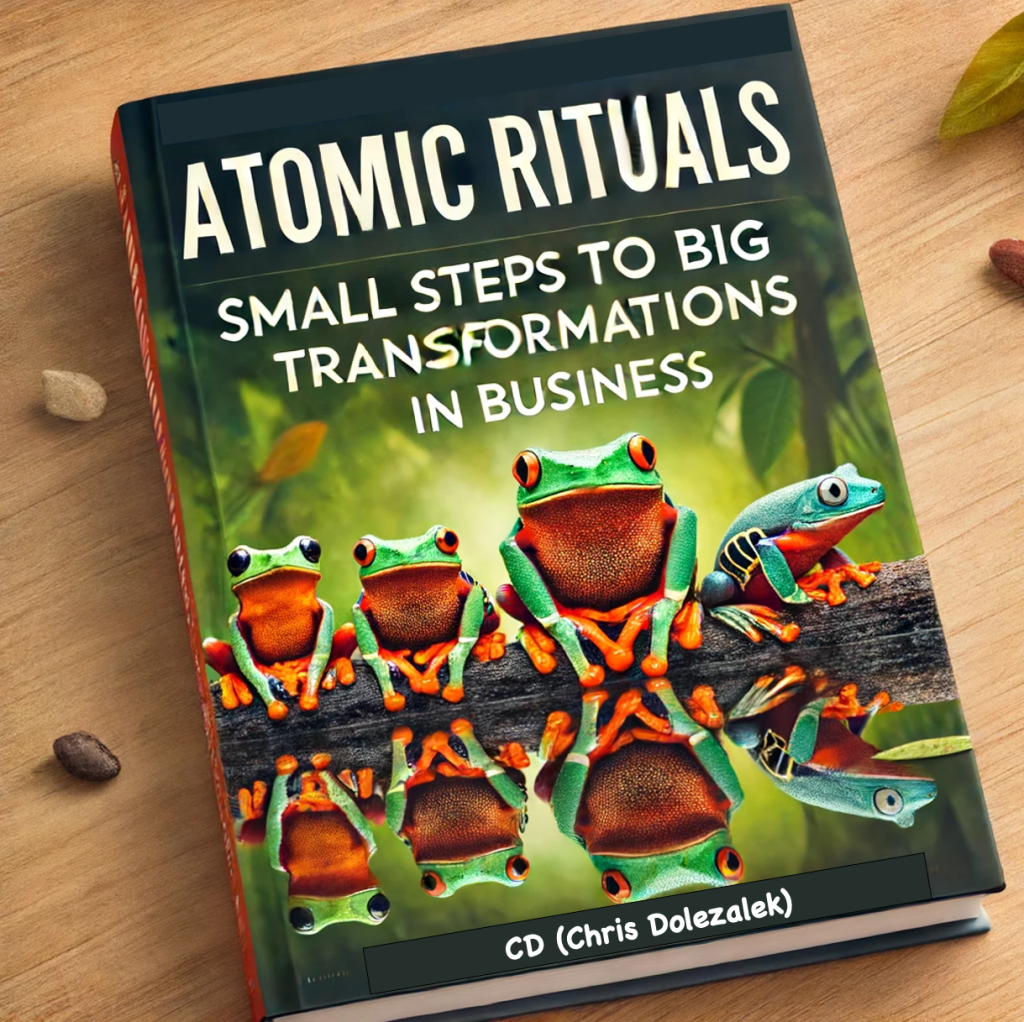
Atomic Rituals Book Variant 1
I’m currently working on two different ways to structure and convey the content and learning opportunities for “Atomic Rituals” the book. I’m calling the “Variant 1”. This book is about a fictitious company; however, it is modeled after real world experiences using examples from the various disruptive tech companies where I’ve been a leader over the last four decades bringing it all into the new world of massive data and AI.
About the Author – Foreword by Steven
It’s a privilege to work alongside someone like CD. As a leader, coach, and visionary, CD has a rare ability to inspire transformation—not just in organizations, but in the people who drive them. His insights, drawn from decades of experience, have shaped the way teams collaborate, adapt, and thrive under the most challenging circumstances.
I’ve had the honor of seeing CD’s principles in action firsthand. The concepts in Atomic Rituals aren’t just theories—they are the culmination of a career spent guiding organizations and individuals to beat the odds. Whether it’s helping startups on the brink of collapse become billion-dollar successes or mentoring leaders through their own journeys of growth, CD’s ability to create meaningful, lasting change is unmatched.
A Journey of Beating the Odds
CD’s leadership philosophy is rooted in his own story of grit and perseverance. From the very beginning of his career, he demonstrated a unique ability to recognize opportunities hidden within challenges. He didn’t just solve problems; he systematically broke them down, identifying small, actionable steps that could transform outcomes. This approach—what he now calls Atomic Rituals—has become his signature method for driving incremental but profound change.
Over the years, CD has refined this framework, embodying the growth mindset he encourages in others. He consistently seeks ways to improve, whether by embracing feedback, iterating on his own processes, or modeling adaptability for those around him. This commitment to evolution is why his guidance resonates so deeply with leaders who are navigating their own journeys.
Helping Companies Beat the Odds
CD has spent his career helping organizations turn adversity into opportunity. His impact can be seen in startups that transformed from near failure to industry leaders, and in leadership teams that shifted from discord to alignment. What sets CD apart is his ability to tailor his approach to the specific needs of an organization, breaking down even the most complex challenges into manageable, actionable steps.
At Hum, CD has helped us drive meaningful progress by leveraging the same principles he shares in this book. His Atomic Rituals framework—built on intentional, iterative actions—has empowered teams to find clarity amidst complexity and build systems that are as adaptable as they are effective. CD doesn’t just deliver results; he equips others to create sustainable success long after he steps away.
A Guide for Leaders on Their Own Journey
What makes CD’s approach especially impactful is his deep understanding of what it means to lead. He knows that leadership isn’t about having all the answers—it’s about fostering curiosity, asking the right questions, and inspiring those around you to grow.
Atomic Rituals is written for leaders who are on their own Leader’s Journey—those who are striving not just to succeed in their roles, but to continuously improve themselves and their teams. CD brings both humility and wisdom to this book, sharing practical tools and stories that are grounded in real-world experience. His approach is not about grand gestures but about the small, intentional actions that build momentum and create extraordinary results.
Closing Thoughts
CD has spent his career helping others thrive, whether by guiding organizations through transformation or mentoring leaders as they navigate their own challenges. Atomic Rituals captures the essence of what makes his leadership so effective: a focus on curiosity, iteration, and the power of collective growth.
If you’re reading this book, you’re likely a leader who is ready to grow. There’s no better guide than CD to accompany you on that journey. The lessons you’ll find in Atomic Rituals will inspire you to think differently, act with intention, and create a legacy of leadership that leaves everything—and everyone—you touch in a better state.
Enjoy the journey,
Steven
Atomic Rituals Foreword
Transformation often feels like an intimidating journey, a mountain to climb when all you see is the summit and the treacherous path ahead. Yet, true transformation doesn’t happen in leaps and bounds—it happens in small, intentional steps. In this book, Atomic Rituals, we explore the concept that big wins for organizations and individuals come from seemingly tiny, deliberate actions. These actions, when repeated consistently, form rituals that shape behaviors, influence culture, and lead to meaningful progress.
The idea of Atomic Rituals is rooted in a powerful insight: rituals have the unique ability to turn a fleeting intention into a lasting impact. Unlike habits, which often operate in isolation, rituals create interconnected systems of improvement. They become the threads of organizational culture, weaving individuals’ goals and collective missions into a cohesive whole. For leaders, these rituals provide a framework for aligning values, fostering collaboration, and sustaining growth.
I’ve seen this firsthand. Over four decades of working with leaders across industries—guiding startups from the brink of collapse to billion-dollar valuations and mentoring seasoned executives at the helm of disruptive technologies—have taught me one unshakable truth: transformation is not a moment; it’s a movement. And every movement begins with a single step.
This book isn’t just about theory; it’s about practice. Through a blend of real-world case studies, actionable frameworks, and reflective exercises, you’ll learn how to design and implement rituals that drive progress and inspire change. Whether you’re a leader looking to shape a thriving team, a founder navigating the chaos of scale, or an individual eager to amplify your impact, Atomic Rituals offers a roadmap for turning small leaps into monumental outcomes.
The journey begins here—with a decision to embrace the small, intentional actions that lead to transformative results. Let’s take that first step together.
Atomic Rituals Introduction
Every leader embarks on a journey. It begins with a vision, often sparked by an aspiration to create something new, solve a pressing challenge, or leave a meaningful legacy. Along the way, there are triumphs and setbacks, moments of clarity and times of doubt. The journey is never a straight line; it’s a winding path shaped by the people we meet, the obstacles we face, and the lessons we learn. This book, Atomic Rituals, is a guide for leaders navigating their own unique journeys. It’s not just about achieving goals—it’s about the rituals that sustain and empower us along the way.
Rather than offering abstract theories or one-size-fits-all strategies, Atomic Rituals invites you to step into the shoes of leaders who have faced defining moments on their journeys. Through their stories—drawn from real-world experiences—you’ll discover how small, intentional actions can transform not only organizations but also the individuals within them. These actions, or rituals, are the connective tissue between vision and execution, between aspiration and achievement.
The Leader’s Journey
At the heart of this book is a parallel to the Hero’s Journey, but with a focus on leadership. Every leader’s journey follows a similar arc: a call to action, a series of challenges and transformations, and the eventual realization of their impact. Along the way, rituals play a vital role. They ground us in times of uncertainty, guide us through complexity, and connect us to a greater purpose.
In the pages that follow, you’ll meet Sarah, a fictional CTO navigating the rapid growth of her startup. You’ll also meet Bill, her seasoned advisor and mentor, who has spent decades helping leaders like Sarah rise to their potential. Their stories, interwoven with lessons and reflections, illustrate the transformative power of Atomic Rituals in real-world contexts.
Through Sarah’s journey, you’ll see how rituals:
- Provide clarity amid chaos,
- Strengthen team cohesion,
- Align individual goals with organizational vision, and
- Drive meaningful progress, one small step at a time.
Why Rituals Matter
Rituals differ from habits in one key way: they are inherently relational. While habits focus on personal improvement, rituals bring people together. They are the shared practices that create culture, establish trust, and inspire collective action. Rituals may appear small—a weekly reflection meeting, a ritualized way of celebrating wins, or even the structure of daily stand-ups—but their impact is anything but. They build momentum, foster accountability, and provide a sense of continuity, even in the face of rapid change.
In Sarah’s case, you’ll see how small rituals like a “Monday Momentum” meeting helped her team stay aligned during a critical product launch. You’ll also see how rituals like a “Five Why Failure Debrief” turned setbacks into opportunities for growth.
How to Use This Book
This book is structured to guide you through the Leader’s Journey while providing actionable insights to apply to your own context. Each chapter includes:
- Narratives: Stories from Sarah, Bill, and other leaders to bring the concepts to life.
- Insights: Lessons and reflections drawn from these experiences.
- Frameworks: Practical tools and strategies to design and implement rituals in your organization.
- Exercises: Thought-provoking prompts to help you reflect on your own journey and the rituals that can guide it.
The Invitation
As you read, you may find echoes of your own experiences in the stories of Sarah, Bill, and others. That’s intentional. This book isn’t just about their journeys—it’s about yours. The goal is not only to inspire but also to equip you with the tools to design rituals that align with your values, amplify your impact, and sustain your growth.
Your Leader’s Journey is unique, but you don’t have to navigate it alone. Through the power of Atomic Rituals, you can connect your daily actions to your greater purpose, empowering yourself and those you lead to achieve extraordinary results.
Let the journey begin.
Atomic Rituals
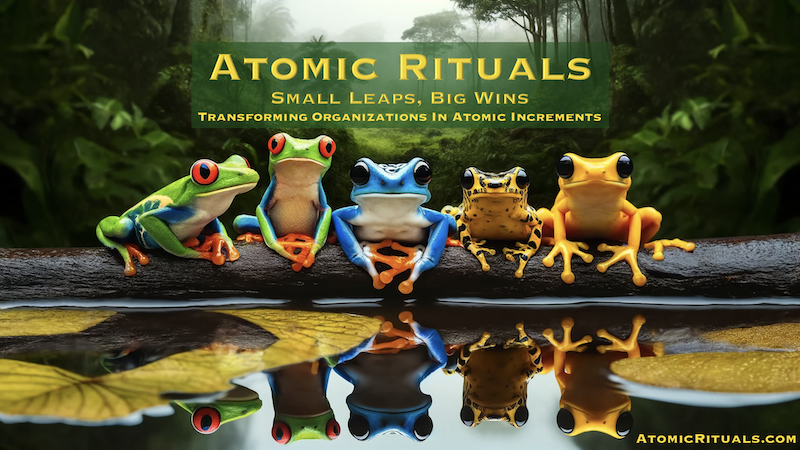
5 frogs on a log, one decides to leap, how many are left?
You might think: 4.
However, likely 5 will be left on the log. Deciding to leap is easy; actually taking the leap is hard.
Imagine you want 5 unique frogs to leap simultaneously into the same unknown puddle.
Chapter 1: The New Beginning – Assessing the Landscape
- Narrative: Sarah joins the startup and begins evaluating the existing culture, processes, and team dynamics.
- Key Insight: Understanding the current state is crucial before implementing changes.
- Content:
- Methods for assessing organizational health and identifying existing rituals.
- Introduction to “meta rituals” as overarching practices that influence company culture.
- Exercise: Conduct a cultural and process audit within your organization to identify existing rituals and areas for improvement.
Narrative:
Sarah stepped out of the Uber and into the sleek, modern lobby of Nova Labs. Silicon Valley sunshine streamed through the floor-to-ceiling windows, reflecting off the polished concrete floors and minimalist décor. It was her first day as the new CTO, and a mix of excitement and trepidation churned in her stomach.
Nova Labs, a fintech startup on the cusp of disrupting the world of decentralized finance, had lured her away from a comfortable, predictable role at a large corporation. The challenge of leading a team at a fast-growing company, building cutting-edge AI-powered technology, had been impossible to resist. But now, facing the reality of her new environment, doubts crept in.
She recalled the advice in The First 90 Days, a book she had re-read on the flight over. Promote yourself. Accelerate your learning. Match strategy to situation. The words swirled in her mind as she approached the reception desk. This wasn’t just a new job; it was a new adventure, a new chapter in her Leader’s Journey.
Sarah was no stranger to challenges. As a woman in tech, she had faced her share of obstacles and biases. But she had always persevered, driven by a deep passion for technology and a belief in its power to transform the world. She had honed her skills, built her expertise, and earned her place at the table.
But this was different. This was a chance to not just build technology, but to build a team, a culture, a company. To create something truly special, something that reflected her values and her vision for a more human-centered workplace.
As she waited for her new boss, Alex, the CEO, Sarah’s gaze fell on a figure sitting across the lobby. It was an older man, exuding an air of quiet confidence and wisdom. He was reviewing notes and occasionally exchanging warm smiles with the people passing by. She didn’t know him yet, but something about his demeanor struck her. Perhaps he was an advisor, a consultant, or maybe even a mentor figure. Little did she know that their paths would cross soon and he would become instrumental in her growth at Nova Labs.
Alex appeared, radiating energy and enthusiasm. “Sarah! Welcome aboard! Ready to dive in?”
Sarah smiled, her apprehension momentarily forgotten. “Absolutely. I’m eager to get started.”
Little did she know that this was just the beginning of her adventure, a journey that would test her limits, challenge her assumptions, and ultimately transform her as a leader. This was her call to adventure, and she was ready to answer it.
Incorporating “The First 90 Days” Principles into the Self-On-Boarding Ritual:
- Listen and Learn First: Sarah starts by observing, asking questions, and gathering information to build a comprehensive understanding of the organization before making any changes.
- Prioritize Relationships: Building trust and credibility is emphasized as foundational to her early success. Sarah is intentional about connecting with her team to establish trust and mutual respect.
- Quick Wins and Long-Term Plans: Sarah balances her approach by looking for small, immediate improvements to build momentum while also laying the groundwork for more substantial, strategic changes.
- Structured Thinking: Sarah organizes her transition into phases, ensuring her time and energy are focused on the right priorities at each stage.
- Collaborative Growth: Her mentor, introduced later, acts as a reflective partner, helping Sarah sharpen her ideas without dictating solutions, reinforcing her confidence and autonomy.
Content:
- Methods for Assessing Organizational Health:
- Observation: Spend time shadowing team members and observing their day-to-day interactions. Pay attention to:
- How decisions are made.
- How meetings are conducted.
- Patterns in communication—who speaks, who doesn’t, and how feedback is handled.
- Interviews and Conversations: Have one-on-one conversations with team members across all levels. Ask open-ended questions like:
- What’s working well in the organization?
- What challenges do you face in your role?
- Are there any traditions or practices you find particularly meaningful (or frustrating)?
- Surveys and Feedback Tools: Use anonymous surveys to gather honest input on team dynamics, leadership, and processes. Include questions about:
- Clarity of roles and responsibilities.
- Alignment with the company’s mission.
- Satisfaction with communication and collaboration.
- Document Review: Examine existing documentation, such as company policies, onboarding materials, and meeting agendas. These often reveal implicit values and priorities.
- Observation: Spend time shadowing team members and observing their day-to-day interactions. Pay attention to:
- Identifying Existing Rituals:
- Explicit Rituals: These are the intentional practices the team engages in, such as weekly stand-ups, performance reviews, or team celebrations. Assess:
- Are these rituals serving their intended purpose?
- Are they consistent and meaningful, or do they feel like mere formalities?
- Implicit Rituals: These are the unspoken habits and routines that have become part of the culture, like who gets to speak first in meetings or how conflicts are addressed. Consider:
- Are these rituals reinforcing positive behaviors, or are they creating barriers?
- Do they align with the organization’s stated values?
- Explicit Rituals: These are the intentional practices the team engages in, such as weekly stand-ups, performance reviews, or team celebrations. Assess:
- Introduction to “Meta Rituals”:
- Definition: Meta rituals are overarching practices that influence the organization’s culture and guide its behaviors. These include:
- Decision-Making Frameworks: How decisions are made, who is involved, and how feedback is integrated.
- Constraint Ritual:
- Prioritization Ritual:
- Review Ritual: for document reviews, design reviews and code reviews
- Improvement Ritual: What to improve, how and when in terms of tech-debt, stability and resilience, scalability
- Communication Norms: How information flows across teams and how transparency is maintained.
- Transparency Ritual:
- Customer Experience Sharing Ritual:
- Cultural Anchors: Practices that reinforce the company’s core values, such as storytelling during all-hands meetings or weekly shout-outs for exemplifying the mission.
- Decision-Making Frameworks: How decisions are made, who is involved, and how feedback is integrated.
- The Role of Meta Rituals: These rituals shape the foundation of the organization. By identifying and evaluating them, leaders can determine whether they’re fostering alignment or contributing to dysfunction.
- Definition: Meta rituals are overarching practices that influence the organization’s culture and guide its behaviors. These include:
Exercise: Conduct a Cultural and Process Audit
To understand the landscape of your organization, complete the following steps:
- Observation: Spend at least a week observing team dynamics and documenting recurring behaviors and practices. Look for patterns in communication, collaboration, and decision-making.
- Interviews: Schedule informal one-on-one conversations with at least five team members. Ask:
- What’s one thing you love about how we work here?
- What’s one thing you wish we could change?
- Are there any traditions or practices you think define our culture?
- Survey: Create a short survey for the entire team with questions focused on:
- Role clarity.
- Collaboration and communication.
- Alignment with the company’s mission.
- Ritual Mapping: Create a list of explicit and implicit rituals you’ve observed. Categorize them as productive, neutral, or counterproductive.
- Reflection: Analyze your findings and identify:
- Key strengths to build on.
- Areas of misalignment or dysfunction.
- Opportunities for new or refined rituals to address gaps.
By implementing these practices, Sarah transformed the hiring process into a thoughtful, intentional ritual that not only attracted the right candidates but also reflected the values and culture of the organization. Through structured interviews, collaborative decision-making, and continuous improvement, she laid the foundation for building her dream team.
Chapter 2: Prioritizing Change – Identifying Leverage Points
- Narrative: Sarah, with Bill’s guidance, identifies key areas where small changes can yield significant impact.
- Key Insight: Focusing on high-leverage areas ensures efficient use of resources and maximizes impact.
- Content:
- Techniques for prioritizing changes based on organizational needs and goals.
- Understanding “molecular rituals” as specific, targeted practices that drive change in particular areas.
- Exercise: Map out potential areas for improvement and prioritize them based on impact and feasibility.
Narrative:
Sarah sat at the edge of the conference room table, her notebook open but untouched. It had been two weeks since she joined Nova Labs as CTO, and she was beginning to sense the undercurrents of the organization—the unspoken rules, the subtle tensions, and the moments of camaraderie that hinted at a strong, but strained, team dynamic.
One of her first observations was a sense of hesitation in meetings. Ideas were cautiously presented, and critical feedback was often wrapped in layers of diplomacy. While the team was undeniably talented, something vital seemed to be missing: trust.
Bill had once told her, “Trust isn’t just the glue that holds a team together; it’s the oil that keeps the machine running smoothly.” Sarah reflected on this as she sketched out her approach to addressing the issue. She decided to start small, with deliberate actions that could begin to build a foundation of trust within the team.
Later that day, she gathered the leadership team for an informal lunch. Instead of diving into strategic priorities, she began with a personal story about a mistake she had made in her previous role. “It was a tough lesson,” she admitted, “but it taught me the importance of being transparent, even when it’s uncomfortable.” The room was quiet, but she could see the tension easing as her vulnerability opened the door for others to share.
Over the weeks that followed, Sarah introduced a series of rituals designed to foster trust. One of these was “Moment of Gratitude,” where team members began each meeting by acknowledging a colleague’s contribution. Another was a “Trust Retrospective,” where the team reflected on moments when trust had been strengthened or challenged. Sarah also started a practice of one-on-one trust-building check-ins, where team members could speak candidly about their concerns and aspirations without fear of judgment.
As the weeks turned into months, the atmosphere began to shift. Ideas flowed more freely, feedback became more constructive, and the team’s collaboration took on a new energy. Sarah realized that trust wasn’t built overnight, but through consistent, intentional actions that reinforced the belief that they were all in this together.
Key Insight:
Building trust is a foundational step in creating a cohesive and high-performing team. Trust allows individuals to take risks, share openly, and collaborate effectively. It is both the starting point and the ongoing thread that weaves a team together.
Content:
- Understanding Trust in Leadership:
- The Four Pillars of Trust:
- Competence: Demonstrating capability and reliability.
- Authenticity: Being genuine and transparent.
- Empathy: Showing care and understanding for others’ perspectives.
- Transparency: being clear and honest about business decisions, company health, etc
- The Role of Vulnerability: Leaders who admit their mistakes and share their learning journey create a safe space for others to do the same.
- Building Psychological Safety:
- Foster an environment where team members feel safe to take risks and voice concerns without fear of retaliation or embarrassment.
- Encourage open dialogue by modeling active listening and validating diverse viewpoints.
- The Four Pillars of Trust:
- Rituals to Build Trust:
- Moment of Gratitude:
- Begin team meetings by sharing gratitude for a specific action or behavior of a colleague.
- Impact: Reinforces positive behaviors and fosters a culture of appreciation.
- Trust Retrospective:
- Hold regular sessions to reflect on how trust is being built or eroded within the team.
- Questions to ask:
- When did we feel most aligned as a team?
- Were there moments when trust was challenged? How did we handle them?
- One-on-One Check-Ins:
- Schedule regular, informal conversations between team members and leaders.
- Purpose: Provide a space for candid dialogue, personal connection, and mutual understanding.
- Open Feedback Rounds:
- Dedicate time in team meetings for structured, constructive feedback.
- Encourage team members to use the “Start, Stop, Continue” framework:
- Start: A new behavior or practice to adopt.
- Stop: A behavior that is hindering progress.
- Continue: A positive behavior to maintain.
- Moment of Gratitude:
- The “Trust Bank” Concept:
- Deposits and Withdrawals:
- Trust is built through “deposits” of consistent, positive actions and eroded through “withdrawals” of negative behaviors.
- Leaders should consciously make deposits by:
- Following through on commitments.
- Recognizing and addressing issues promptly.
- Showing fairness and consistency in decision-making.
- Rebuilding Trust:
- Acknowledge the impact of trust withdrawals openly and take deliberate steps to rebuild.
- Deposits and Withdrawals:
- Leveraging the “Start with Trust” Framework:
- Create Psychological Safety:
- Ensure team members feel safe to speak up without fear of retribution.
- Encourage open dialogue by modeling active listening and validating diverse viewpoints.
- Model Trust-Building Behaviors:
- Share your own challenges and invite others to contribute to solutions.
- Highlight stories of trust-building moments within the organization.
- The Power of Transparency:
- Leaders should clearly communicate both successes and challenges.
- Regularly update the team on progress and seek input on obstacles to foster a sense of shared ownership.
- Create Psychological Safety:
- Sustaining Trust Over Time:
- Continuous Reflection: Regularly revisit the team’s trust-building efforts and adapt as the organization evolves.
- Celebrate Milestones: Recognize moments when trust has led to significant breakthroughs or successes.
- Expand the Circle of Trust: As new members join the team, integrate them through onboarding rituals that emphasize trust as a core value.
- Trust Calibration: Periodically reassess trust levels within the team to identify new opportunities for growth and reinforcement.
- Storytelling as a Tool: Use narratives of past successes or challenges to underline the role of trust in achieving outcomes. Personal stories from leaders can be particularly impactful in reinforcing these values.
Exercise:
- Assess Team Trust Levels:
- Reflect on the current state of trust within your team. Ask:
- Do team members feel safe to share ideas and feedback?
- Are there visible signs of collaboration and mutual respect?
- Reflect on the current state of trust within your team. Ask:
- Design a Trust-Building Ritual:
- Identify a specific area where trust needs to be strengthened.
- Create a ritual to address this need. For example:
- If feedback is an issue, introduce Open Feedback Rounds.
- If appreciation is lacking, start a Moment of Gratitude practice.
- Measure Progress:
- Gather feedback on the impact of trust-building rituals.
- Use tools like anonymous surveys or facilitated discussions to evaluate changes in team dynamics.
Chapter 3: Building the Dream Team – Enhancing the Hiring Process
- Narrative: Sarah realizes the importance of building a cohesive team and focuses on refining the hiring process.
- Key Insight: Effective hiring is foundational to organizational success and can be improved through specific rituals.
- Content:
- Implementing atomic processes to enhance recruitment and selection.
- Establishing rituals that promote diversity, inclusion, and alignment with company values.
- Exercise: Design a hiring ritual that reflects your organization’s values and objectives.
Narrative:
Sarah sat in her office, reflecting on the startup’s hiring process. Over the past few months, she had seen how the team’s composition influenced everything—their ability to innovate, collaborate, and execute. Some recent hires had fit seamlessly, contributing immediately, while others struggled to adapt, creating friction and slowing progress. Sarah knew the issue wasn’t the talent itself; it was the process used to identify, evaluate, and onboard them.
Determined to refine the process, Sarah outlined her initial ideas before meeting Bill for their regular discussion. She wasn’t looking for answers—she wanted a sparring partner to help challenge and shape her thinking.
When they met, Sarah began confidently, “Bill, I’ve been focusing on the hiring process. It’s clear that the team’s long-term success hinges on bringing in people who don’t just have the right skills but also the right mindset and fit for our culture.”
Bill nodded, intrigued. “What are you seeing that you want to change?”
“We’ve been too focused on evaluating what people already know,” Sarah said. “I want to shift the focus to why they know it. Are they curious? Do they have a growth mindset? Can they tackle challenges outside their current expertise?”
“That’s a solid shift,” Bill said. “How do you plan to uncover those qualities in candidates?”
“I’ve been thinking about redesigning our interview process,” Sarah replied. “Each interviewer would focus on a specific skill or quality, but instead of just assessing past experience, they’d use dynamic questions that push candidates into unfamiliar territory. I want to see how they think, not just what they know.”
Bill leaned back, clearly impressed. “That sounds promising. How will you ensure the process is consistent and effective?”
Sarah smiled. “I want to standardize the questions and train interviewers. No one should go into an interview unprepared or decide on their own whether someone is a good fit. We’d also delay decisions until a debrief session, where everyone shares their observations before making a collaborative call.”
Bill raised an eyebrow. “Why delay the decision?”
Sarah leaned forward. “Because too many decisions are made in the first five minutes of an interview, based on instinct. I want us to collect information first, discuss it as a group, and then decide. It’s a way to ensure we’re making informed decisions, not snap judgments.”
Bill grinned. “That’s sharp. You’re building a system that’s fairer, more thoughtful, and aligned with your values. What challenges do you see in implementing it?”
“Getting buy-in,” Sarah admitted. “Some people might resist the added structure. But I’m confident the results will speak for themselves once they see how it works.”
Bill nodded. “Sounds like you’ve got a solid plan, Sarah. What’s your first step?”
“I’m going to pilot the process with the next few hires,” she said. “We’ll test it, gather feedback, and refine it before rolling it out more broadly. It’s all about small, intentional steps.”
Bill smiled. “I love it. You’re applying the same growth mindset to your process that you’re looking for in your team. That’s leadership in action.”
Sarah left the meeting feeling energized, not because Bill had given her answers, but because their conversation had pushed her thinking further. She knew she was on the right path, and she was ready to take the next step.
Key Insight:
Effective hiring doesn’t just evaluate what candidates know—it uncovers why they know it, how they think, and their capacity to grow. Structured processes that emphasize collaboration, growth mindset, and informed intuition lead to better, more intentional hiring decisions.
Content:
- Hiring for Why They Know It:
- Growth Mindset Over Static Knowledge: Assess candidates for their curiosity, motivation, and ability to learn rather than solely their current expertise.
- Collaborative Problem-Solving: Design interview questions that:
- Start with a problem related to the role.
- Allow the candidate to explore the problem interactively with the interviewer.
- Gradually increase complexity, taking candidates into new territory to assess how they approach the unknown.
- Outcomes to Observe:
- How candidates ask clarifying questions.
- Their willingness to adapt their thinking.
- Their collaborative problem-solving skills.
- Delaying or Informing Intuition in Decision-Making:
- The Problem: Research shows that many interviewers make their hire/no-hire decision within the first few minutes of an interview.
- The Solution:
- Train interviewers to focus solely on collecting information during the interview, not making judgments.
- After all interviews are complete, hold a structured debrief session where:
- Each interviewer shares how the candidate performed on their specific question.
- Interviewers avoid making judgments or comparisons until all information is shared.
- Once all feedback is heard, ask interviewers: “How excited would you be to mentor this candidate for the next three months?”
- Atomic Rituals for Structured Interviews:
- Develop Specific Questions:
- Create a bank of well-defined, role-specific questions that incrementally explore a candidate’s knowledge, problem-solving, and adaptability.
- Interviewer Certification:
- Train interviewers on how to ask specific questions and what to look for in responses.
- Allow them to lead the interview under the observation of a certified interviewer.
- Iterative Development: Start with a small set of questions and improve them incrementally based on feedback and outcomes, aligning with the principles of Atomic Rituals.
- Develop Specific Questions:
- Building Bridges in the Hiring Process:
- Creating Strong Connections:
- Build relationships with candidates through a transparent, empathetic, and engaging process.
- Introduce rituals like pre-interview “coffee chats” to establish rapport and ease nerves.
- Candidate Experience Mapping:
- Identify key moments where the hiring process can feel impersonal or overly transactional. Address these by:
- Sending personalized follow-ups after interviews.
- Sharing detailed feedback, regardless of the decision.
- Identify key moments where the hiring process can feel impersonal or overly transactional. Address these by:
- Onboarding Alignment:
- Ensure the hiring process aligns with onboarding by integrating cultural and role-specific insights shared during interviews into the new hire’s first 90 days.
- Creating Strong Connections:
- Embedding Diversity, Equity, and Inclusion (DEI):
- Sourcing Rituals:
- Partner with diverse talent pipelines and create sourcing goals to ensure an inclusive pool of candidates.
- Blind Screening:
- Remove identifying details from resumes to minimize unconscious bias.
- Cultural Alignment Interviews:
- Dedicate a portion of the interview to exploring values alignment, ensuring candidates resonate with the organization’s mission.
- Debrief Rituals:
- In debrief sessions, include a discussion of how the hiring process supports diversity, equity, and inclusion goals.
- Sourcing Rituals:
Exercise: Design a Hiring Ritual
- Define Your Hiring Vision:
- What qualities do you value most in your team members?
- How do you want candidates to experience your hiring process?
- Map the Candidate Experience:
- Break the hiring process into stages: sourcing, screening, interviews, and decision-making.
- Identify opportunities to introduce structured rituals at each stage.
- Design Specific Rituals:
- Create one new interview question that progresses in complexity.
- Develop a debrief process that uses informed intuition (e.g., the “mentor excitement” question).
- Plan a ritual to review and iterate on interview questions quarterly.
- Train Interviewers:
- Establish a certification process for each role’s specific questions.
- Ensure all interviewers understand and adhere to the rituals designed.
- Iterate and Improve:
- After each hire, gather feedback from candidates and interviewers to refine the process.
By implementing these practices, Sarah transformed the hiring process into a thoughtful, intentional ritual that not only attracted the right candidates but also reflected the values and culture of the organization. Through structured interviews, collaborative decision-making, and continuous improvement, she laid the foundation for building her dream team. Readers, too, will walk away from this chapter equipped to refine their hiring practices and create teams aligned for success.
Chapter 4: Seamless Integration – Crafting an Onboarding Ritual
- Narrative: With new hires coming in, Sarah develops an onboarding process that integrates employees into the company culture effectively.
- Key Insight: A structured onboarding ritual ensures new team members are aligned, engaged, and productive from the start.
- Content:
- Steps to create an onboarding ritual that encompasses training, mentorship, and cultural immersion.
- Utilizing “meta rituals” to maintain consistency across departments.
- Exercise: Outline an onboarding ritual that can be implemented in your organization to facilitate smooth integration of new employees.
Narrative:
With new hires coming in, Sarah develops an onboarding process that integrates employees into the company culture effectively. This process is not only about imparting information but also about fostering a culture of open communication and feedback from day one. Drawing from the principles of Radical Candor, Sarah ensures that new team members feel safe to share their perspectives while also receiving candid and constructive input to support their growth.
Sarah leaned back in her chair, reviewing the feedback from the team’s recent onboarding efforts. While the company had made progress in hiring talented individuals, she noticed an unsettling trend: new hires were taking longer to ramp up than expected. Some felt unsure about their roles, while others struggled to integrate into the team. The inconsistency wasn’t due to a lack of effort—it was a lack of structure and intentional feedback.
Sarah began outlining her vision for an improved onboarding process. She wanted it to be more than a checklist; she envisioned a ritual that would align new hires with the company’s values, equip them with the tools to succeed, and instill a mindset of continuous improvement from day one.
When she met Bill later that week, Sarah dove right in. “Bill, I’ve been thinking about onboarding. It’s clear we need to create something more intentional—something that sets people up for success from the start.”
Bill nodded, curious. “What’s your vision?”
“I want onboarding to feel like an invitation, not just an introduction,” Sarah said. “It should connect new hires to our culture and our goals while giving them the tools and confidence they need to contribute immediately.”
“That sounds strong,” Bill said. “How are you thinking about structuring it?”
“I’ve mapped out a few ideas,” Sarah replied, flipping open her notebook. “First, we need a documented onboarding guide. Not just a static manual, but something that evolves. Every new hire—and their mentor—would be responsible for improving it, so it gets better with every iteration.”
Bill smiled. “I like that. It turns the process itself into a tool for growth.”
“Exactly,” Sarah said. “I also want to pair every new hire with a spin-up buddy—someone who can guide them through the first few months, answer their questions, and help them navigate the unspoken rules.”
“That’s a great addition,” Bill said. “What else?”
“I want to embed the mindset of leaving things better than you found them,” Sarah continued. “From day one, new hires would see improvement as part of their role—whether it’s refining the onboarding guide, optimizing a workflow, or contributing to a project.”
Bill leaned forward, impressed. “How do you plan to make this a reality?”
“I’ll start small,” Sarah said. “We’ll pilot the new process with the next few hires. I’ll ask for feedback from the new hire, their mentor, and the team to see what works and what needs tweaking. Over time, we’ll refine and scale it.”
Bill nodded. “That sounds like a thoughtful approach. You’re not just building an onboarding process—you’re building a culture of growth.”
“That’s the goal,” Sarah said. “If we do this right, onboarding won’t just integrate people—it’ll inspire them.”
As Sarah left the conversation, she felt confident. She wasn’t just solving a problem; she was setting the stage for something transformative.
Key Insight:
A structured onboarding ritual ensures new team members are aligned, engaged, and productive from the start. By embedding mentorship, continuous improvement, and cultural immersion into the process, organizations create a foundation for long-term success.
Content:
- Steps to Create an Onboarding Ritual:
- Document the Process:
- Create a centralized onboarding guide that outlines the key steps, expectations, and resources for new hires.
- Include sections on:
- Company mission, values, and culture.
- Role-specific responsibilities and objectives.
- Tools, systems, and workflows the new hire will use.
- Regularly update the document to reflect changes and improvements.
- Assign a Spin-Up Buddy/Mentor:
- Pair each new hire with a mentor or buddy who can provide guidance, answer questions, and offer context during the onboarding period.
- Define the buddy’s role as:
- Providing technical and cultural orientation.
- Facilitating introductions to key team members.
- Acting as a point of contact for questions or concerns.
- Embed Continuous Improvement:
- Encourage new hires and their mentors to collaboratively improve the onboarding process by:
- Documenting gaps or ambiguities they encounter.
- Suggesting updates or additions to the onboarding guide.
- Sharing insights on how to make the experience smoother for the next hire.
- Encourage new hires and their mentors to collaboratively improve the onboarding process by:
- Cultural Immersion:
- Design rituals that immerse new hires in the company’s culture, such as:
- A welcome lunch or team-building activity.
- Regular check-ins with leadership to discuss company vision and values.
- Participation in existing team rituals, like weekly retrospectives or stand-ups.
- Design rituals that immerse new hires in the company’s culture, such as:
- Feedback Loops:
- Conduct an onboarding retrospective at the end of the new hire’s first 90 days, involving the new hire, their mentor, and their manager. Discuss:
- What worked well in the process.
- Areas for improvement.
- Suggestions for enhancing the onboarding experience.
- Conduct an onboarding retrospective at the end of the new hire’s first 90 days, involving the new hire, their mentor, and their manager. Discuss:
- Document the Process:
- Incorporating Radical Candor into Onboarding:
- Creating a Feedback-Rich Environment:
- Train spin-up buddies and mentors to deliver feedback in the spirit of Radical Candor—caring personally while challenging directly.
- Encourage new hires to reciprocate with feedback about their onboarding experience, fostering mutual respect and trust.
- Establishing a Foundation of Trust:
- From day one, leaders should model transparency by sharing their own lessons learned and areas for growth.
- Include a session on the importance of candid communication as part of the onboarding process.
- Practicing Immediate Feedback:
- Incorporate daily or weekly feedback rituals where new hires and their mentors exchange observations.
- Use prompts like:
- “What’s one thing I can do to support you better?”
- “What’s one thing you’ve learned this week that surprised you?”
- Creating a Feedback-Rich Environment:
- Developing a Growth Mindset:
- Leave It Better Than You Found It:
- Make it an explicit expectation that every employee, starting from day one, leaves every process, tool, or document they touch in a better state.
- Curiosity as a Core Value:
- Foster an environment where employees are encouraged to ask, “How can this be better?” and take small, incremental steps toward improvement.
- Iterative Learning:
- Emphasize deep practice and repetition with reflection during the onboarding process.
- Leave It Better Than You Found It:
- Utilizing Feedback Loops:
- Structured Retrospectives:
- Schedule a retrospective after the first 30, 60, and 90 days of onboarding to reflect on:
- The effectiveness of the process.
- Suggestions for improvement.
- Individual and team alignment with company values.
- Schedule a retrospective after the first 30, 60, and 90 days of onboarding to reflect on:
- Incorporate Growth-Oriented Questions:
- Use prompts to guide reflections:
- “What’s one thing we can do to improve this process?”
- “What support do you need to feel more confident in your role?”
- Use prompts to guide reflections:
- Structured Retrospectives:
Exercise: Outline an Onboarding Ritual
- Define Objectives:
- What should new hires know and feel by the end of their first week? Their first month?
- How will you ensure they are aligned with company values and culture?
- Design the Process:
- Break the onboarding experience into phases (e.g., Week 1, Month 1, Month 3).
- Assign specific deliverables and milestones for each phase.
- Create Supporting Rituals:
- Define how new hires will be welcomed and integrated into the team (e.g., introductory team lunches, shadowing sessions).
- Establish feedback checkpoints with mentors and managers.
- Assign Accountability:
- Pair new hires with a spin-up buddy or mentor.
- Define the buddy’s responsibilities and schedule regular check-ins.
- Embed Improvement:
- Include a ritual for onboarding feedback and process improvement (e.g., an onboarding retrospective at the 30-, 60-, and 90-day marks).
- Task new hires and mentors with documenting and addressing any gaps in the onboarding process.
By implementing this onboarding ritual, Sarah created an experience that not only set new hires up for success but also instilled a mindset of continuous improvement from day one. This chapter equips readers with actionable steps to craft onboarding rituals that drive alignment, engagement, and cultural integration while reinforcing the values of curiosity and incremental progress.
Chapter 5: Continuous Improvement – Establishing Feedback Loops
- Narrative: Sarah introduces regular feedback sessions to foster open communication and continuous improvement.
- Key Insight: Regular feedback rituals create a culture of transparency and growth.
- Content:
- Designing feedback mechanisms that are constructive and aligned with organizational goals.
- Incorporating “molecular rituals” to address specific areas such as performance reviews and peer evaluations.
- Exercise: Develop a feedback ritual that encourages open communication and supports development within your team.
Narrative:
Sarah walked through the open office, noticing how quiet the team seemed after their latest project sprint. While the deliverables were solid, something felt off. She could sense the tension—a hesitancy in communication and a lack of the usual energy that characterized her team. When she asked a few people how they thought the project went, their responses were polite but vague. It was clear that honest feedback wasn’t flowing the way it needed to.
Later that week, she sat down with Bill for their regular conversation. “Bill, I’ve noticed something,” she said, getting straight to the point. “The team’s been delivering great work, but I feel like there’s a barrier to open communication. Feedback isn’t happening naturally, and it’s holding us back.”
Bill leaned forward, interested. “What do you think is causing it?”
Sarah thought for a moment. “Part of it might be fear—people don’t want to offend each other or step on toes. And when feedback does happen, it sometimes feels more critical than constructive, which makes people defensive.”
Bill nodded. “Sounds like you’re identifying both sides of the coin: how people give feedback and how they receive it. What are you thinking about doing?”
“I’ve been reflecting on how we frame feedback,” Sarah said. “I want the team to see it as a gift—something offered to help them grow, not as criticism. But I also want to help them receive feedback as a gift, even when it’s hard to hear. If they can shift their mindset, they’ll see it as an opportunity to improve.”
“That’s a powerful mindset shift,” Bill said. “How do you plan to make it part of your culture?”
Sarah smiled, flipping open her notebook. “I’m thinking of creating feedback rituals. For example, structured peer reviews where we focus on specifics—what’s working, what could improve, and what to try next. And I want to train the team on how to give feedback constructively and how to receive it with curiosity, not defensiveness.”
Bill raised an eyebrow. “What about the team’s current saboteurs?”
Sarah nodded. “I was thinking about that, too. If someone’s inner saboteur is triggered, they might shut down. I want to give them tools to pause, reflect, and ask themselves: ‘What can I learn from this?’ I want them to build inner allies that help them lean into growth.”
Bill leaned back, impressed. “You’re designing a system that focuses on development at every level. What’s your first step?”
“I’ll start by introducing the rituals in small ways,” Sarah said. “For instance, in our retrospectives, we’ll end by asking, ‘What’s one piece of advice you’d give to help a teammate grow?’ I’ll also hold a workshop on giving and receiving feedback to help everyone build confidence.”
“That’s a great start,” Bill said. “How will you measure whether it’s working?”
Sarah tapped her pen on her notebook. “I’ll ask the team. Feedback about feedback, if you will. And I’ll watch for changes in how openly they communicate and how much they collaborate.”
Bill smiled. “It sounds like you’re not just building a feedback culture—you’re creating a learning culture. That’s the hallmark of a strong team.”
Sarah left the conversation feeling energized. She had a clear plan to not only implement feedback loops but to create a culture where feedback was embraced as a tool for growth and connection.
Key Insight:
Regular feedback rituals create a culture of transparency and growth. When feedback is framed as a gift and received with a growth mindset, it becomes a powerful tool for individual and organizational development.
Content:
- Designing Feedback Mechanisms:
- Reframing Feedback as a Gift:
- Giving Feedback: Teach the team to view feedback as advice or insights offered to help the recipient grow, not as criticism or judgment.
- Use language like:
- “Here’s something you might consider to make this even better.”
- “What do you think about trying this approach?”
- Use language like:
- Receiving Feedback: Encourage individuals to see feedback—even tough or poorly delivered feedback—as a gift to help them improve.
- Teach them to ask: “What can I learn from this? How can this make me better?”
- Giving Feedback: Teach the team to view feedback as advice or insights offered to help the recipient grow, not as criticism or judgment.
- Feedback Ground Rules:
- Be specific: Focus on observable behaviors or outcomes.
- Be constructive: Frame feedback in a way that invites curiosity and collaboration.
- Be timely: Offer feedback close to the event to keep it relevant.
- Teach Emotional Awareness: Help team members recognize and manage their inner saboteurs when receiving feedback. Encourage them to:
- Pause and reflect before reacting.
- Ask clarifying questions if feedback feels unclear or unfair.
- Focus on the value of growth over the discomfort of critique.
- Reframing Feedback as a Gift:
- Incorporating Molecular Rituals:
- Performance Review Check-Ins:
- Replace annual reviews with regular, smaller check-ins (e.g., monthly or quarterly).
- Structure each session around three questions:
- What’s going well?
- What could be improved?
- How can I support you?
- Peer Review Circles:
- Create peer-led feedback sessions where team members share feedback in a roundtable format.
- Guidelines:
- Start with positives before moving to areas of improvement.
- Focus on behaviors, not personalities.
- End with actionable suggestions.
- Document, Code, or Design Review Rituals:
- Frame reviews as opportunities for mutual learning and growth.
- Encourage reviewers to use language that reflects the “gift” mindset, such as:
- “I wonder if this approach might simplify things?”
- “Have you considered how this might scale?”
- Include a closing ritual where the recipient reflects on one key takeaway.
- Performance Review Check-Ins:
- Developing a Growth Mindset through Feedback:
- See Everything as a Gift: Regularly remind the team that feedback—positive or negative—is a tool for growth, not a personal attack.
- Foster Inner Allies: Use coaching questions to help individuals build a positive, self-supportive mindset. For example:
- What’s one thing your inner ally would tell you about this feedback?
- How can you use this input to take one step closer to your goals?
- Promote Curiosity: Encourage team members to ask:
- What’s one thing I can do better tomorrow?
- What opportunities for growth can I find in this challenge?
- The Cyclical Nature of Improvement:
- Drawing from The Talent Code:
- Chunking: Break feedback down into actionable, bite-sized pieces that are easy to implement.
- Repetition with Reflection: Regularly practice giving and receiving feedback, with time to reflect on lessons learned.
- Feedback Loops: Use feedback sessions as opportunities to refine processes, improve collaboration, and reinforce a culture of continuous improvement.
- Drawing from The Talent Code:
Exercise: Develop a Feedback Ritual
- Evaluate a Current Challenge:
- What is the most pressing obstacle your team or organization is facing right now?
- How is this challenge affecting morale, communication, or productivity?
- Analyze Existing Rituals:
- Which rituals are helping the team navigate the challenge?
- Which rituals need to be adapted or replaced to better support the team?
- Propose a New or Adapted Ritual:
- Design a ritual that directly addresses the challenge. For example:
- If communication is breaking down, implement a “Daily Alignment” ritual where team leads briefly sync.
- If morale is low, create a “Gratitude Circle” ritual to end each week on a positive note.
- Design a ritual that directly addresses the challenge. For example:
- Test and Iterate:
- Introduce the new ritual and observe its impact over time.
- Gather feedback from the team and refine the ritual to ensure it continues to meet their needs.
By the end of this chapter, Sarah transformed her team’s culture, fostering openness, curiosity, and growth. Readers will gain actionable strategies to build feedback rituals that empower individuals, enhance collaboration, and drive continuous improvement on their Leader’s Journey.
Chapter 6: Navigating Challenges – Beyond the Obstacle
- Narrative: The company faces unforeseen challenges, and Sarah leads the team through them by adapting existing rituals.
- Key Insight: Flexibility in rituals allows organizations to navigate obstacles effectively.
- Content:
- Strategies for modifying rituals in response to changing circumstances.
- Case study: “Beyond the Obstacle” – looking past immediate challenges to find growth opportunities.
- Exercise: Identify a current challenge in your organization and propose a ritual adjustment to address it.
Narrative:
The company had been moving forward with momentum, but as often happens in any journey of growthThe company had been moving forward with momentum, but as often happens in any journey of growth, an unexpected challenge arose. A key product launch was delayed due to unforeseen technical complexities. Customers were growing impatient, the team felt the weight of the pressure, and cracks in communication began to surface. The usual energy of collaboration and optimism started to wane, replaced by stress and self-doubt.
Sarah stood before her team, her presence calm yet energized. She could feel the tension in the room as they prepared for an all-hands meeting to address the situation. She began, not with solutions or directives, but with a question: “What’s the gift in this challenge?”
The room was silent for a moment. Then one voice chimed in, hesitant but curious: “The gift?”
“Yes,” Sarah said, nodding. “Every challenge brings us something to learn, a way to grow, or an opportunity to improve. Let’s take a moment to reflect. What can this delay teach us? What’s the obstacle showing us about how we work together?”
Later, in her weekly conversation with Bill, Sarah shared her reflections on the experience. “It’s tough, Bill. The team is feeling this, and I can see it shaking their confidence. But I also think this is a defining moment. If we navigate it well, it could make us stronger.”
Bill nodded, his expression thoughtful. “What are you doing to lead them through it?”
“I’m focusing on two things,” Sarah replied. “First, helping them see that this obstacle isn’t the end—it’s part of the journey. It’s a chance to adapt, learn, and improve. Second, I’m modeling what I want them to embrace: resilience, curiosity, and the willingness to step back and ask, ‘What’s next?’”
Bill leaned forward. “That’s powerful, Sarah. How are you keeping them focused on growth rather than fear?”
Sarah smiled, flipping open her notebook. “I’m using our rituals. In our retrospectives, we’ve shifted the focus to what we’re learning and what we can do differently. I’ve also introduced a new reflection practice: at the end of each week, we share one thing we’ve learned from the challenge and one thing we’re grateful for.”
“And how’s it going?” Bill asked.
“It’s not perfect,” Sarah admitted. “There’s resistance—it’s hard to see the gift in something that feels like failure. But I remind them that we haven’t solved this yet. I’m confident we will.”
Bill smiled. “Sarah, you’re not just guiding them through a challenge. You’re showing them how to transform through it. That’s what leaders do.”
Sarah left the conversation feeling reaffirmed in her approach. This wasn’t just about fixing a problem; it was about modeling a mindset and creating rituals that would serve the team for years to come.
Key Insight:
Flexibility in rituals allows organizations to navigate obstacles effectively. By adapting existing practices and fostering resilience, leaders can turn challenges into opportunities for growth and innovation.
Content:
- Strategies for Modifying Rituals in Response to Challenges:
- Assess the Situation: Evaluate the specific nature of the challenge. Is it a sudden crisis, a prolonged difficulty, or an internal misalignment?
- Adapt Rituals to Meet the Moment:
- Daily Check-Ins: During high-stress periods, shift from weekly stand-ups to daily check-ins. Focus on immediate priorities and quick wins.
- Celebrating Small Wins: Create a ritual to recognize incremental progress, reminding the team of what’s still going well.
- Open Forums: Establish a ritual for open dialogue, where team members can voice concerns and share ideas without fear of judgment.
- Maintain Core Values: While rituals may change in format or frequency, ensure they continue to reflect the organization’s core values and goals.
- Reinforce Psychological Safety: Use rituals to foster an environment where team members feel safe to experiment, fail, and learn.
- Case Study: “Beyond the Obstacle” Drawing from the principles outlined in Weathering Storms:
- Facing the Storm: When challenges arise, it’s natural for fear to take hold. Leaders must acknowledge the difficulty without being consumed by it.
- Seeing Through the Storm: Encourage the team to look beyond the immediate obstacle. Ask:
- What opportunities does this challenge present?
- How can this situation help us grow stronger or more innovative?
- Adapting the Rituals: In one instance, Sarah shifted the team’s weekly retrospective into a “storm retrospective,” where they:
- Identified what they could control.
- Discussed what they were learning through the challenge.
- Highlighted small victories that kept them moving forward.
- Outcome: This shift in focus renewed the team’s energy and resilience, allowing them to tackle the launch delay with fresh ideas and a united spirit.
- Building Resilience Through Rituals:
- Leaders Set the Tone: Use rituals to model resilience and optimism. For example:
- Start each meeting by sharing a personal challenge you overcame and what you learned from it.
- End each meeting with a reflection on what the team achieved that day.
- Continuous Improvement: Treat challenges as opportunities to refine rituals. For example:
- If a crisis reveals communication gaps, create a ritual to address them, such as a post-crisis communication debrief.
- Encourage a Growth Mindset: Reinforce the idea that obstacles are part of the journey, not roadblocks. Use rituals to ask:
- What did we learn today that will make us better tomorrow?
- How can we apply this learning to other areas of our work?
- Leaders Set the Tone: Use rituals to model resilience and optimism. For example:
Exercise:
Gather feedback from the team and refine the ritual to ensure it continues to meet their needs.
Evaluate a Current Challenge:
What is the most pressing obstacle your team or organization is facing right now?
How is this challenge affecting morale, communication, or productivity?
Analyze Existing Rituals:
Which rituals are helping the team navigate the challenge?
Which rituals need to be adapted or replaced to better support the team?
Propose a New or Adapted Ritual:
Design a ritual that directly addresses the challenge. For example:
If communication is breaking down, implement a “Daily Alignment” ritual where team leads briefly sync.
If morale is low, create a “Gratitude Circle” ritual to end each week on a positive note.
Test and Iterate:
Introduce the new ritual and observe its impact over time.
Chapter 7: Celebrating Success – Rituals of Recognition
- Narrative: As the company achieves milestones, Sarah implements rituals to celebrate successes and reinforce positive behaviors.
- Key Insight: Celebration rituals boost morale and reinforce a culture of appreciation.
- Content:
- Creating meaningful recognition rituals that resonate with the team.
- Balancing individual and team acknowledgments to foster unity.
- Exercise: Design a recognition ritual that can be used to celebrate achievements in your organization.
Narrative:
Atomic Rituals Expansion 10
Chapter 7: Celebrating Success – Rituals of Recognition
Narrative:
As the company achieves milestones, Sarah implements rituals to celebrate successes and reinforce positive behaviors. By incorporating the principle of “trust but clarify” with data, these celebrations are not only about acknowledging achievements but also about understanding and highlighting the contributions that led to success. This data-driven clarity fosters transparency, encourages replication of effective practices, and ensures that recognition is meaningful and impactful.
The team had done it. After months of hard work, overcoming obstacles, and pushing boundaries, they had delivered a critical project that had once seemed impossible. The sense of relief in the office was palpable, but Sarah knew this wasn’t just a moment for relief—it was a moment to celebrate and reflect. She also understood that how the team celebrated would set the tone for future successes.
Standing at the front of the room during the team’s end-of-project meeting, Sarah didn’t start by praising the outcome. Instead, she opened with a question. “What’s one thing you’ve learned during this project that made you better?”
The team was silent for a beat, then one person spoke. “I learned how to ask for help. I used to think I had to solve everything on my own, but working through the challenges here showed me how much better things get when I lean on the team.”
Another voice chimed in. “I realized I don’t have to get everything right on the first try. It’s about iterating, learning, and making progress.”
Sarah nodded, her smile widening. “Exactly. This project wasn’t just about what we delivered—it was about how we grew. That’s what I want us to celebrate today: the curiosity, grit, and perseverance that got us here. Let’s not just look at where we succeeded but also at the times we stumbled and kept going. That’s how we become better.”
Later, in her regular conversation with Bill, Sarah shared her reflections on the celebration. “It felt important to focus on growth and effort, not just the results,” she said. “I wanted the team to understand that this success is about more than the launch—it’s about the people we’re becoming along the way.”
Bill leaned back, his curiosity evident. “How did they respond?”
“Better than I expected,” Sarah said. “When we framed the conversation around learning and growth, people opened up. They shared moments of struggle, but also pride in how they handled them. I think it shifted their perspective on what success really means.”
“That’s powerful, Sarah,” Bill said. “You’re building a culture where success isn’t just about outcomes but about the journey and the people involved. What’s your next step?”
“I want to make this a ritual,” Sarah said. “Every time we celebrate, we’ll ask: What did we learn? How did we grow? And I want to include a space for gratitude—recognizing not just what we did but how we supported each other.”
“That sounds meaningful,” Bill said. “What about the misses?”
“I’ve been thinking about that, too,” Sarah said. “I want us to reframe failure as part of the process. If we didn’t get something right, we’ll say, ‘We’re not there yet,’ and focus on how to improve. It’s all part of the journey.”
Bill smiled. “Sarah, you’re showing them what leadership looks like. Celebrating the right things creates a culture that values growth over perfection. That’s a legacy.”
Sarah left the conversation feeling inspired, not just by the team’s success but by the opportunity to shape how they viewed success itself. This wasn’t just a celebration—it was a chance to reinforce the values that would guide them forward.
Key Insight:
Celebration rituals boost morale and reinforce a culture of appreciation. By focusing on effort, growth, and resilience rather than fixed traits or outcomes, leaders can inspire a growth mindset and foster unity across their teams. Incorporating data-driven clarity ensures that recognition is both specific and replicable.
Content:
- Creating Meaningful Recognition Rituals:
- Celebrate Growth, Not Fixed Traits:
- Avoid celebrating individuals for being “smart” or “talented,” as this reinforces a fixed mindset.
- Recognize behaviors that demonstrate:
- Curiosity: Taking initiative to explore new ideas or solutions.
- Effort: Putting in the work to overcome challenges or achieve goals.
- Grit: Persevering through difficulties with passion and commitment.
- Learning: Demonstrating growth by embracing feedback or stepping outside the comfort zone.
- Reframe Misses with “Yet”:
- When celebrating, acknowledge areas where the team fell short, but use language that instills confidence:
- “We didn’t quite get this part right yet, but we’re closer than ever, and I know we’ll get there.”
- When celebrating, acknowledge areas where the team fell short, but use language that instills confidence:
- Celebrate Growth, Not Fixed Traits:
- Leveraging Data for Meaningful Recognition:
- Clarify Contributions:
- Use data to highlight specific contributions that led to success. For example:
- Metrics showing improved customer satisfaction.
- Reduced time-to-market due to team efficiency.
- Ensure the team understands the link between their actions and outcomes.
- Use data to highlight specific contributions that led to success. For example:
- Encourage Data-Driven Stories:
- Invite team members to share how their contributions impacted the project’s success, supported by data.
- Example prompt: “What action did you take that made the biggest difference, and how do we know?”
- Clarify Contributions:
- Balancing Individual and Team Acknowledgments:
- Team Recognition:
- Highlight collective achievements to reinforce unity and collaboration.
- Examples:
- A team-wide “Shout-Out Circle” where everyone shares one thing they appreciated about their colleagues during the project.
- A ritual like a “Milestone Mural,” where every team member contributes a note or artifact representing their contribution to the achievement.
- Individual Recognition:
- Celebrate individual contributions in a way that emphasizes effort and growth over innate ability.
- Examples:
- Recognize someone who demonstrated resilience with a “Grit Award.”
- Highlight someone’s curiosity or innovative thinking by calling it out in a team meeting.
- Tie individual successes to team goals to prevent overemphasis on individualism.
- Team Recognition:
- Embedding Grit and Resilience into Celebrations:
- Grit Stories: Create a ritual where team members share stories of perseverance during the project, focusing on how they overcame challenges.
- Resilience Awards: Recognize individuals or teams who demonstrated exceptional resilience, even in the face of setbacks.
- Lesson Celebrations: Dedicate a portion of the celebration to lessons learned:
- What did we learn from this process that will make us better next time?
- How can we apply these lessons to future projects?
- Ritualizing Recognition to Build a Growth Mindset:
- Gratitude and Reflection:
- Begin celebrations with a reflection on the journey, asking:
- “What are we most proud of?”
- “What surprised us about what we achieved?”
- End with gratitude, asking team members to share one thing they appreciated about the team’s effort.
- Begin celebrations with a reflection on the journey, asking:
- Looking Forward:
- Incorporate a forward-looking component to the celebration:
- “What’s our next goal, and how can we build on this success?”
- “What skills or strengths do we want to develop further as a team?”
- Incorporate a forward-looking component to the celebration:
- Gratitude and Reflection:
Exercise: Design a Recognition Ritual
- Define What You’re Celebrating:
- Are you celebrating a milestone, effort, growth, or resilience?
- What behaviors or values do you want to reinforce?
- Choose the Format:
- Will the celebration be a team-wide event, a one-on-one acknowledgment, or a hybrid?
- How can you ensure it’s inclusive and meaningful for everyone involved?
- Incorporate Growth Mindset Principles:
- Focus on effort, curiosity, and perseverance rather than fixed traits.
- Acknowledge areas of improvement using the language of “yet.”
- Create a Structured Ritual:
- Example: A “Growth Celebration” ritual could include:
- A reflection on what was learned during the project.
- Peer-to-peer shout-outs for specific examples of grit or effort.
- A discussion of how the team can build on this success moving forward.
- Example: A “Growth Celebration” ritual could include:
- Iterate and Improve:
- Gather feedback after the celebration to refine the ritual for future use.
By the end of this chapter, Sarah’s team had developed a new appreciation for how success was celebrated. The rituals she implemented not only recognized achievements but also inspired a culture of growth, curiosity, and resilience. Readers will leave with actionable steps to create recognition rituals that reinforce their team’s values and propel them forward on their Leader’s Journey.
Chapter 8: Sustaining Growth – Evolving Rituals Over Time
- Narrative: With the company’s growth, Sarah and Bill discuss the need to revisit and evolve rituals to suit the expanding organization.
- Key Insight: Rituals should evolve with the organization to remain effective and relevant.
- Content:
- Assessing the effectiveness of existing rituals and identifying areas for improvement.
- Scaling rituals to accommodate organizational growth and diversification.
- Exercise: Conduct a ritual audit in
Narrative:
Sarah stood at the podium, the hum of anticipation filling the room as her team gathered for their quarterly leadership workshop. This wasn’t just any meeting—it was the culmination of the first transformative years of her role at Nova Labs. The time had been marked by challenges, breakthroughs, and steady growth, both for her and her team. The theme for this session was clear: Leadership growth is not a one-time achievement but a continuous journey of self-awareness, adaptability, and fostering others’ potential.
Reflecting on her first year, Sarah recalled her initial focus on stabilizing operations, aligning the team, and building trust. By the second year, she had shifted her attention to creating systems that enabled sustainable growth. Along the way, she had embraced Bill’s wisdom: leadership is not about having all the answers but about asking the right questions and fostering an environment where others can thrive. Bill’s mentorship was pivotal, serving as both a guide and a mirror to help Sarah refine her own practices.
Sarah began, “Leadership isn’t just about milestones or accomplishments. It’s about the journey—the steps we take to grow ourselves and our teams every day. Today, we’re going to explore how we can each take the next step in becoming not just better leaders but also enablers of leadership in others.”
She glanced at Bill, who gave her an encouraging nod from the front row. Their conversations had increasingly emphasized a central truth: leadership is not about commanding others but about creating an environment where leadership thrives at all levels. Bill’s guidance had been instrumental in helping Sarah see that her role was as much about developing new leaders as it was about her personal growth.
Key Insight:
Leadership development is an ongoing process that requires self-reflection, adaptability, and a commitment to fostering leadership in others. By embedding rituals of mentorship, feedback, and learning, organizations can create a culture where leadership is both shared and continuously evolving.
Content:
- Leadership as a Multi-Year Journey: Growth in leadership unfolds over time and through persistent effort. Sarah’s journey at Nova Labs reflected this truth:
- Self-Awareness Practices: Sarah started with weekly reflection sessions to examine her leadership style and decisions. Over time, she broadened these reflections to include insights from her team, turning personal growth into a shared practice.
- Mentorship Networks: Recognizing the value of shared learning, Sarah formalized “Leadership Circles,” where experienced leaders mentored new managers, fostering a culture of continuous development.
- Building Leadership Capacity: Bill’s advice emphasized fostering a growth mindset in leadership. Sarah adopted rituals to cultivate this mindset:
- Feedback Loops: Regular one-on-one coaching sessions became a cornerstone of leadership development, emphasizing constructive feedback and collaborative problem-solving.
- Leadership Labs: These interactive workshops tackled real-world challenges, promoting critical thinking and collective leadership.
- Modeling Vulnerability: Sarah openly shared her own struggles and growth, setting a tone of authenticity that empowered her team to do the same.
- Expanding Influence Through Empowerment: Empowerment became a hallmark of leadership at Nova Labs. Sarah developed “Empowerment Blueprints,” enabling leaders to:
- Clearly articulate their team’s purpose and objectives.
- Delegate effectively to build team confidence and capacity.
- Facilitate rituals like “Autonomy Hours,” where team members led discussions on strategy or improvements, ensuring diverse perspectives were heard.
- Encouraging Collective Leadership: Leadership at Nova Labs extended beyond individual roles, focusing on collective growth:
- Collaborative Decision-Making Forums: Monthly sessions brought together cross-functional teams to tackle organizational challenges.
- Leadership Retrospectives: Quarterly reviews evaluated leadership behaviors, fostering shared accountability and continuous improvement.
- Navigating and Growing Through Challenges: Sarah’s resilience as a leader was tested and strengthened by the obstacles Nova Labs faced:
- Structured Reflection: After major projects, the team conducted post-mortems not only on outcomes but also on leadership behaviors.
- Addressing Saboteurs and Allies: Sarah introduced a ritual where leaders identified internal and external forces—both positive and negative—that influenced team performance.
- Failing Forward: Celebrating productive failures became a core practice, emphasizing the importance of learning and adaptability.
- Data-Driven Leadership Growth: Borrowing from principles in “Data: Trust but Clarify,” Sarah integrated objective measures into leadership development:
- Pulse Surveys: Regular surveys gauged team sentiment on leadership effectiveness and areas for growth.
- Leadership Metrics: Leaders tracked both qualitative and quantitative progress, linking their impact to team and organizational goals.
Exercise:
- Reflect on Your Leadership Journey:
- What key milestones have shaped you as a leader?
- What challenges have stretched your capacity, and what lessons have you drawn from them?
- Identify Opportunities to Foster Leadership in Others:
- Who on your team demonstrates leadership potential?
- What specific opportunities can you create to help them grow?
- Design a Leadership Development Ritual:
- What small, consistent action could you take to support ongoing leadership growth within your organization?
- How can you make this ritual visible and meaningful for others?
By the end of the workshop, Sarah had not only shared her vision for leadership development but had also created space for her team to reflect, contribute, and take ownership of their growth. The impact was palpable: a renewed sense of purpose and an actionable framework for embedding leadership development into the fabric of their organization.
Meta Atomic Ritual: The Cycle of Learning Between Sarah and Bill
Throughout Sarah’s journey, her conversations with Bill exemplify a meta atomic ritual of collaborative growth. By seeking insights, reflecting on ideas, and iterating together, they model the cyclical process of learning and improvement that fuels sustainable success.
By the end of this chapter, Sarah’s approach to evolving rituals ensured they remained relevant, impactful, and aligned with the organization’s growth. Readers will leave with actionable strategies to adapt their rituals, foster innovation, and sustain progress on their Leader’s Journey.
Bibliography
Much of the content I draw upon in creating Atomic Rituals is derived from content I’ve created over the last eight years while reflecting on four decades of leadership at disruptive tech companies. That content can mostly be found in two places. What’s missing from the following pages are a couple dozen work-in-progress drafts – as they reach completion, they’ll be added to the blow pages. Note also that the pages and posts undergo continuously incremental evolution as my Leader’s Journey continues with experiences, books read, talks listened to and conversations had.
- Talent Whisperers’ blog posts.
- Talent Whisperers’, Human Transformation’s Atomic Rituals’ pages.
Books Relevant and Complimentary to Atomic Rituals
Note, the books below is a small sampling of books consumed, often more than once, to specifically benefit in systemically understanding and incrementally improving rituals within teams and organizations. A longer list, though also not entirely current can be found here.
Atomic Habits by James Clear
An Easy & Proven Way to Build Good Habits & Break Bad Ones. While this book specifically address the habits we hold and live by as individuals, many of the concepts and approaches can be extrapolated to apply to teams and organizations. This is especially true for teams and organizations that have matured to a point of functioning as one entity or organism comprised of symbiotic/complimentary members.
Leading at a Higher Level by Ken Blanchard
Emphasizes on continuous improvement and developing leadership at all levels with an incremental approach
Organizational Culture and Leadership by Edgar H. Schein
Discusses the role of leaders in shaping culture through consistent, small actions and rituals.
Primal Leadership by Daniel Goleman, Richard E. Boyatzis, and Annie McKee
Focuses on the role of emotional intelligence in leadership. It stresses the importance of incremental, emotionally intelligent interactions in shaping a supportive and effective leadership style.
The Dichotomy of Leadership by Jocko Willink and Leif Babin is interesting because it seems to have notably fewer readers than their first book “Extreme Ownership” and yet a primary focus of the second book is to correct for nuances missed in the first. The Dichotomy emphasizes the importance of balance in leadership actions. Suggesting that small, balanced adjustments in leadership style can lead to significant, positive changes in team dynamics and performance.The book’s focus on balancing dichotomies suggests that leaders must adapt their behaviors incrementally, depending on the situation. This adaptability is a key aspect of “Atomic Rituals,” where small, context-sensitive changes drive overall improvement.
Better Thinking, Better Results: Case Study and Analysis of an Enterprise-Wide Lean Transformation by Bob Emiliani
Emphasizes the importance of continuous improvement through small, incremental changes. Lean principles advocate for identifying and eliminating waste, improving processes bit by bit.
The Checklist Manifesto – How to Get Things Right by Atul Gawande
The use of checklists breaks down complex tasks into smaller, manageable steps, ensuring that each step is completed correctly. Gawande emphasizes the importance of a systematic approach to complex tasks, using checklists to ensure no steps are overlooked.
The Unicorn Project – A Novel About Developers, Digital Disruption, and Thriving in the Age of Data by Gene Kim
Highlights the need for continuous improvement and small, iterative changes to drive progress. The protagonists implement DevOps practices and agile methodologies, which focus on incremental improvements.
The Book of TameFlow: Theory of Constraints Applied to Knowledge-Work Management by Steve Tendon
Tendon advocates for identifying and addressing constraints in knowledge work processes through small, manageable changes. This iterative process ensures that the most critical issues are tackled first, leading to continuous improvement.
The Fifth Discipline by Peter Senge
Introduces the idea of the “learning organization,” where teams are continually learning and evolving together. Senge emphasizes the importance of systems thinking, which views the organization as a complex, interrelated system where the whole is greater than the sum of its parts.
- Personal Mastery – small, incremental changes to their behaviors and practices.
- Mental Models – small, new rituals, to shift and improve team perspectives and processes
- Shared Vision – ensuring movement in one direction through consistent, small actions.
- Team Learning – fostering an environment of collaboration and continuous feedback.
- Systems Thinking – small changes with significant impact on the larger system
- Empowerment and Engagement – encouraging/enabling personal and collective growth
The Culture Code by Daniel Coyle
Explores how successful groups create a sense of belonging and shared identity. He emphasizes the importance of creating safety, sharing vulnerability, and establishing purpose. These elements foster a strong collective identity and make the team function seamlessly as a unit.
The Empowered Manager: Positive Political Skills at Work by Peter Block
Emphasizes small actions to build political skills and drive change aligns well with the concept of incremental organizational transformation.
Saving Face: How to Preserve Dignity and Build Trust byMaya Hu-Chan
Preserving dignity through small, respectful actions
Rebels at Work: A Handbook for Leading Change from Within by Lois Kelly and Carmen Medina
Leading change from within through incremental actions
Tribes by Seth Godin
Explores the idea of leadership and community-building within organizations, emphasizing the importance of forming tribes. Within these tribes, rituals play a crucial role in defining and reinforcing group identity, cohesion, and culture.
Dare to Lead by Brené Brown
Highlights the importance of vulnerability and courage in leadership, similar to how “Atomic Rituals” encourages leaders to embrace small acts of openness and honesty to build a strong, trust-based organizational culture.
The impact of small, consistent acts of vulnerability and authenticity in creating a resilient and transparent leadership culture.
Leaders Eat Last by Simon Sinek
Discusses how leaders who prioritize their team’s well-being create environments of trust and cooperation to focus on building a supportive culture through small, consistent acts of care and leadership.
Supernormal – The Untold Story of Adversity and Resilience by Meg Jay
Explores the concept of resilience and how individuals can overcome significant challenges and adversity to achieve remarkable success. This theme aligns with the concept of “Atomic Rituals” in several meaningful ways:
- Overcoming Adversity Through Small Steps
- Building Resilience through Continuous Improvement and Adaptability
- The Power of Rituals and Habits
- Coping Mechanisms and Adaptability
Leading Change by John P. Kotter
Outlines his eight-step process for leading change in organizations, which has become a foundational framework for change management.
Switch: How to Change Things When Change Is Hard by Chip Heath and Dan Heath
Delves into the psychology of change, exploring how to harmonize the rational and emotional aspects of the human mind to drive successful change.
The Hard Thing About Hard Things – Building a Business When There Are No Easy Answers by Ben Horowitz
Offers essential advice on building and running a startup – practical wisdom for managing the toughest problems business school doesn’t cover,
Creativity, Inc. – Overcoming the Unseen Forces That Stand in the Way of True Inspiration by Ed Catmull
Reflects on the management principles that built Pixar’s singularly successful culture.
Who Moved My Cheese? by Spencer Johnson and Kenneth Blanchard
Good to Great by Jim Collins
A business fable about two mice and two small people in a maze, dealing with change in their search for cheese, which serves as a metaphor for achieving goals.
Introduces the idea of Level 5 Leadership and the importance of having the right people in the right seats. He emphasizes creating a culture of discipline and humility, which leads to a cohesive, high-performing team that operates with a strong collective identity.
The Five Dysfunctions of a Team by Patrick Lencioni
Discusses the importance of building a cohesive leadership team. He argues that when trust, conflict, commitment, accountability, and results are properly managed, the team functions as a unified entity.
The Heart of Change: Real-Life Stories of How People Change Their Organizations by
John P. Kotter and Dan S. Cohen – Building on Kotter’s earlier work, this book uses real-life stories to illustrate how emotional connections can drive successful change.
ADKAR: A Model for Change in Business, Government and our Community by Jeffrey M. Hiatt
Provides a structured approach to change management, focusing on five key building blocks: Awareness, Desire, Knowledge, Ability, and Reinforcement.
Eleven Rings The Soul of Success by Phil Jackson
Through his rituals of bringing teams together, Jackson led his teams to the ultimate goal: the NBA championship – six times with the Chicago Bulls and five times with the Los Angeles Lakers.
The Lean Startup – How Today’s Entrepreneurs Use Continuous Innovation to Create Radically Successful Businesses by Eric Ries
Describes a method for developing businesses and products that aims to shorten product development cycles and rapidly discover if a proposed business model is viable. The book focuses on creating hypotheses about what the product should be, developing minimal viable products (MVPs) to test these hypotheses, and using customer feedback to iterate and optimize. However, while I worked at the Lean Startup (IMVU) I introduced Atomic Rituals to improve organization processes as well as further improving product development cycles.
Glossary of Terms and Concepts for Atomic Rituals
This glossary captures all essential concepts and terms as an authoritative resource for Atomic Rituals. Note, the hyperlinks on the titles drill down further on the concept or term in greater detail.
10x Growth
The concept of achieving exponential improvement through small, consistent actions that amplify individual or team performance.
Allies
Positive forces, behaviors, or dynamics that support growth, innovation, and alignment. Allies often help individuals and teams overcome challenges and reach their potential.
Andon Cord
A concept from the Toyota Production System where workers can halt production to address quality issues immediately, promoting a culture of continuous improvement and problem-solving.
Atomic Constraint Cycle
An iterative framework for identifying the most critical constraint in a system, improving it through focused, incremental actions, and then reassessing to address the next constraint. This cycle ensures continuous, high-impact growth.
Atomic Rituals
Small, intentional practices embedded into daily routines or organizational processes that drive incremental, meaningful improvements over time. They compound to create significant personal, team, or organizational transformation.
Autonomy, Mastery, Purpose
Key motivators identified by Daniel Pink in his book Drive, suggesting that individuals are driven by the desire for autonomy (control over work), mastery (improvement of skills), and purpose (meaningful work).
Best Practices
Context-specific actions or strategies derived through iterative improvement. Unlike static, one-size-fits-all solutions, best practices emerge from experimentation and refinement in specific environments.
Build-Measure-Learn Cycle
A feedback loop popularized by Eric Ries in The Lean Startup, emphasizing rapid prototyping, measuring results, and learning from the outcomes to drive continuous improvement.
Ceremonies
Defined, often rigid, activities or events in Agile frameworks, such as sprint planning or retrospectives. Differentiated from rituals by their prescribed nature, ceremonies may evolve into rituals when personalized and embedded into team culture.
Confidence Villains
Self-sabotaging beliefs or behaviors that undermine confidence. Rituals that emphasize incremental progress and reflection help individuals overcome these obstacles.
Constraint Theory
A concept popularized by The Phoenix Project, which focuses on identifying and improving the bottleneck in a system to maximize its overall performance.
Deep Practice
Engaging in practice methods that involve breaking down skills into smaller components, practicing them slowly, and gradually increasing complexity to build mastery.
Deliberate Practice
A focused and purposeful approach to practicing skills, emphasizing continuous improvement through targeted exercises and feedback.
Empowerment
The practice of enabling teams and individuals to take ownership of their processes and evolve practices incrementally. Empowerment acknowledges that what works for one group may not work for another, fostering adaptability and autonomy.
Experiments
Small, controlled trials designed to test new ideas or processes. Atomic improvements often stem from experiments, where the small scale ensures minimal risk if results are negative, while offering valuable insights for refinement.
Feedback Loops
Mechanisms for gathering continuous input from individuals, teams, or systems. Feedback loops are critical for assessing the effectiveness of rituals and identifying areas for improvement.
Group Evolution
The process by which teams grow and transform over time through shared experiences, challenges, and rituals. Atomic rituals serve as catalysts for navigating and accelerating this evolution.
Groupthink
A collective saboteur where the desire for harmony suppresses dissent and innovation. Rituals that encourage diverse perspectives can mitigate this dynamic.
Huddles
Brief, structured meetings where teams align on goals, share updates, and address constraints. A foundational ritual for building trust and collaboration.
Incremental Improvement
The philosophy of making small, manageable changes to systems, processes, or behaviors. These changes compound over time to drive sustained growth and innovation.
In-game Focus Rituals
Practices that help maintain composure and focus under pressure, such as breathing techniques or self-affirmations.
Kaizen
A Japanese philosophy of continuous improvement through small, incremental changes, fostering a culture of sustained development and efficiency.
Lean Out
A leadership philosophy of stepping back to empower teams, fostering autonomy and accountability while ensuring leaders focus on enabling systems rather than micromanaging.
Meta-Rituals
The “rituals of rituals”—processes or practices that reflect on, refine, and improve existing rituals to ensure their relevance and effectiveness. Meta-rituals create a framework for continuous cultural and operational evolution.
Myelination
The process of forming a myelin sheath around nerve fibers, which increases the speed and efficiency of neural connections. Repetitive practice leads to myelination, enhancing performance.
Organizational Patterns
Reusable frameworks for addressing common constraints and challenges within teams or systems. These patterns provide a foundation for designing effective rituals.
Post-game Reflection Rituals
Structured moments for analyzing outcomes, celebrating successes, and identifying areas for growth. These rituals ensure continuous learning and improvement.
Pre-game Routines
Rituals designed to mentally and physically prepare individuals or teams for performance. Common in sports, these routines also translate effectively to professional contexts.
Primal Cues
Intrinsic signals or motivations that drive individuals to engage deeply in practice and learning, often linked to fundamental human desires for competence and autonomy.
Psychological Safety
The sense of security individuals feel to take risks, share ideas, and communicate openly without fear of judgment or retribution. Rituals like structured feedback sessions help foster psychological safety.
Radical Candor
A cultural practice that encourages honest, constructive feedback while fostering trust and respect. Rituals around communication help teams embrace candor as a norm.
Regenerative Organizations
Organizations that continually renew and adapt by embedding rituals that sustain resilience, innovation, and alignment with evolving goals.
Relentless Incrementalism
A mindset that prioritizes small, consistent improvements as a means to drive transformative outcomes over time.
REPS Approach
A deliberate practice framework that stands for:
- Reaching/Repeating: Stretching beyond current abilities.
- Engagement: Focused participation.
- Purposefulness: Practicing with clear goals.
- Strong, Direct Feedback: Immediate corrections for improvement.
Ritual Audits
A systematic review of existing rituals to evaluate their effectiveness and alignment with organizational goals. Audits help identify which rituals should be refined, replaced, or removed.
Ritual Design Workshops
Collaborative sessions where teams co-create or refine rituals to ensure alignment with shared values and goals.
Ritual Resilience
The adaptability and durability of rituals, ensuring they evolve alongside changing organizational needs while maintaining their purpose and effectiveness.
Saboteurs
Internal or external forces that undermine growth, progress, or alignment. These can manifest as individual behaviors (e.g., procrastination) or collective dynamics (e.g., resistance to change).
Sports Rituals
Rituals used by athletes and teams to enhance focus, build discipline, and foster unity. These serve as a metaphor and practical guide for applying rituals in non-sports contexts.
Talent Whispering
A coaching approach that focuses on unlocking individual and collective potential through subtle, intentional actions. Atomic rituals are a key tool in this methodology.
The Talent Code
A framework for skill development through deliberate practice, which aligns with creating atomic rituals for consistent improvement.
Value Stream Mapping
A tool for visualizing workflows to identify inefficiencies and constraints within processes. Essential for targeting areas where rituals can be improved or introduced.
Target Audience
The audience for Atomic Rituals includes individuals who resonate with the principles in Atomic Habits and are now eager to explore how small, intentional practices can create transformation not just within themselves but across their groups, teams, or organizations. These readers are curious, growth-oriented individuals who recognize the power of incremental change and are seeking to harness it in fostering collaboration, trust, and alignment in the contexts where they lead.
The target audience is on their own Leader’s Journey—one of continuous growth and evolution while navigating the complexities of leadership in various forms. They relate to the challenges and triumphs of leadership as portrayed through the narrative of Sarah and the practical frameworks provided, finding inspiration and tools for their own path.
Primary Audience
- Leaders and Aspiring Leaders:
- Managers, executives, and team leaders seeking practical tools to improve team performance and organizational culture.
- Professionals newly stepping into leadership roles who need a roadmap to build trust and cohesion within their teams.
- Experienced leaders looking for incremental methods to enhance their leadership style and strengthen their teams.
- Professionals and Entrepreneurs:
- Founders, startup leaders, and innovators managing the dual challenges of scaling their businesses and aligning their teams.
- Individuals who recognize the importance of personal and team rituals in driving collective success.
- Coaches, Educators, and Mentors:
- Executive coaches, leadership coaches, and organizational development professionals who want actionable frameworks to guide their clients.
- Teachers, sports coaches, and mentors guiding groups toward shared goals and growth.
Secondary Audience
- Personal Growth Enthusiasts:
- Readers of Atomic Habits who are inspired to extend their understanding of small changes from personal habits to team dynamics.
- Individuals leading informally in their communities, families, or peer groups, recognizing that leadership happens in everyday life.
- Teams and Organizations:
- Companies fostering leadership development, group cohesion, and adaptability through intentional practices.
- HR professionals and organizational development specialists embedding meaningful rituals into workplace culture.
Why This Audience Will Find Atomic Rituals Valuable
- The Leader’s Journey Connection:
- Readers will see their own experiences reflected in Sarah’s story and Bill’s mentorship, connecting deeply with the relatable challenges and opportunities of leadership.
- The book mirrors the arc of growth they seek—starting with self-awareness and trust-building and evolving into navigating challenges, fostering collaboration, and celebrating success.
- Alignment with Atomic Habits:
- Just as Atomic Habits demonstrated the power of small actions for individual transformation, Atomic Rituals extends this to group and organizational dynamics, offering a logical next step for readers inspired by incremental change.
- Relatable and Actionable:
- Through its narrative and practical exercises, the book ensures readers can both envision the transformation and implement it immediately in their contexts.
- Universal Applicability:
- The broad appeal of the book recognizes that leadership isn’t confined to formal titles; it exists in every facet of life. This inclusivity ensures readers from varied backgrounds see themselves in the journey.
- Practical Guidance for Change:
- The embedded exercises and rituals serve as adaptable tools, encouraging readers to experiment and tailor the ideas to their unique situations and goals.
- Building on Proven Success:
- Concepts such as trust-building, psychological safety, and the Leader’s Journey provide a rich framework for collective transformation, bridging the gap between personal development and team growth.
- The book also resonates as relevant as it draws heavily on the author’s own Leader’s Journey that spans four decades of leadership role at disruptive tech companies that beat the odds to achieve tremendous success. A journey that combined learning on the job with continuous reading of leadership books and listening to expert talks on leadership.
- Whether in Ries’ The Lean Startup, Boyd’s OODA Loop, Epstein’s Range, Coyle’s Talent Code’s REPS, Toyota’s TPS, Collins’ Great by Choice, or Christensen’s Jobs to be Done the notion of small, iterative steps in cycles of continuous refinement and improvement echo’s through much literature about building effective teams and businesses.
Appendix of Rituals
5-Why Ritual
Constraints Rituals
Cost Reduction Rituals
Faced with paradigm shifts in the market or unforeseen obstacles, companies often realize they must cut costs. Done wrong, this can be the first step towards failing as a business. Done right, it can become a rite of passage that leads a company to not only surviving but thriving. “Bad companies are destroyed by crises. Good companies survive them. Great companies are improved by them.” – Andy Grove
Cycles Ritual
First 90 Days Ritual
This is like an Uber-Meta Ritual. Whether joining as a full-time employee, or a long or short-term advisor/consultant/coach, there are ways to observe and learn about existing rituals, finding early-adopter teams eager to experiment with changes and customize the rituals to begin the journey of evolution.
Narrative
Gifting Ritual
Hiring Rituals
Narrative
When Sarah joined Nova, there was a need to make a few critical hires
Ritual Overview
Finding and assessing which people hold the characteristics of 10x contributors
Breaking this down into Atomic components
- First Contact Rituals – In sourcing, first impressions matter and how to
- Tailored Interview Rituals – interview questions and processes designed to explore less what someone know and more why they know it (IQ, EQ, and AQ) as resilience, growth mindset, and curiosity continue to become more important in a rapidly changing world.
- Interviewer Training and Certification Rituals – In recognizing the importance of finding and hiring the right people, the importance of training, shadowing and certifying select interviewers on specific interview questions is invaluable.
- Manager Close Ritual – The manager close is a distinct and critical aspect of hiring top candidates. Having repeatedly had the experience in a manager close of candidates telling me the conversation with them changed how they see themselves, their careers and their own purpose is rewarding and repeatable.
Ritual Details Link
On-Boarding Rituals
On-boarding valuable new hires to help them contribute to culture and success – this too breaks down into atomic component rituals.
The well-known practice of 5-Whys in post-mortem root-cause-analysis is mostly understood. However, there is not only room for improvement and adjustment, but also value in applying this approach when prioritizing or in finding optimal solutions.This ritual can also help find the core objective or value a business or feature is seeking to impact. Factor Analysis is another valuable angle of root cause analysis.
Managing Interrupt Rituals
Performance Improvement Rituals
Process Improvement Rituals
Experiment with proposed changes in sprints with retros
Radical Candor Rituals
Radical candor delivered as a gift is valuable to others and to ourselves
Resolving Conflict Rituals
- Resolving Conflict Rituals – Conflicts arise and are healthy in any relationship private or at work.
- Addressing Dysfunction Rituals – Few, if any, organizations (much like families) exist without some form of dysfunction. Left unaddressed it can be crippling if not fatal.
Systems Architecture Rituals
Especially when building disruptive tech, building resilient and adaptable systems will help your business grow while finding the optimal solutions
 Atomic Rituals