
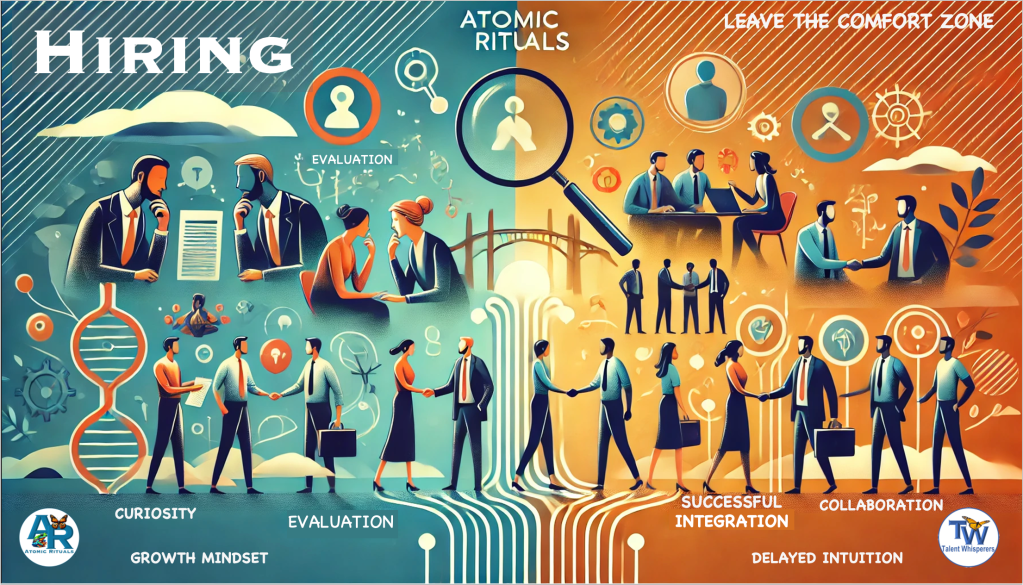
Hiring Rituals describe a comprehensive guide to a deliberate, human-centered approach to hiring—a process designed to uncover not just what candidates can do, but why they can do it and who they are as people. It captures rituals that guide every stage, from initial outreach to post-hire integration, ensuring consistency, depth, and alignment with the company’s mission.
Table of Contents
- The Philosophy of Hiring
- Core Hiring Rituals
- Evaluating Candidates Holistically
- Specialized Hiring Rituals
- The Post‑Interview Debrief Ritual
- Continuous Improvement
- Closing Thoughts
- Hiring Rituals at a Glance
- Glossary of Terms
- Frequently Asked Questions
- See Also
- Deep Dive on the Manager Close
1: The Philosophy of Hiring
“Hire them not for what they know, but for why they know it.“ – CD
The essence of great hiring lies in uncovering motivation, curiosity, and resilience. Knowledge and skills are proxies for a deeper truth: the candidate’s capacity to learn, grow, and thrive in the face of challenges.
In hiring 10x-Engineers/top-contributors, it’s key to recognize what sets them apart. The hiring ritual starts by training the interviewers. Training them involves having well defined questions but also, perhaps more importantly, on how to ask those questions. The objective of an interview in the interview should NOT be to make a hire/no-hire decision. It’s widely accepted that people will use their intuition to make hiring decisions in the first minute or two of an interview. The role of an interviewer should understand how they interact and answer the questions asked. It should not be solely focused on whether they answered them correctly. They should know that the question of hire/no-hire will be discussed in the debrief once every interviewers’ experience has been heard.
Delaying the decision allows for something known as “delayed intuition” or “informed intuition.” Delaying the decision has been shown in studies to result in a much higher correlation to whether it turns out to be a good hire later on. See Delayed Intuition as discussed by Adam Grant and Daniel Kahneman which Kahneman (author of Thinking Fast and Slow) discusses more deeply in his great book Noise.
Leave the Comfort Zone
Take the candidate outside their comfort zone with structured questions. This allows various avenues and depths for the interviewer to go. You learn a great deal more than if you probe them for what knowledge they have. Candidates taken down a path beyond their existing knowledge need to collaborate with the interviewer. They need to first understand the problem and then explore possible solutions.
Do they ask enough questions to understand the problem? If you offer a suggestion, do they jump on it without considering its merits? If you ask them if they’re certain about a solution or path they’ve taken is finding one, do the stubbornly insist and continue? Basically, are they open to the possibility that they might be wrong and willing to explore other approaches?
People with fixed mindsets quickly stall or give up when you take them down this path. People with a growth mindset will derive energy from a new challenge. They’re able to grasp specifics of problems they’ve never seen before with a willingness to be vulnerable in potentially failing as they explore possible solutions. The final question is if they are drained because they weren’t able to come up with solutions based purely on their prior knowledge? Or, are they energized by collaborating and exploring solutions. To get ahead, you need to solve problems others haven’t solved and/or to solve them in ways others haven’t solved them before. Hence, hire those eager to explore the unknown and learn and discover than to hire someone who knows existing answers to existing problems.
Who the Candidates are as People

Consider again that it’s not about what they know but rather why they know it. Similarly, it’s not what they are capable of doing, but why they are capable of doing it. What they know and are able to do are proxies for their motivation to gain knowledge and get things done. So, ultimately, it’s about who they are. As such, it’s important that the very first company contact from a sourcer followed by the recruiter that should convey company culture if you want to attract the right candidates. The whole experience through to the close should be a consistent experience. I like to close out an interview with the following question.
“If you look back on your life (ideally your life outside of work), can you find one moment, one experience, one event that you’re willing to share that changed who you are and how you see and approach the world?” One reason to leave this question to the end is that it helps to have build up the trust and connection that you genuinely care who they are as a person. I’ve gotten some of the most amazing responses to this question. People have said they’ve never share what they were telling me with anyone else. They often share a tail that makes it clear that they have found a strong purpose in their life and a drive towards achieving something and having an impact.
Why Hiring Rigor Matters:

- Consistency in Culture: Each hire shapes the collective behaviors and attitudes that define the organization.
- Alignment with Mission: Candidates must align not just with what the company does but with why it does it.
- Resilience in Ambiguity: Disruptive companies require individuals who can adapt, learn, and excel in uncharted territory.
- Growth Mindsets Building Disruptive Tech: You may be limiting your business if you hire people because they are great with existing problems and solutions. You may not be hiring the people to disrupt by doing things that have never been done before or solving existing problems in ways they have never been solved before. The truly successful business as those that are disruptive, and the need for disruption is great in a world that is changing at an accelerating rate. You want to hire people that will grow and change with it, not be left in the past doing things the way they’ve always been done.
2: Core Hiring Rituals
1. Consistent Messaging:
- Every interaction—from the sourcer’s first email to the onboarding experience—must reflect the company’s values and mission.
- This builds trust and ensures candidates understand what to expect and how they fit into the broader vision.
2. Designed Questions:
- Questions should assess growth mindset, problem-solving ability, and hunger to learn. This is achieving by designing questions that while focused on one topic, allow and encourage the interviewer to push the complexity of the question such that it exceeds a candidate’s current set of experiences and knowledge.
- The objective of these questions is not to assess a candidates knowledge or existing skills. It’s rather to assess how a candidate engineer would collaboratively solve a problem they haven’t seen before.
- Do they realize when they need to ask clarifying questions or for more details?
- If they start going down a rat-hole that doesn’t lead to success, will they hear the interview’s questions about whether this is the right path when their pride reminds them of their belief they are being assess for their knowledge?
- If alternatives are suggested, …
- Do they immediately take up the interviewer’s suggestion?
This is bad as it suggests a short-coming of independent thought and willingness to add value with their own thoughts and perspectives. - Do they stubbornly stick to their own solution?
This is also bad and suggests they lack a growth mindset and/or a collaborative mindset. - Or, do they become curious to discuss the pros and cons of each solution?
This is what we are looking for.
- Do they immediately take up the interviewer’s suggestion?
3. Qualify Your Interviewers:
- Train: Train interviewers to on specifically designed questions that solve for the above.
- Shadow: Implement a two-way shadowing process where interviewers are both observed and observe others.
- Certify: Certify interviewers for specific questions to ensure they understand what to probe for and how with a specific question.
- Manage: Create a matrix of interview questions for a certain role and people that are certified for each of those questions.
4. Delayed and Informed Intuition:
- Quick decisions: Interviewers often make hire/no hire decisions in the first minute or first five minutes of an interview. They are relying on their instincts, which can be good. However, those instincts are more like snap judgements.
- Adjustments: Avoid making immediate hire/no-hire decisions during interviews. This can be done by ensuring qualified interviewers understand the outcome of the interview that is desired from them is not a hire/no-hire decision, but rather and insightful report on how the candidate di on their assigned question.
- The Debrief: Use the “debrief huddle” to synthesize insights and allow for informed intuition—a process where instincts are shaped by structured evaluation and team discussion. After every interviewer has reported out, everyone present now has a fulled context to base a decision on. I may trigger their intuition by going around the room and asking each one, if we hired this candidate and they started tomorrow and you were assigned as their dedicated mentor to work closely with them for the next three months – are you excited, or does that make you cringe? This line of questioning evokes what is know as delayed or informed intuition.
- Why delayed intuition helps: I’ve had the experience of every interviewer thinking a candidate had excellent answers to every question, and yet when we went around the room, no one wanted to be their buddy or mentor. Double-clicks on whys in those situations have consistently revealed red-flags that had been overlooked at first.
Likewise, I’ve had candidates where every interviewer felt the candidate really struggled on every question. However, when I went around the room, everyone wanted to be their buddy and mentor. When asked why, they often saw an excitement, a humility, a curiosity and a tremendous hunger to learn and grow. With these candidates, I’ve had a few cases where I called them, told them they bombed every single question. I followed this by telling them however, that if they were willing to risk giving it a try, the team would be excited to help them succeed. The candidates like this that I’ve hired have been some of my best, most dedicated and fastest learning hires.
3: Evaluating Candidates Holistically
Scoring Traits: Inspired by Daniel Kahneman’s research, break the interview process into key traits such as:
- Work Ethic: Assess through examples of persistence and commitment.
- Analytical Ability: Probe their capacity to break down complex problems.
- Integrity: Use situational questions to evaluate honesty and decision-making.
- Collaboration: Discover how well the candidate collaborated with the interviewer to truly understand the problem and then to arrive at the optimal solution.
- Curiosity: Determine if the candidate is willing to explore new and different approaches to problems they struggle to solve at first.
- Humility: Is the candidate willing to be humble and admit mistakes when embarking into unfamiliar territory?
- Growth Mindset: Does the candidate demonstrate a mindset that they can and will arrive at a solution if they keep trying, or do they assume if they can’t, at first, solve the problem, that it lies beyond their abilities?
Score each trait independently before bringing the team together for collective discussion.
Leave the Comfort Zone: Take candidates beyond their knowledge base to assess:
- How they approach unfamiliar challenges.
- Their willingness to ask clarifying questions.
- Their openness to exploring alternative solutions.
For example, if a candidate suggests a solution, follow up with: “Are you certain this approach is optimal? Why or why not?” This tests their ability to reflect and adapt.
One very telling thing can be achieved by at the end of the day, an HR person walks the candidate out and they ask – How do you think it went? Remember this candidate was just pushed beyond the limits of their experience and knowledge in every single interview. Hence, in none of the interviews did they solidly know the answer. Are they disappointed and dejected because they believe they failed? Or, are they energized and excited because they may be given opportunity to collaboratively learn how to solve problems they haven’t solved before? This distinction helps distinguish someone with a growth mindset from someone with a fixed mindset.
Who They Are as People: End interviews with deeply personal questions to understand candidates’ motivations and values. For instance:
- “Can you share a moment from your life—outside of work—that fundamentally changed how you see the world?” This question often reveals purpose and character, fostering a deeper connection.
4: Specialized Hiring Rituals
The Manager Close Ritual: This is a crucial moment for securing top talent. The hiring manager must:
- Build trust and personal rapport.
- Emphasize how the role aligns with the candidate’s values and goals.
- Highlight the company’s commitment to growth, purpose, and support.
Example close: “Joining Nova isn’t just about the work you’ll do; it’s about the journey we’ll take together to grow, solve meaningful challenges, and create something extraordinary.”
Hiring Leaders: For leadership roles, consider “speed-dating interviews” consisting of:
- Fifteen concise questions designed to assess leadership philosophy, problem-solving, and vision.
- A debrief focused on both structured scoring and holistic impressions.
- See: www.TalentWhisperers.com/15-Speed-Dating-Interview-Questions
P.S. ask/DM me for the password if it’s password protected (as it may be when I’m actively hiring for this role).
Hiring Product Managers: Assess the ability to bridge technical and customer needs. Rituals include:
- Scenario exercises to test strategic thinking.
- Collaborative problem-solving sessions to gauge alignment with engineering teams.
10x Engineer Rituals: When hiring exceptional engineers, focus on:
- Grit and Curiosity: Look for candidates energized by solving novel problems.
- Collaborative Problem-Solving: Test their ability to work with interviewers to tackle unfamiliar challenges.
- Resilience: Evaluate how they handle failure and iterate on solutions.
5: The Post-Interview Debrief Ritual
The Debrief Huddle: After all interviews are complete, gather the team to:
- Share independent observations and scores for each trait.
- Discuss discrepancies and align on key insights.
- Use a “champion and veto” system, where any interviewer can veto a candidate, but a strong champion is required to move forward.
This ritual ensures that every decision is deliberate, collaborative, and aligned with the company’s values.
6: Continuous Improvement
Hiring rituals are not static. As leasers, HR and teams learn, every hiring cycle is an opportunity to refine and improve. This is aided by
- Feedback Loops: Post-hire reviews to assess the accuracy of the process and identify areas for improvement.
- Ritual Evolution: Regular updates to interview questions and scoring rubrics to adapt to changing needs and lessons learned.
Closing Thoughts
Hiring is not just about filling roles; it’s about building a team that embodies the organization’s mission and values. The rituals described here are designed to ensure that every hire strengthens not just the team but a culture and resilience. By focusing on growth, curiosity, and alignment, leaders can create a process that delivered exceptional results.
Hiring Rituals at a Glance
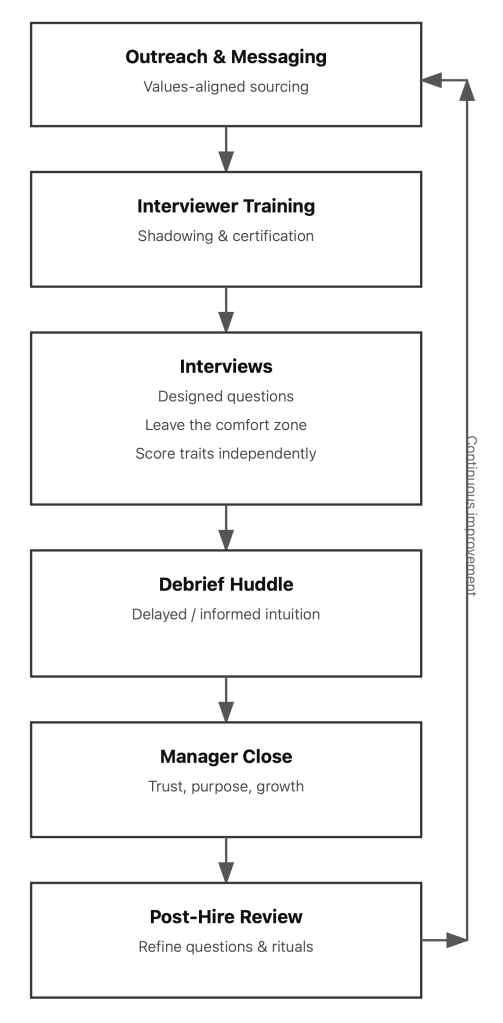
The Philosophy
- Hire for why they know things, not what they know.
- Look for curiosity, humility, and the ability to learn fast.
- Push candidates beyond their comfort zone to see how they think.
- Delay decisions until the debrief to reduce noise and bias.
Core Rituals
1. Consistent Messaging
- Every touchpoint reflects the company’s values.
- From sourcing to onboarding, the experience must feel aligned.
2. Designed Questions
- Use structured questions that exceed the candidate’s experience.
- Look for clarifying questions, collaboration, and cognitive flexibility.
- Avoid assessing only existing knowledge.
3. Interviewer Qualification
- Train interviewers on how to ask and probe.
- Use two‑way shadowing to build consistency.
- Certify interviewers for specific questions.
4. Delayed and Informed Intuition
- No hire/no‑hire decisions during interviews.
- Use the debrief to form intuition from shared insights.
- Look for excitement or hesitation when imagining mentoring the candidate.
Evaluating Candidates
Key Traits
- Work ethic
- Analytical ability
- Integrity
- Collaboration
- Curiosity
- Humility
- Growth mindset
Each trait is scored independently before the team meets.
Leave the Comfort Zone
- Push candidates past what they know.
- Watch how they respond to uncertainty.
- Look for energy, not discouragement.
Who They Are
- End with a personal question about a life‑changing moment.
- Listen for purpose, values, and motivation.
Specialized Rituals
Manager Close Ritual
- Build trust.
- Connect the role to the candidate’s goals.
- Reinforce growth, purpose, and support.
Hiring Leaders
- Use speed‑dating interviews with fifteen short questions.
- Debrief with both structure and holistic impressions.
Hiring Product Managers
- Use scenario exercises.
- Test strategic thinking and cross‑functional alignment.
Hiring 10x Engineers
- Look for grit, curiosity, and resilience.
- Focus on how they learn, not what they know.
The Debrief Ritual
- Share independent scores.
- Discuss differences.
- Use the champion and veto system.
- Make a deliberate, values‑aligned decision.
Continuous Improvement
- Review hires after they join.
- Update questions and rubrics.
- Evolve rituals as the company grows.
Glossary of Terms
Analytical Ability
The capacity to break down complex problems into clear parts. In this hiring system, it reflects how a candidate thinks when facing challenges they have never seen before.
Champion and Veto System
A debrief ritual where any interviewer can veto a candidate, but a strong champion is needed to move forward. It ensures decisions are deliberate and aligned with values.
Clarifying Questions
Questions a candidate asks to better understand a problem. They reveal curiosity, humility, and the ability to slow down before jumping to solutions.
Collaborative Problem‑Solving
Working with the interviewer to explore a problem together. It shows how a candidate behaves when they cannot rely on prior knowledge.
Cognitive Flexibility
The ability to shift thinking when new information appears. It shows up when candidates explore alternatives instead of clinging to a single idea.
Designed Questions
Structured questions created to push candidates beyond their current experience. They test how someone learns, adapts, and collaborates under uncertainty.
Delayed Intuition
A hiring practice where interviewers avoid snap judgments. Instead, they wait until the debrief to let intuition form from shared insights and structured evaluation.
Fixed Mindset
A belief that abilities are static. Candidates with this mindset often shut down when pushed beyond what they already know.
Growth Mindset
A belief that abilities can grow through effort. Candidates with this mindset gain energy from new challenges and unfamiliar problems.
Holistic Evaluation
A scoring approach that breaks the interview into traits like curiosity, humility, and work ethic. Each trait is scored separately before the team meets.
Human‑Centered Hiring
A hiring philosophy that focuses on who candidates are, not just what they know. It values motivation, purpose, and the deeper reasons behind their abilities.
Informed Intuition
Intuition shaped by structured discussion in the debrief. It is more accurate than the snap judgments made in the first minutes of an interview.
Interviewer Certification
A process where interviewers are trained and approved to ask specific questions. It ensures consistency and depth across the hiring loop.
Leave the Comfort Zone
A ritual where candidates are guided into unfamiliar territory. It reveals how they think, collaborate, and respond when they cannot rely on past experience.
Manager Close Ritual
A final conversation where the hiring manager builds trust, aligns values, and helps the candidate see the purpose and growth in the role.
Purpose Signal
A moment in the interview when a candidate shares a life experience that shaped who they are. It reveals motivation, values, and personal drive.
Rat‑Hole
A path a candidate takes that leads away from a useful solution. How they respond when this is pointed out shows humility and adaptability.
Resilience in Ambiguity
The ability to stay engaged and curious when the path is unclear. It is a key trait for roles that require solving problems no one has solved before.
Scenario Exercises
Short, practical challenges used for roles like Product Management. They test strategic thinking and the ability to bridge customer and technical needs.
Shadowing (Two‑Way Shadowing)
A training ritual where interviewers observe each other. It helps them learn how to ask questions, probe effectively, and stay aligned with the hiring philosophy.
Speed‑Dating Interviews
A leadership hiring ritual with fifteen short questions. It reveals a leader’s philosophy, clarity, and ability to think under time pressure.
Structured Debrief
A team discussion after all interviews are complete. Each interviewer shares their scores and insights before the group makes a final decision.
Work Ethic
A trait assessed through examples of persistence and commitment. It shows how a candidate behaves when work becomes difficult or unclear.
Frequently Asked Questions
Why do we push candidates beyond their comfort zone?
Because real work often requires solving problems no one has solved before. When candidates face unfamiliar challenges, you see how they think, collaborate, and adapt. This reveals more about their potential than questions based only on past experience.
Why don’t interviewers make hire or no‑hire decisions during the interview?
Snap judgments are unreliable. Interviewers often form opinions in the first few minutes. Delaying the decision allows for informed intuition, which is shaped by structured evaluation and team discussion.
What if a candidate struggles with every question?
Struggle is expected. What matters is how they respond. Candidates who stay curious, humble, and energized often become exceptional hires. Some of the best performers start by “failing” every question but showing strong learning potential.
What if a candidate answers every question well?
Strong answers do not always mean strong fit. A candidate may perform well but lack curiosity, humility, or collaborative instincts. The debrief helps uncover these gaps.
Why do we use designed questions instead of standard technical questions?
Designed questions reveal how candidates learn, not just what they know. They allow interviewers to increase complexity until the candidate reaches the edge of their knowledge. This is where true behavior shows up.
Why is curiosity such an important trait?
Curiosity drives learning. It shows up when candidates ask clarifying questions, explore alternatives, and stay engaged even when they are unsure. Curious people grow faster and adapt better.
What is the purpose of the debrief huddle?
The debrief brings all insights together. Each interviewer shares their observations and scores before the group forms a decision. This reduces noise, balances perspectives, and leads to better outcomes.
Why do we use a champion and veto system?
It ensures that every voice matters. A veto protects the team from risks one person sees clearly. A champion ensures that strong potential is not overlooked.
Why do we ask personal questions at the end of the interview?
These questions reveal purpose, values, and the deeper motivations behind a candidate’s work. They help you understand who the person is, not just what they can do.
How do we evaluate candidates fairly across different interviewers?
By scoring traits independently before the debrief. Each interviewer focuses on specific behaviors like curiosity, humility, and collaboration. This creates a consistent and structured evaluation.
Why is humility important in technical roles?
Humility allows candidates to admit when they are wrong, ask for help, and explore new ideas. Without humility, collaboration breaks down and learning slows.
What does it mean when a candidate is “energized” after a difficult interview?
It signals a growth mindset. These candidates enjoy learning and see challenges as opportunities. They often thrive in fast‑changing environments.
Why do we train and certify interviewers?
Consistency matters. Certified interviewers know how to ask questions, how to probe, and what signals to look for. This reduces bias and improves the quality of hiring decisions.
Why is the manager close ritual important?
Top candidates often have multiple options. The manager close builds trust, aligns values, and helps candidates see the purpose and growth in the role. It is a key moment in securing great talent.
How do we hire for roles that require disruption or innovation?
We look for people who enjoy solving new problems, not just known ones. Curiosity, resilience, and cognitive flexibility matter more than existing expertise.
Why do we review the hiring process after someone joins?
Continuous improvement keeps the rituals strong. Post‑hire reviews help you see what worked, what didn’t, and how to refine the process for the next cycle.
See Also
Interview Questions
Interview questions carefully thought out can make the difference between success and failure.What would the experts ask?
New Hires – Once you’ve hired someone, don’t stop there. Make the right investment to spin them up properly.
Onboarding Rituals: Setting the Foundation for Success
Andreessen Horowitz’s Matt Oberhardt on Backchannels, Mock Interviews, and Exec Recruiting in 2024
The 10x Engineer Root Cause – An exploration of growth mindset, resilience, motivation, and the deeper human drivers of excellence.
Radical Candor
A double-Click on Kim Scott’s notion of Radical Candor as a valueable feedback mechanism.
Assume Positive Intent – A foundational mindset and ritual for building trust, reducing conflict, and elevating performance conversations.
Everything Is a Gift – A perspective on reframing challenges, setbacks, and feedback as opportunities for strengthening.
Weathering Storms – A reflection on resilience, leadership steadiness, and navigating uncertainty without losing the team.
New Managers – Guidance on developing leaders who can practice rituals of strengthening and support with their teams.
On-Boarding Rituals
Onboarding rituals are critical to ensuring new hires integrate seamlessly into an organization’s culture, processes, and mission. These rituals go beyond administrative tasks to create an environment where new team members feel welcomed, valued, and equipped to contribute meaningfully from day one. Thoughtful onboarding not only accelerates productivity but also strengthens long-term engagement and retention.
Departure Rituals
Departure rituals are an essential yet often overlooked component of organizational culture and operational effectiveness. How and when to let people go has a profound impact on team morale, company culture, and the organization’s long-term reputation. Approached thoughtfully, departure rituals can balance empathy and pragmatism, maintaining dignity for the departing individual while minimizing disruption for the remaining team.
Manager Close
The “Manager Close” is a vital part of any interview process. I did two extensive sessions on how to do manager closes for all managers in both business units at Pure Storage at the request of my boss who had listened in on how I do them. This was over ten years ago, and I hear that the recordings are still being viewed by new managers that are promoted or join.
You can find the recordings and transcripts here.
 Atomic Rituals