

Non-Verbal Confidence for Founders: Tools to Win Investor Trust
Tools to Win Investor Trust
Founders with deep expertise in finance, biology, data science, or AI often lead with insight, not instinctive charisma. But when pitching to investors, how you say something can matter just as much as what you say. If you want to convey non-verbal confidence as a founder, it’s crucial to master subtle signals like posture, gestures, and tone.
Research from behavioral scientist Vanessa Van Edwards shows that non-verbal communication — posture, gestures, facial expressions — deeply influences how people perceive confidence, trustworthiness, and optimism.
This guide translates her findings into practical, science-backed tips that help founders project authentic presence — even if confidence doesn’t come naturally. Each section includes a description, a cue to remember, and a video link to reinforce the technique. These insights support your ability to show non-verbal confidence for founders in action.
Related Aspects

Note: From personal experience, these may be helpful tips on conveying confidence, engagement, passion, interest, but nothing beats genuine conviction, passion, interest and engagement that will subconsciously convey all these things often using many and other non-verbal supporting cues. However, for the more stoic founder or perhaps one brilliant in solving problems but perhaps holding some Asperger-like traits, it can help explore ways to come across more convincingly.
These get more into a favorite area of mine which is subconscious, non-verbal communication. The page gets into ways of consciously connecting to the sub-conscious audience. Genuinely conveying confidence, engagement, passion, interest simply by being confident, engaged, passionate and deeply interested can lead to sub-consciously conveying that as well. This aspect became very near and dear to my heart as I discovered my connection to horses. I was later told I was a horse-whisperer and started reading about consciously understanding how to convey messages and signals to an audience (in this case of horses) that would engender agreement rather than adversity.
1. Power Posture Before You Enter
Cue: “Expand before you engage.”
Standing tall with open posture increases feelings of confidence and is perceived as leadership. Before a pitch, take two minutes in private to stand like a leader — arms wide or hands on hips, shoulders back.
Video: Use this body language trick to get what you want
2. Lead With the Chin, Not the Shoulders
Cue: “Chin up, shoulders down.”
Tension often shows as raised shoulders or a sunken neck. Drop your shoulders, lengthen your spine, and lead with your chin for instant calm authority.
Video: The Connection Between Body Language and Confidence
3. The Shoulder Gap Rule
Cue: “Increase the space between ears and shoulders.”
Vanessa Van Edwards emphasizes that shrinking the distance between your ears and shoulders — often a sign of stress — makes you look anxious or unsure. Confident people hold their shoulders low and relaxed. Throughout your pitch, check in with your body. If your shoulders start to creep upward, breathe deeply, roll them back, and let them drop.
Video: The Connection Between Body Language and Confidence
4. The Confident Hands Rule
Cue: “Show your hands, show your trust.”
Keeping your hands visible and using open gestures builds trust. Avoid hiding them in pockets, under the table, or crossing arms — it signals nervousness or defensiveness.
Video: The Power of Open Palms
5. Eye Contact: The Triangle of Trust
Cue: “Eyes-mouth-eyes — never stare.”
Use the triangle method: alternate your gaze between each eye and the mouth. This feels warm and engaged, not robotic or intense. Aim for 60–70% eye contact.
Video: Eye Contact Explained

6. Smile With Purpose
Cue: “Smile when it matters.”
A well-timed smile (at greetings, big wins, or mission moments) boosts warmth. But over-smiling or smiling under stress can look inauthentic. Let your smile anchor optimism.
Video: 7 Charming Habits of Socially Confident People
7. Anchor in Optimism
Cue: “Start with a win.”
Open your pitch with something you’re genuinely excited about — a mission, breakthrough, or story. This emotion naturally uplifts your tone, facial expression, and presence. This is one of the best cues for non-verbal confidence for founders.
Video: You are contagious | Vanessa Van Edwards | TEDxLondon
8. Pause for Power
Cue: “Silence speaks volumes.”
Confident people don’t rush. Pause before key points and after tough questions. Let silence land. It signals composure, not hesitation.
Video: The Psychological Tricks To Be Confident In Any Situation
9. Frame Half-Full
Cue: “Risk-aware, not risk-averse.”
Technically-minded founders often default to risk narratives. Reframe challenges as opportunities, and pair every threat with a plan or upside.
Video: How To Be More Confident
10. Mirror and Lead the Room
Cue: “Match, then lift.”
You don’t need to fake extroversion. Just mirror the room’s tone subtly — then raise your energy by 10%. It draws people upward without feeling forced.
Video: Mastering the Art of Communication with Cues
11. Practice With Video — Then With a Human
Cue: “Feedback > feelings.”
Many founders feel confident but don’t look it. Record a 2-minute pitch. Watch it with the sound off. Get feedback from someone who knows you.
Video: Build Confidence and Be More Social with Vanessa Van Edwards
Final Tip: Use the “CHIP POWER” Mnemonic
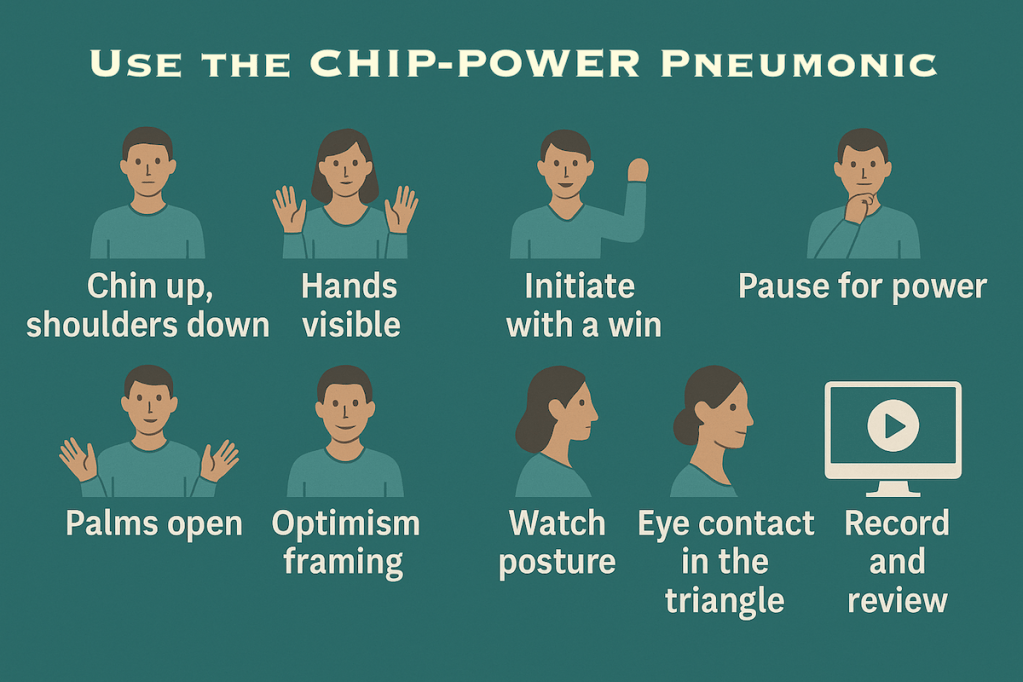
- Chin up, shoulders down
- Hands visible
- Initiate with a win
- Pause for power
- Palms open
- Optimism framing
- Watch posture
- Eye contact in the triangle
- Record and review
The 97 Cues
Vanessa Van Edwards’ book Cues: Master the Secret Language of Charismatic Communication outlines 96 specific cues designed to enhance charisma by signaling warmth and competence. These cues are categorized into four primary channels:
1. Nonverbal Cues
These involve body language, posture, gestures, and facial expressions.
Examples include:
- Open posture
- Purposeful hand gestures
- Eye contact
- Facial expressions
- Mirroring
2. Vocal Cues
These pertain to the tone, pitch, pace, and volume of speech.
Examples include:
- Vocal tone
- Pace of speech
- Volume control
- Pitch variation
- Pausing
3. Verbal Cues
These involve word choice, syntax, and storytelling techniques.
Examples include:
- Word choice
- Storytelling
- Metaphors
- Power words
- Positive framing
4. Imagery Cues
These encompass visual elements like clothing, colors, and background settings.
Examples include:
- Clothing style
- Color choices
- Accessories
- Background settings
- Personal branding elements
For a comprehensive understanding of all 96 cues and how to apply them effectively, it’s recommended to refer directly to Vanessa Van Edwards’ book. Additional insights and summaries can be found on her official website, Science of People.
See Also
- Captivate by Vanessa Van Edwards
- The Science of People YouTube Channel
- Amy Cuddy on Power Poses
- Cues Master the Secret Language of Charismatic Communication – By Vanessa Van Edwards, Narrated by Vanessa Van Edwards
- Captivate The Science of Succeeding with People – – By Vanessa Van Edwards, Narrated by Vanessa Van Edwards
Appendix: Verbal Presence Tips from Never Split the Difference
These techniques from Chris Voss, a former FBI negotiator and author of Never Split the Difference, align perfectly with non-verbal confidence strategies. They enhance your tone, presence, and control during high-stakes conversations like VC pitches.
🎙️ 1. Use a Late-Night FM Radio Voice
Cue: “Calm is contagious.”
Speak slowly, deeply, and with warmth — just like a late-night radio host. This tone conveys competence, steadiness, and reassurance, especially when discussing complex risks or setbacks.
Video: Late Night FM DJ Voice w/ Chris Voss @RunGPG Podcast
🪞 2. Mirror Strategically
Cue: “Repeat the last 1–3 words.”
Mirroring builds rapport and encourages your listener to expand. Just repeat the last few words they said with an upward tone. It shows you’re engaged without being pushy.
Video: Chris Voss Teaches The Stealth Power of “Mirrors” in Negotiation
🧠 3. Label Emotions
Cue: “It seems like…” or “It sounds like…”
Use tactical empathy to name what the other party may be feeling. This disarms defensiveness and builds trust — even when stakes are high.
Video: What is Tactical Empathy? How It Can Help in Negotiations at Work
❓ 4. Ask Calibrated Questions
Cue: “How can we…?” instead of “Can you…?”
Open-ended, calibrated questions shift the burden of solutioning to the listener — without sounding confrontational. Try “How would you feel if…?” or “What’s the biggest risk you see?”
Video: The Creation Of Calibrated Question | Chris Voss
🛡️ 5. Master the Accusation Audit
Cue: “You’re probably thinking I’m too optimistic, but…”
Addressing objections before they arise builds credibility. Pre-label your potential negatives, and the audience feels safe — not skeptical.
Video: How to use Chris Voss’s accusation audit
These strategies pair powerfully with the non-verbal tools above, helping you express clarity, confidence, and leadership in every word and movement.
Appendix 2 – Further Learning: Courses & Resources on Non-Verbal Confidence
To build on what you’ve learned in Non-Verbal Confidence for Founders, the following courses offer immersive, science-backed training in body language, charisma, and subconscious influence. These programs are especially suited for founders, technical leaders, and high-stakes communicators.
1. The Secrets of Body Language
Instructor: Vanessa Van Edwards
Platform: CreativeLive
Overview: Learn powerful techniques to project confidence, trust, and charisma through non-verbal cues. Covers posture, gestures, and facial expressions with hands-on video instruction.
2. The Power of Presence and Charisma
Instructor: Vanessa Van Edwards
Platform: Mindvalley
Overview: A comprehensive program designed to help you cultivate authentic presence and magnetic charisma for both professional and personal interactions.
3. Presence and Power Posing
Instructor: Amy Cuddy
Platform: TED Talk + Book (Presence)
Overview: Not a course per se, but Amy Cuddy’s TED Talk and her book form a practical toolkit for building physical and psychological presence. Great for pitch preparation.
4. The Power of Body Language
Institution: University of California, Irvine
Platform: Coursera
Overview: A scientific introduction to how body language affects communication, negotiation, and leadership. Includes peer-reviewed exercises and assessments.
5. The Science of Confidence
Instructor: Mel Robbins
Platform: MasterClass
Overview: A mindset-driven approach to building confidence and presence, using voice, movement, and psychology. Particularly useful for founders facing performance pressure.
6. People School
Instructor: Vanessa Van Edwards
Platform: Science of People
Overview: A flagship course covering all the “Cues” channels — non-verbal, vocal, verbal, and visual. Ideal for leaders who want to sys
📺 BONUS VIDEO RESOURCES
7. Science of People – YouTube Channel
Instructor: Vanessa Van Edwards
Platform: YouTube
Overview: Short-form tutorials on charisma, confidence, and communication cues. Great for quick refreshers or focused practice.
8. Charisma Matrix – YouTube Channel
Host: Charlie Houpert
Platform: YouTube
Overview: Tactical training on vocal tone, posture, and persuasion — especially geared toward introverted or analytical communicators.
 Atomic Rituals