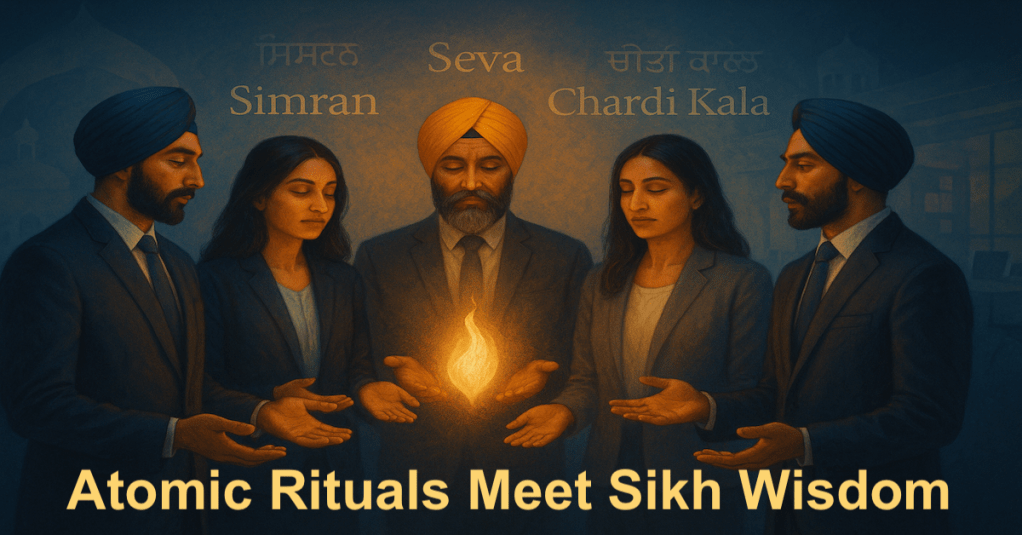
In Sikh tradition, transformation is not a sudden overhaul but a disciplined, conscious evolution. Sikhism teaches that divinity lies in the everyday—in actions repeated with mindfulness, in service done without ego, and in resilience shown during challenge. These same values echo powerfully in the framework of Atomic Rituals.
I want to acknowledge that I am not Sikh. I’m writing as someone who has been learning from Sikh colleagues and from witnessing how Sikh principles show up in daily life, leadership, and community. This page is not an attempt to define Sikh teachings, but to explore how the Sikh emphasis on disciplined, values‑aligned practice has helped me understand Atomic Rituals in a deeper and more grounded way. If anything here feels misframed or incomplete, I welcome correction.
Atomic Rituals are small, deliberate acts that, over time, shape collective identity and enable sustained transformation in teams, organizations, and communities. This, much like Atomic Habits teaches us a simple set of rules as individuals for creating good habits and breaking bad ones. When seen through a Sikh lens, these rituals become more than productivity tools; they become paths of alignment with the Divine.
This page explores the foundational ideas of Atomic Rituals in dialogue with Sikh principles—revealing a shared rhythm of spiritual growth, selfless service, and resilient leadership.
In this context, the word atomic does not point to efficiency, optimization, or productivity techniques. It points to what is foundational and irreducible — actions so small and repeatable that they quietly shape orientation, conduct, and identity over time.
Sikh tradition has long emphasized that transformation does not arrive through dramatic overhaul alone, but through daily alignment with Hukam, honest action, and service practiced without ego. These practices are “atomic” not because they are minimal, but because they are formative — when lived consistently, they shape everything else.
Aligning Atomic Rituals with Sikh Core Concepts
1. Seva (Selfless Service) → Atomic Acts of Contribution
- In Sikhism, Seva is a sacred duty. It’s not about credit but about contribution. Likewise, Atomic Rituals focus on small, consistent actions that improve the collective without ego.
- In organizations, this might look like daily standups that prioritize team support over self-promotion or rituals that celebrate behind-the-scenes contributors.
2. Simran (Remembrance, Mindfulness) → Rituals of Reflection
- Simran grounds Sikhs in the Naam (the Divine Name), cultivating presence.
- Reflection rituals—like retrospectives or gratitude check-ins—mirror this. They help teams stay grounded, aligned with purpose, and aware of each other’s journeys.
3. Chardi Kala (Resilient Optimism) → Rituals for Enduring Through Storms
- Chardi Kala teaches us to remain in high spirits even in adversity. It’s not naive positivity, but divine resolve.
- The Weathering Storms Ritual exemplifies this. It helps organizations develop the mindset and muscle to withstand existential challenges while remaining purpose-driven.
4. Naam Japna (Repetition as Identity Formation) → Identity-Building Through Repetition
- In Sikhism, repeating the Naam is both devotion and transformation.
- Likewise, repeating key team rituals shapes group identity: “We’re the kind of team that…” becomes a mantra of culture.
5. Sangat and Pangat (Community and Equality) → Rituals of Belonging and Equity
- Sikhism emphasizes community (Sangat) and equality (Pangat). Everyone eats together. Everyone belongs.
- Atomic Rituals promote inclusion by designing rituals that honor every voice, ensure psychological safety, and align actions with shared values.
Leadership and Ritual in Sikh Thought
Guru Nanak rejected hierarchy and emphasized moral action over status. Similarly, effective Atomic Rituals are not top-down mandates. They emerge from the ground up, co-created and adapted by those closest to the work.
The Sikh notion of leadership is deeply intertwined with responsibility, humility, and courage. The leader is not a commander but a sevadar—a servant.
Leaders practicing Atomic Rituals through this lens:
- Invite teams to question and refine rituals using the 5 Whys (akin to Gurbani’s encouragement to inquire and seek understanding).
- Model vulnerability and consistency, much like Ardaas (the daily prayer) grounds Sikhs in humility.
- Celebrate progress collectively, not individually.
Sikh life recognizes that not all formative practices operate at the same scale. Some are lived daily and quietly, shaping the inner posture of the individual through repetition. Others occur less frequently, but mark irreversible shifts in identity, responsibility, or collective belonging.
Understanding this distinction helps clarify how daily practices like Nitnem, communal practices like Langar, and initiatory commitments such as Amrit Sanskar each function differently — while still participating in the same deeper rhythm of alignment and discipline.
Meta, Molecular, and Atomic Levels Through a Sikh Lens
- Meta Rituals echo Rehat Maryada (Sikh code of conduct): the big frame that shapes how smaller actions fit into the larger mission.
- Molecular Rituals align with community practices like Langar (communal kitchen), which break down into atomic tasks done with love.
- Atomic Rituals mirror daily Nitnem (recited prayers): seemingly small acts, repeated daily, that mold identity over time.
In Sikh tradition, Nitnem is not practiced as a technique to produce specific outcomes. It is an act of return — returning the mind from dispersion, the ego from inflation, and the day from reactivity back to remembrance.
Over time, this steady orientation shapes resilience and discernment not by force, but by repetition. What changes first is posture; what follows is conduct.
Rituals as Vehicles of Spiritual and Organizational Resilience
Sikh spirituality is not oriented toward withdrawal from the world, but toward full participation within it. The householder’s life (Gristi Jiwan) is the primary arena where remembrance, work, service, and responsibility converge.
In this sense, the household — and by extension the everyday contexts of earning, leading, caregiving, and decision-making — becomes the true “atomic unit” of Sikh life. It is where values are tested under real conditions, and where discipline either holds or collapses.
Both Sikhism and Atomic Rituals treat hardship as a forge, not a flaw.
Sikh history is filled with martyrs, reformers, and everyday heroes who met challenges with unwavering resolve. The same energy animates teams that use rituals to stay connected during layoffs, pivots, or failures.
Rituals become:
- Anchors in uncertainty.
- Acts of hope and solidarity.
- Reminders of purpose when outcomes are unclear.
Final Reflections: A Sikh Invitation to Ritual
Throughout Sikh tradition, ritual is never an end in itself. It is valued only insofar as it reshapes conduct, softens ego, and deepens service. When repetition becomes empty or performative, it is understood to have missed its purpose.
What ultimately endures is not the form of the ritual, but the life it produces.
To a Sikh reader, Atomic Rituals may already feel familiar. Their essence lives in daily Ardaas, in serving langar, in remembering Waheguru between tasks. They are not new; they are newly named.
This convergence offers an invitation: use your faith as a lens to lead transformation. Bring Chardi Kala into your retrospectives. Bring Seva into your hiring. Bring Simran into your meetings.
Your Sikh path isn’t separate from your organizational life. It can be its deepest foundation.
See Also
- Atomic Rituals (Main Site)
Overview of the Atomic Rituals framework, with principles, case studies, and foundational theory on how small collective practices transform organizations over time. - Weathering Storms Rituals
A deep dive into how teams can remain resilient during crises using ritualized reflection, transparency, and cohesion — a parallel to the Sikh concept of Chardi Kala. - Langar – The Practice of Equality Through Service
Describes Langar as a sacred Sikh tradition rooted in Seva, inclusion, and community — a model for designing equitable team rituals. - Nitnem – Daily Devotion Through Routine
Details the daily prayer routine in Sikhism that shows how repeated, intentional practices shape identity — much like Atomic Rituals. - Leadership in Sikhism
An overview of leadership principles from Sikh teachings, emphasizing service, humility, and community engagement over hierarchy.
Talent Whisperers, Human Transformation and Atomic Rituals related material
AtomicRituals.com and related sister sites.

- Sikh Leadership Resources (Talent Whisperers).
What does it mean to lead like a Sikh? Across the globe, Sikh professionals, executives, and entrepreneurs are drawing on timeless spiritual principles — service (seva), justice (nyaya), humility (nimrata), and resilience (chardi kala) — to shape a distinct and values-driven approach to leadership. This collaborative resource page curates some of the most insightful tools, articles, and programs available for Sikh leaders — from academic research to professional mentorship to purpose-driven retreats. - A Next Level Strength: A Sikh Perspective (Talent Whisperers).
An in-depth look at Chardi Kala as a force for transcendent optimism, leadership endurance, and emotional resilience. - The Turban and the Title (Talent Whisperers).
Leadership as sacred responsibility in visible roles. The Turban and Title analogy is explored here. In Sikh tradition, wearing a turban is not merely a religious symbol. It is a public declaration of identity, honor, and accountability. To tie one’s turban each day is to visibly affirm one’s values. It signals to the world: this is who I am, this is what I stand for. - Sikh Wisdom for Weathering Storms (Talent Whisperers).
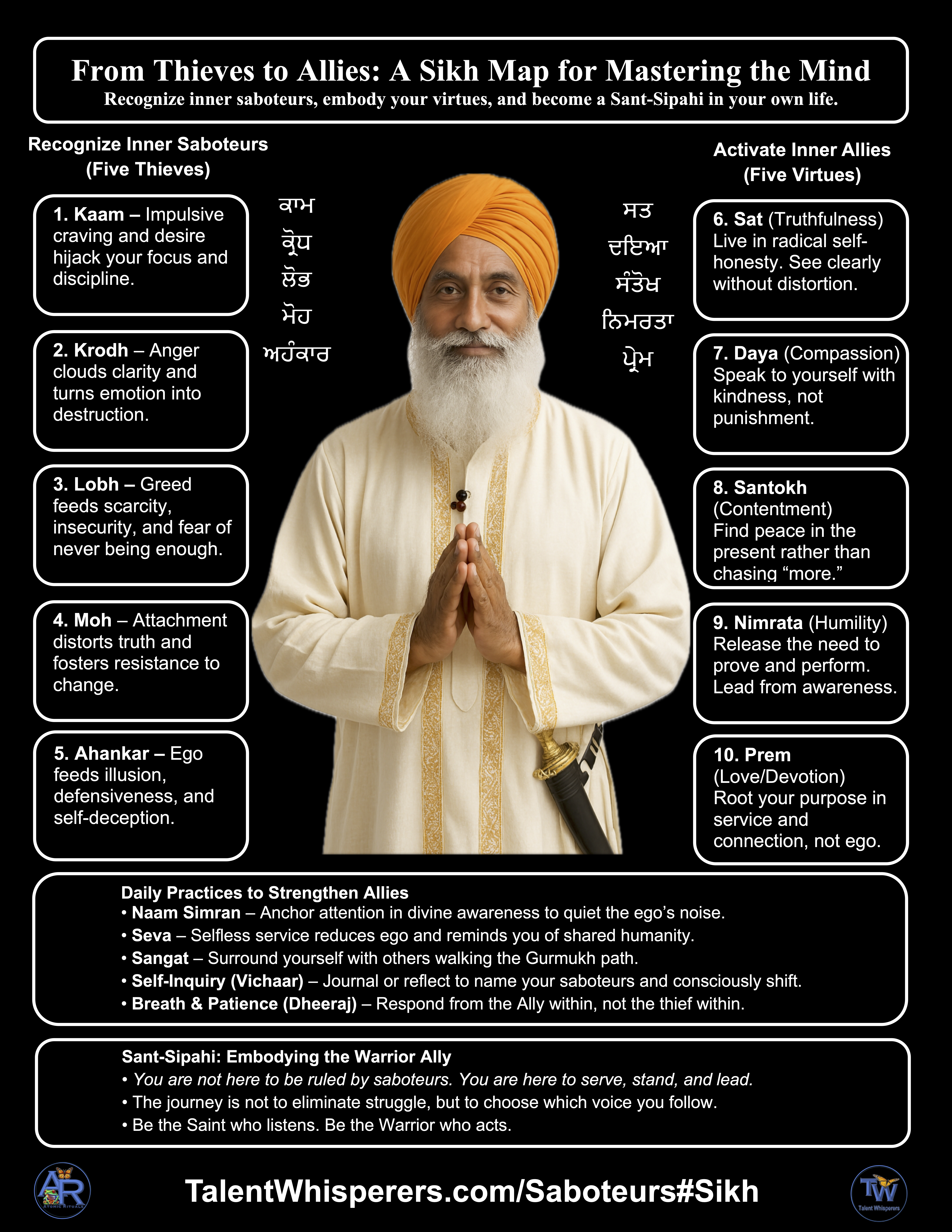
This page explores how Sikh teachings—Chardi Kala (ever-rising spirit), Seva (selfless service), Naam Simran (remembrance), and the Five Virtues—can inform each core section of the Weathering Storms navigational framework. For Sikh professionals, these principles are not abstract ideals. They are daily disciplines—anchoring decisions, stabilizing teams, and elevating leadership through grace and grit alike. - From Thieves to Allies: A Sikh Map for Mastering the Mind (Talent Whisperers).
In Sikh philosophy, the battle between inner voices—those that empower us and those that hinder us—is deeply explored through spiritual teachings, historical narratives, and meditative practices. The Sikh perspective offers a profound lens on recognizing and transforming the saboteurs within, aligning one’s inner voice with truth, courage, and divine connection. - From Thieves to Allies: A Sikh Map for Mastering the Mind (Talent Whisperers Infographic)
Visual guide exploring the five inner “thieves” and five balancing virtues, reflecting saboteur and ally dynamics in Sikh teachings. - Learned Resilience in the Eyes of a Sikh (Talent Whisperers).
Sikh resilience is a powerful human trait. esilience is a powerful human trait. For Sikhs, this quality is deeply woven into their spiritual and historical fabric. It is not merely about enduring hardship. Instead, Sikh resilience involves the active cultivation of spirit. This profound strength stems from core principles. A unique philosophy called Chardi Kala expresses this strength. - The Individual Journey Through the Lens of Sikh Belief (Human Transformation).
In Sikhism, the journey of an individual is deeply spiritual and purpose-driven, rooted in the recognition of divine presence within oneself and the universe. This journey is not solitary; it is both personal and universal, reflecting Sikhism’s emphasis on the interconnectedness of all life through the concept of Ik Onkar (One Creator). Sikh teachings encourage us to explore this path through self-reflection, service, and alignment with divine will. - The Collective Journey in Sikh Belief (Human Transformation).
In Sikhism, the concept of a collective journey is deeply interwoven with the principles of community and unity. Known as Sangat (holy congregation), this idea emphasizes that spiritual growth is not just an individual pursuit but a shared experience. The collective journey highlights how coming together with others strengthens faith, fosters compassion, and brings us closer to the divine. - Sikh Wisdom for Healing and Resilience (Talent Whisperers).
Offers a gentle path for navigating challenge, burnout, and personal struggle through Sikh perspectives on sound, rest, and self-compassion. - The Divine Rabab (Talent Whisperers).
Explores the notion that Sikh belief offers a profound understanding of the relationship between humanity and the Divine through the metaphor of The Musician, the Song, and the Divine Rabab. Music holds a sacred place in Sikhism, with Gurbani Kirtan (devotional singing) being central to spiritual practice. This metaphor explores the interplay between the individual, the divine, and the harmony that results when one aligns with divine wisdom. - Talent Whisperers Through a Sikh Lens (Talent Whisperers).
Explores the Essence of a Talent Whisperer in the context of Sikh belief. The Whisper, the Sword, and the Vow — different expressions of the same sacred duty: to see the divine in others, and to help them see it in themselves. - Co-Active Coaching and Sikh Wisdom (Talent Whisperers).
A guide for coaches and clients exploring intersections between Sikh beliefs and coaching principles like wholeness, presence, and transformation. - This Document: Atomic Rituals as Seen through a Sikh Lens (Atomic Rituals).
In Sikh tradition, transformation is not a sudden overhaul but a disciplined, conscious evolution. Sikhism teaches that divinity lies in the everyday—in actions repeated with mindfulness, in service done without ego, and in resilience shown during challenge. These same values echo powerfully in the framework of Atomic Rituals.
 Atomic Rituals